
SND: Bridging the Gap Between Structure and Semantics for Influential Node Detection
A New Structural and Semantic Approach for Identifying Influential Nodes in Social Networks
The paper introduces SND (Semantic and structural influential Nodes Detection), a three-phase framework designed for Influence Maximization in social networks. By integrating structural topology with node semantic attributes (interests), SND identifies key spreaders more accurately than traditional structure-only methods, achieving higher influence propagation across diverse real-world datasets.
TL;DR
The "Influence Maximization" (IM) problem asks: If you can only pick people to start a trend, who should they be? The SND (Semantic and structural influential Nodes Detection) algorithm moves beyond just looking at "who knows whom" by incorporating "who likes what." By combining community detection with a semantic diffusion model, it achieves superior spread efficiency compared to traditional structural heuristics.
The Missing Dimension in Social Influence
Most classic IM algorithms treat social networks like a pipe system—if node A is connected to node B, info flows through. But in reality, influence is interest-driven. You might have 1,000 friends, but you only influence them on topics they care about.
Prior works like the Independent Cascade (IC) or Linear Threshold (LT) models often ignore this "Semantic Richness." SND addresses this by arguing that an influential node must be both structurally central and semantically aligned with its neighbors.
Methodology: The Three Pillars of SND
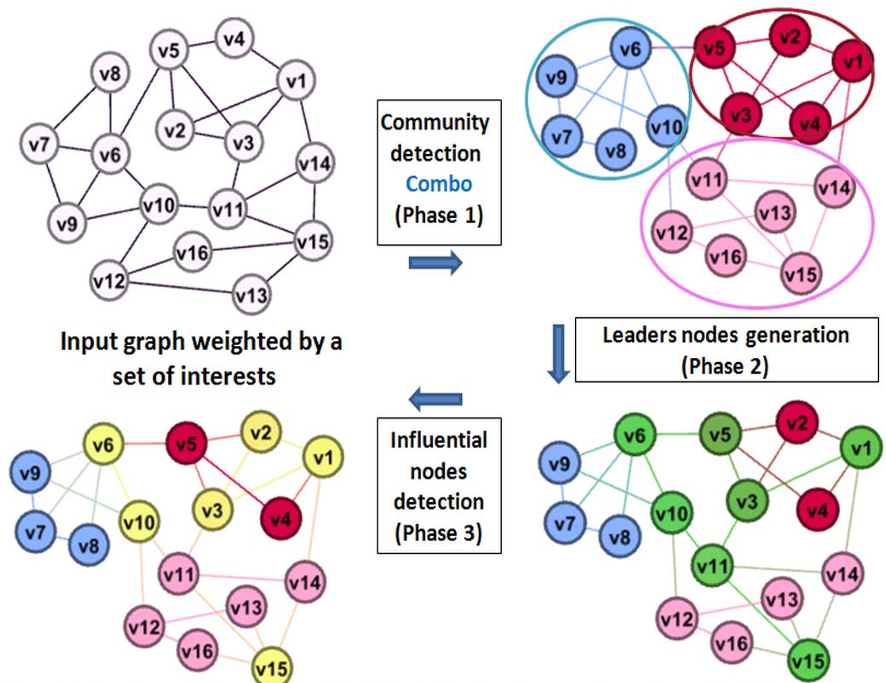
The SND framework operates in three distinct phases, transitioning from the macro-structure of the network to the micro-details of user attributes.
1. Structural Partitioning (Community Detection)
The network is first divided into communities using the Combo algorithm. This ensures the algorithm accounts for the "echo chamber" effect, where influence is most potent within dense clusters.
2. Identifying Semantic Leaders
Within each community, "Leader Nodes" are identified via Degree Centrality. Unlike standard models, SND uses a Semantic Similarity weight () based on common attribute vectors (binary interests). A node only activates its neighbor if the weighted similarity exceeds a dynamic threshold .
3. Influence Ranking
Finally, active nodes are ranked using Closeness Centrality. This identifies nodes that can reach the rest of the network through the shortest paths, effectively turning "active" nodes into "influential" seeds.
Performance Benchmarks
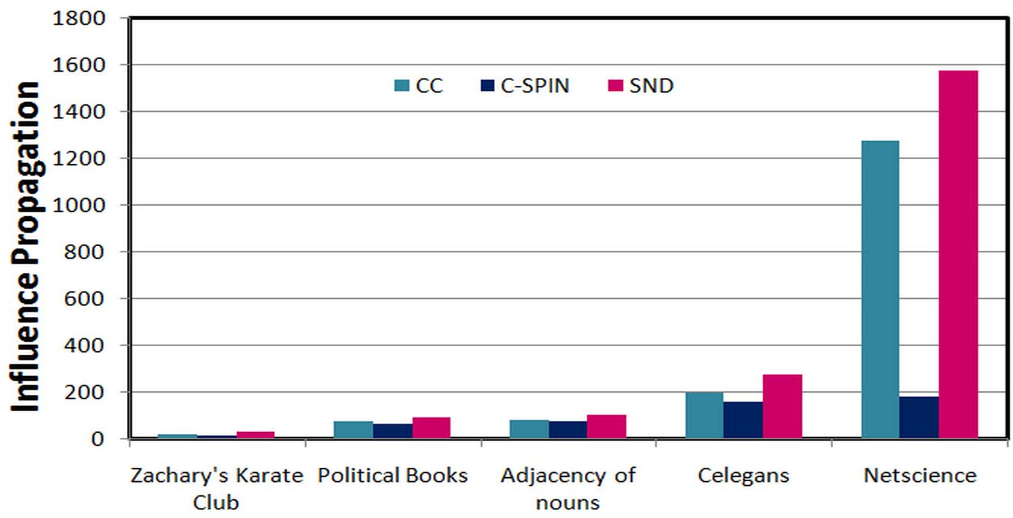
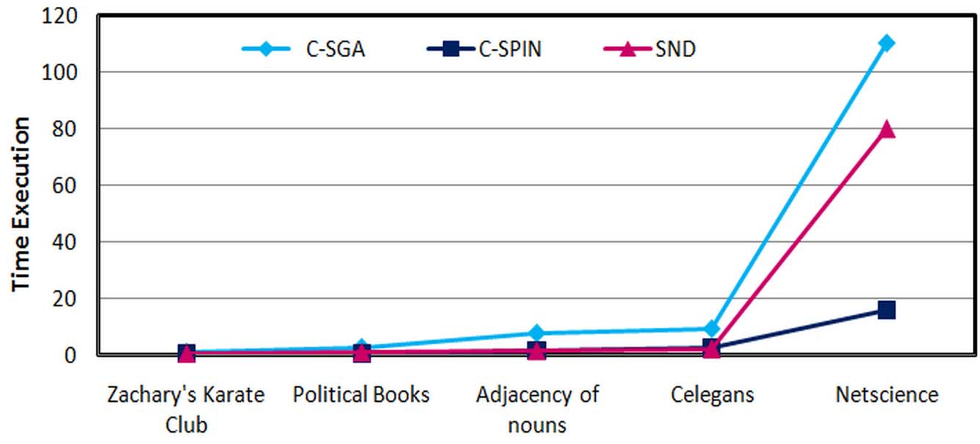
The authors tested SND against Coreness Centrality (CC), C-SPIN, and C-SGA.
Influence Propagation vs. Scale
As the network size increases (transitioning to the Netscience dataset), SND maintains a clear lead in the total number of influenced nodes.
The Cost of Precision
Efficiency comes with a trade-off. While SND dominates in spread, its runtime is higher than C-SPIN due to the intensive community detection and shortest-path calculations required for high-quality seeding. However, it still significantly outperforms C-SGA in speed.
Deep Insights
The core achievement of SND is the realization that Influence is Local and Topical.
- The Inductive Bias: By performing detection within communities first, SND avoids the "Global Hub Trap"—nodes that are central to the whole network but lack deep influence within specific niche groups.
- Semantic Filtering: The use of Jaccard-like similarity for attributes ensures that the propagation mimics real-world "word-of-mouth" where common interests are the primary vehicle for persuasion.
Conclusion & Future Outlook
SND provides a robust blueprint for modern viral marketing and information diffusion research. The integration of node attributes into the diffusion model is a massive step forward.
Limitations: The algorithm currently relies on binary attributes (like/dislike). Moving toward weighted embeddings (e.g., node2vec or GNN features) could capture even more nuance. Future Work: Scaling this algorithm to handle the massive, high-velocity data of platforms like Twitter remains the ultimate frontier for the SND framework.