
Beyond Static Text: Leveraging Time-Series Dynamics for Chinese New Word Identification
New Word Identification in Social Network Text ased on Time Series Information
This paper introduces a novel approach for Chinese New Word Identification (NWI) specifically tailored for social network texts by leveraging time-series information. The authors propose a Conditional Random Field (CRF) framework that combines traditional static features with newly designed "dynamic features" to capture temporal variations in string statistics, achieving state-of-the-art performance on Sina Weibo datasets.
TL;DR
Chinese New Word Identification (NWI) is a critical bottleneck for word segmentation, especially in the volatile environment of social networks. This paper breaks the tradition of viewing text as a static collection. Instead, it treats social media as a "text series" and introduces Dynamic Features—statistical traits that track how words evolve over hours and days. By integrating these temporal signals into a CRF model, the researchers achieved a massive 9.79% boost in precision on microblog data.
The Social Media Challenge: Why Static Models Fail
The Chinese language lacks spaces between words, making segmentation (CWS) the "front door" of all downstream NLP tasks. However, social networks like Sina Weibo are breeding grounds for neologisms, slang, and abbreviations (e.g., "Nao Can", "Zhen Huan").
Traditional methods rely on:
- Rule-based patterns: Often too rigid for creative internet slang.
- Global statistics: Metrics like Mutual Information (MI) or Accessor Variety (AV) calculated across the entire corpus.
- Text-local features: Statistics within a single post.
The problem? Social media posts are too short (often <140 characters). A single tweet doesn't provide enough context for local statistics to be reliable. Furthermore, traditional models ignore the time stamps that come with every post, missing the fact that many new words explode in popularity simultaneously across thousands of short texts.
The Insight: Temporal Synchronization
The authors observed a fascinating physical intuition: Substrings of a new word move together in time.
As shown in the paper's visualization, for a new word like "Zhen Huan" (甄嬛), the characters "甄" and "嬛" show near-identical frequency spikes and dips throughout a specific period. Conversely, random character combinations that do not form a word exhibit chaotic, unsynchronized patterns.
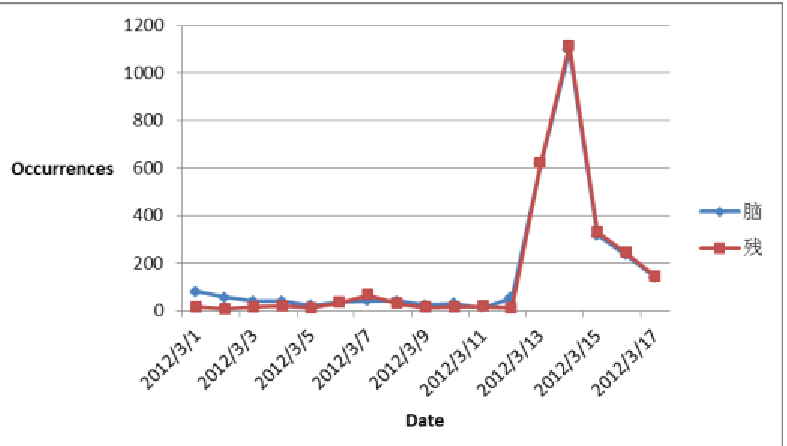 Figure 1: Comparison of temporal fluctuations between substrings of valid new words vs. random character sequences.
Methodology: Dynamic Feature Engineering
The proposed framework utilizes Conditional Random Fields (CRF), but the "secret sauce" lies in the feature vector construction. The researchers divided the time domain () into discrete units (, e.g., one day) and calculated features locally within those intervals.
1. Feature Categories
- Static Global Features: Term Frequency (TF), IDF, and Left/Right Entropy across the full dataset.
- Static Text-local Features: TF/Entropy within a single message.
- Dynamic Time-domain Features: The breakthrough addition. These include
Time-TF,Time-IDF, andTime-MI.
2. The Algorithm
The system segments the corpus with minimal granularity (character level) and then computes the dynamic feature vector for every string by looking at its behavior within its specific time interval .
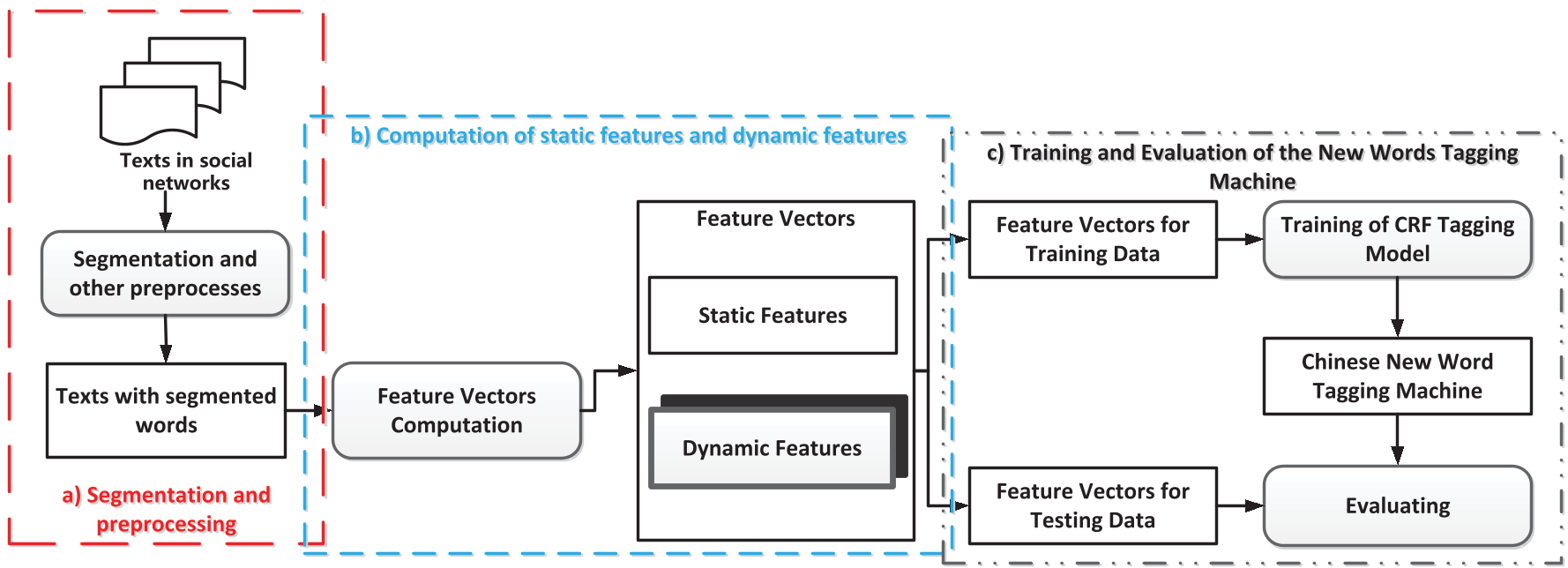 Figure 2: The workflow transforming raw microblog streams into feature-rich vectors for the CRF tagger.
Experiments and Results
The model was tested on a manually annotated dataset from Sina Weibo containing over 44,000 microblogs and 148 specific new words.
Performance Gains
The results were conclusive: dynamic features significantly outclass text-local features in the social media context.
- Overall Precision: 93.17%
- Overall Recall: 98.76%
- F1-Measure: 95.88% (A 4.17% absolute improvement over previous SOTA).
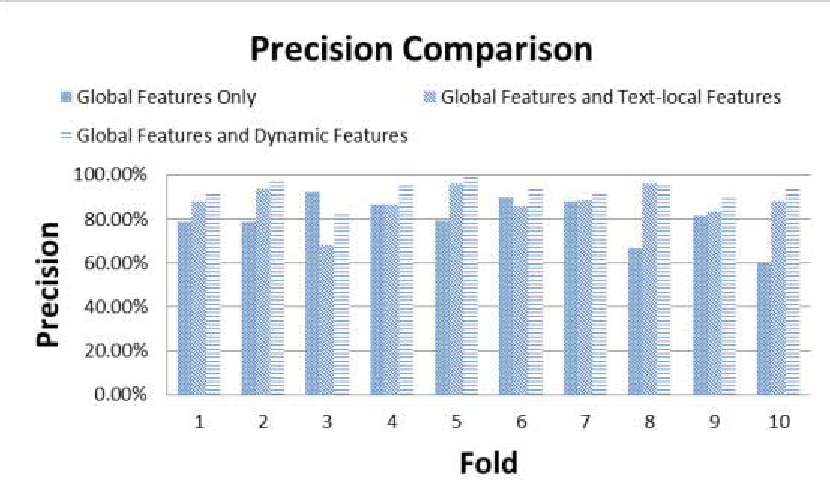 Figure 3: Precision comparison across different feature configurations shows that "Global + Dynamic" consistently wins.
Critical Analysis & Conclusion
This work demonstrates that for "fast-moving" data, the temporal axis is just as important as the linguistic axis. By shifting the statistical scope from a single document to a time window, the authors effectively solved the data sparsity problem inherent in short-form content like Weibo or Twitter.
Limitations:
- The method relies on pre-defined time intervals (Time Units). If a word's lifecycle is much shorter than the unit, the signal might be diluted.
- The computational cost of updating dynamic features in a streaming environment needs further exploration.
Future Outlook: This principle could be extended to Multimodal Social Media analysis, where the "temporal co-occurrence" of specific text strings and image patterns (memes) could identify new internet trends even research faster than text-only models.