
News Not Noise: The Battle Against Social Information Overload
News not noise: socially aware information filtering
The paper introduces a socially aware information filtering approach for online social networks like Facebook to combat information overload. It proposes a new interface prototype that prioritizes news and friends based on social proximity, specifically targeting "offline" meeting likelihood and interaction frequency.
TL;DR
As social networks grow, our "friend" lists become cluttered with acquaintances, leading to a "News Feed" filled with noise. This 2008 study from the University of Birmingham identifies why we don't delete people we barely know and proposes a visual, socially-aware interface that uses social proximity to prioritize the news we actually care about.
The "Zombie Acquaintance" Problem
The central paradox of social media is that while our cognitive capacity for maintaining relationships is limited—often cited as Dunbar’s Number (approx. 150)—our digital friend lists grow indefinitely.
The research reveals several critical insights:
- No "Unfriending": Users feel a social stigma or "confrontational" pressure against deleting friends.
- Context Collapse: A mix of close friends, family, and "zombie sub-acquaintances" leads to a News Feed where only a fraction of content is relevant.
- The Failure of Manual Labor: Users dislike manually tagging or categorizing friends. It’s not just "too much work"—it feels socially "creepy" and uncomfortable.
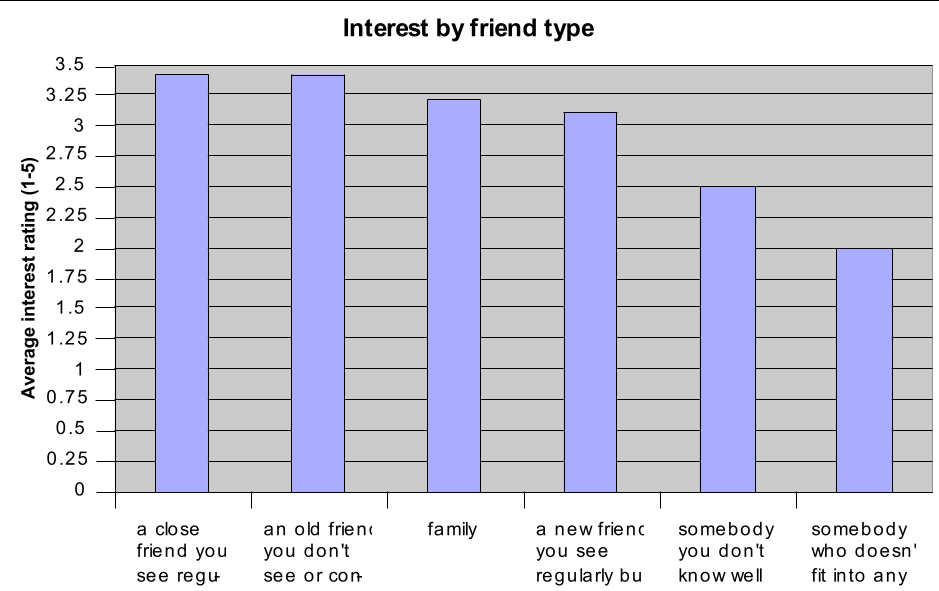 Figure: Survey data highlights how interest levels vary drastically across different friend categories.
Methodology: Mapping Social Proximity
The authors argue that "News Feed" algorithms shouldn't just be random streams. Instead, they propose a design based on Social Proximity.
The Force-Directed Model
By analyzing shared friends and co-appearance in photographs, the researchers could identify social "clusters" (e.g., high school friends vs. work colleagues). This reflects homophily—the tendency for similar people to group together.
The Concentric Circle Interface
The proposed prototype uses a radical UI shift:
- Centrality: The most important friends (those met offline or visited often) appear in the inner circles.
- Angle as Context: Groups of friends from the same "world" (work, school) are situated in the same angular slice of the circle.
- On-Demand Content: Users hover over photos to see snippets, theoretically reducing visual noise.
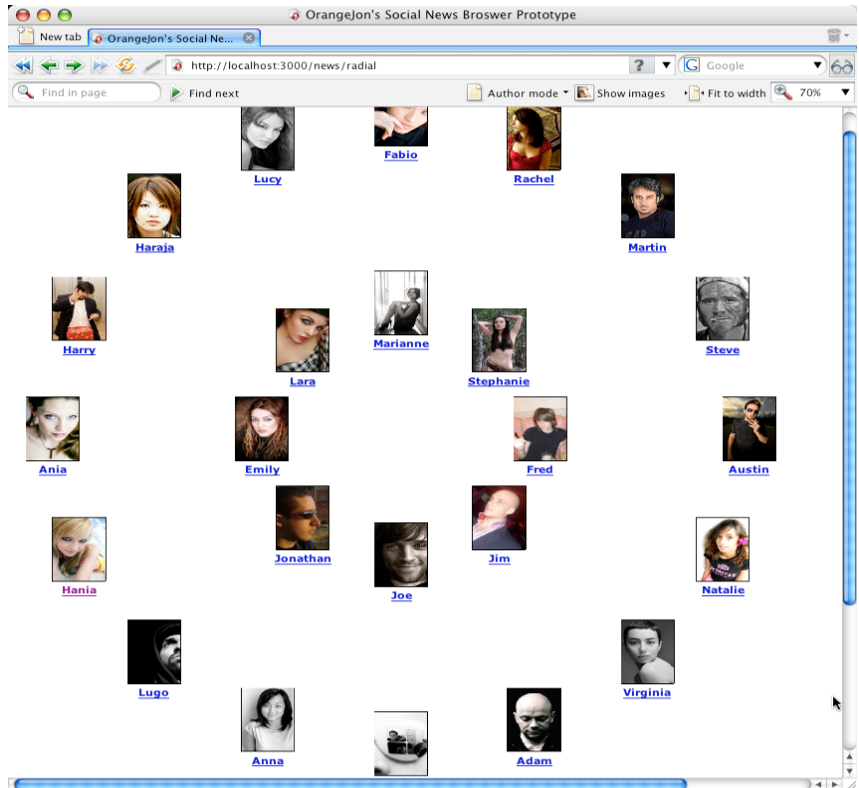 Figure: The "Socially Aware" prototype using concentric circles to denote relationship depth.
Experimental Insights: What Users Actually Want
The study’s survey of Facebook users yielded some harsh truths for UI designers:
- Low Baseline Satisfaction: Only 14% of users found more than half of their feed items interesting.
- Efficiency Over Aesthetics: While users loved the concept of the computer automatically figuring out who their best friends were, they hated the interaction of clicking photos. They wanted to "scan" a list, not engage in a "treasure hunt" for news.
- The Serendipity Factor: There is a fine line between filtering noise and creating an echo chamber. Some users feared that too much filtering would remove the "surprising" updates from distant contacts.
Critical Analysis & Future Outlook
This work was remarkably prescient. Published in 2008, it identified the very "algorithmic feed" issues that platforms like TikTok and Instagram spend billions of dollars solving today.
Takeaway: The real value isn't in fancy visualizations, but in the underlying social model. Successful filtering must be invisible. It should learn from our behavior (who we click on, who we meet) to surface "news" without requiring us to "file" our friends into folders.
Limitations: The prototype's reliance on "hover-to-reveal" interactions proved to be a friction point. Modern feeds have largely moved toward vertical scrolling with auto-play features, proving that minimizing interaction cost is just as important as the relevance of the content itself.