
From Engagement to Empowerment: Turning Social Media Feeds into Behavioral Therapy
Newsfeed Filtering and Dissemination for Behavioral Therapy on Social Network Addictions
The paper introduces N3S (Newsfeed Substituting and Supporting System), a data-driven framework designed to alleviate Social Network Addiction (SNA) through personalized behavioral therapy. It combines an Addictive Degree Model (ADM) to quantify newsfeed addictiveness and a randomized optimization algorithm (RNOS) to transition users from addictive content to supportive social environments without sacrificing core preferences.
TL;DR
Social Network Addiction (SNA) is increasingly recognized as a public health crisis, yet current platform algorithms are designed to maximize the very engagement that fuels it. This paper introduces N3S, a framework that uses data mining to act as a digital "nicotine patch." By identifying addictive content through the Addictive Degree Model (ADM) and optimizing feeds using the RNOS algorithm, it gradually substitutes harmful content with supportive social interactions, reducing addiction scores by 30% without requiring users to quit the platform.
The Addiction Trap: Why Relevance != Wellness
Traditional recommendation systems (like those used by Facebook or Instagram) are built on latent factor models that predict what a user wants to see. However, for an addicted user, "wanting" often stems from Malicious Envy (the compulsive need to track a competitor's success) or Loneliness.
Previous clinical approaches suggested Total Abstinence, but as any therapist knows, "Cold Turkey" leads to relapse. This paper identifies a critical gap: data scientists haven't built tools that understand the difference between a "preferred" post and an "addictive" one.
Methodology: The Psychology of the Feed
The authors propose a two-phase system that translates psychological theories into mathematical constraints.
1. The Addictive Degree Model (ADM)
Instead of just looking at clicks, ADM extracts Addictive Features (AFs):
- Social Dependency: Measuring if a user's world revolves around a single person (Cyber-Relationship Addiction).
- Parasocial Relationships: One-sided interactions where users feel a false sense of intimacy with celebrities.
- Social Comparison: A clever regularization term distinguishes between Malicious Envy (friends with similar backgrounds, leading to low self-esteem) and Benign Envy (friends with different backgrounds, leading to motivation).
2. High-Stakes Optimization: SANSP & RNOS
The team formulated the SNA-Aware Newsfeed Sharing Problem (SANSP). This is not a simple filtering task; it’s a balancing act. If you filter out a user's post because it's "addictive" to others, that user loses the Social Support (likes/comments) they might need to combat their own loneliness.
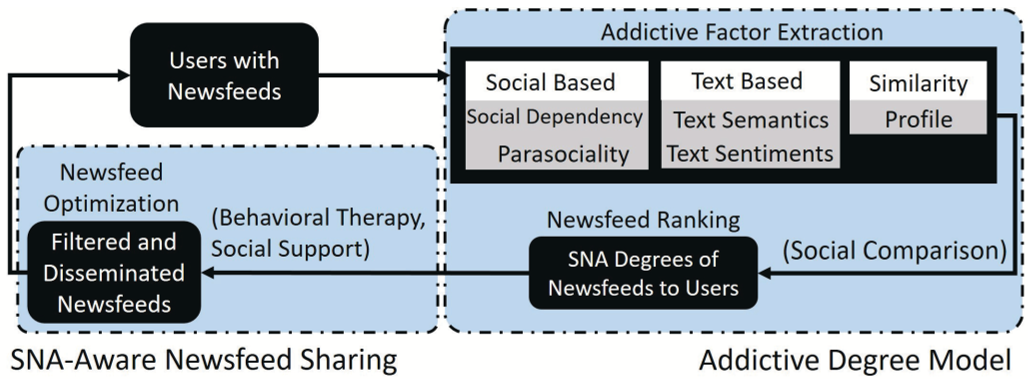
The RNOS (Randomized Newsfeed Optimization) algorithm solves this by:
- Allocating more "computing budget" to find better solutions for the most severe patients.
- Ensuring a gradual reduction in addiction levels to prevent the anxiety associated with sudden content changes.
Experimental Evidence: Success Where Others Failed
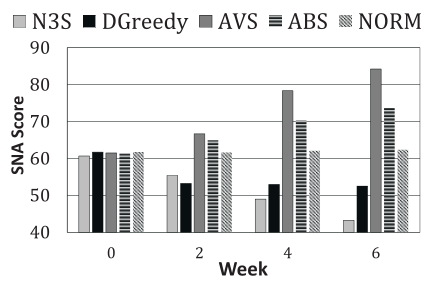
The most striking result comes from the user study involving 716 users and 11 psychiatrists.
- The Abstinence Failure: Users told to stop Using Facebook (Abstinence group) all quit the study within two weeks.
- The N3S Success: Users in the N3S group stayed, and their SNA scores plummeted by 30%.
The researchers found that the ADM's quantified addictive degree had a much higher correlation with clinical labels (Pearson 0.84) compared to standard preference models (GBPR 0.30). This suggests that "relevance" models are essentially blind to the mental health status of the user.
Critical Insight: Social Support as the Antidote
One of the paper's "Aha!" moments was the case of User A. She posted frequently to seek support but usually received very few "likes," driving her deeper into addiction. By reshuffling the feed to ensure her posts reached friends most likely to provide meaningful feedback, N3S increased her "likes" from 5 to 11 per post and reduced her addiction score by 25%.
This proves that the key to curing SNA isn't less technology—it's more meaningful social connection.
Conclusion & Future Horizons
N3S represents a bridge between Data Science and Clinical Psychology. While it was tested on 2018-era feed structures, the logic is more relevant than ever in the age of TikTok's infinite scroll. The primary limitation remains the need for platform-level access to manipulate feeds; however, as "Digital Wellbeing" becomes a regulated requirement, frameworks like N3S could become the blueprint for the next generation of ethical OSNs.