
Beyond Static Deployment: The Rise of Self-Evolving Agentic RL Systems
Next-Generation Agentic Reinforcement Learning Systems Enable Self-Evolving Agents
The paper introduces a system substrate for self-evolving enterprise agents, moving beyond static LLM deployments. It proposes three core pillars—ATDP, a data proxy, and an evolution control plane—and instantiates them through AREAL2.0, an online RL system that enables policy weight updates directly from production workloads.
TL;DR
LLM agents are currently "static" artifacts—deployed once and updated manually. This paper argues that the next leap in AI capability requires Self-Evolving Agents that learn continuously from situated experience. The authors present a blueprint for an enterprise-scale system substrate and introduce AREAL2.0, a prototype that transforms production workloads into an online Reinforcement Learning (RL) pipeline for real-time policy updates.
The Problem: The "Deployment Freeze" Paradox
In the current enterprise landscape, when an agent (e.g., a customer support bot or coding assistant) fails, the fix is painful:
- Human operators inspect traces.
- New evaluation benchmarks are defined.
- Prompts are manually edited or models are fine-tuned offline.
- The system is redeployed.
This manual loop cannot scale. While personal agents like OpenClaw show promise, enterprise environments demand governance, privacy, and credit assignment. Current systems lack the infrastructure to turn a raw execution log into a "replayable" learning signal that an RL algorithm can actually use.
The Three Pillars of Self-Evolution
The authors argue that self-evolution is not just about having a better optimizer like PPO or DPO; it is a system architecture problem. They propose three mandatory pillars:
1. ATDP: The Language of Learning
Standard logs record what happened; the Agent Trajectory Data Protocol (ATDP) records why. It captures:
- Observations (): Tool outputs and retrieval snippets.
- Hidden State (): Internal reasoning or scratchpads.
- Outcomes (): Not just the action, but how the environment/user reacted.
- Late-bound Rewards (): Signals that arrive steps later (e.g., a user eventually closing a ticket successfully).
2. The Enterprise Data Proxy
This is the "First Safety Boundary." It intercepts traffic between the agent and the LLM/Tools. Unlike a simple logger, it:
- Anonymizes data for compliance.
- Ensures Replayability: Distinguishes between deterministic events and non-replayable side effects, allowing the system to ask "What if I used a different prompt here?"
- Harvests Rewards: Turns implicit user behavior (like not deleting a generated code block) into training signals.
3. The Evolution Control Plane
Self-evolution shouldn't always mean changing model weights. The Control Plane acts as a governor that chooses the most efficient intervention:
- Memory Update: If a fact is missing.
- Skill Patch: If a specific procedure is failing.
- Harness Edit: If prompt instructions are being ignored.
- Policy Update (RL): For broad, cross-tenant behavioral improvements.
AREAL2.0: From Pipeline to Micro-service
To prove the concept, the authors built AREAL2.0. It treats RL components (Rollout and Training workers) not as an offline batch process, but as pluggable micro-services.
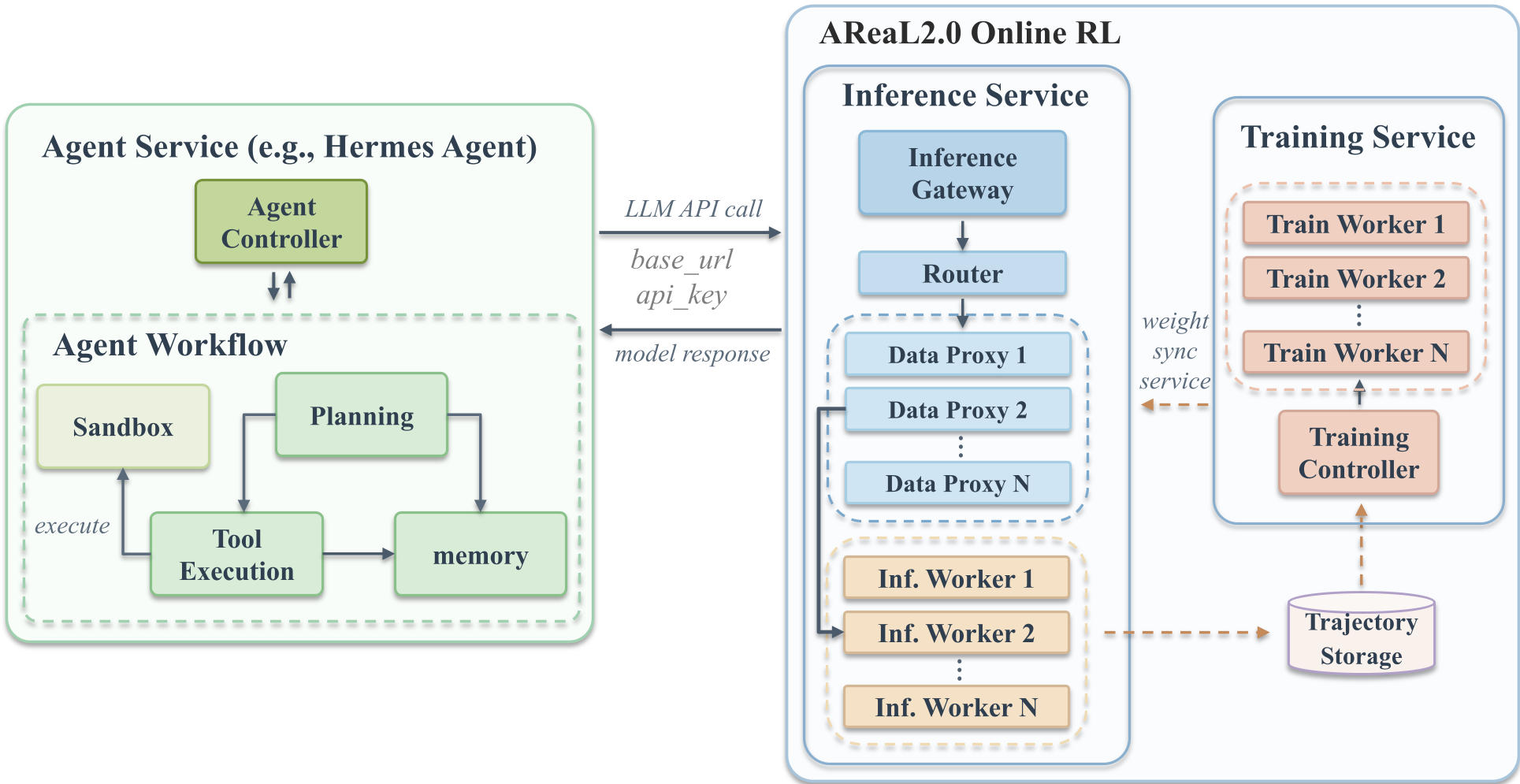 Figure 1: The AREAL2.0 workflow. By redirecting LLM API calls to the AREAL2.0 Gateway, an agent service (like Hermes) automatically contributes its trajectories to an online RL loop.
Why this matters:
- Minimal Integration Cost: You don't rewrite your agent. You just point your API endpoint to the AREAL2.0 Gateway.
- Real-world Realism: The RL agent trains on the exact distribution of prompts and tool-calls it sees in production, eliminating "distribution shift" issues common in offline training.
Critical Analysis & Future Outlook
While AREAL2.0 successfully tackles policy weight updates, the authors candidly admit that the "Full Substrate"—including automated skill patching and multi-surface evolution—is still a research frontier.
Key Takeaways:
- Systems > Algorithms: We have enough RL algorithms; we lack the data proxies to feed them safely.
- Governed Self-Evolution: The goal isn't "unrestricted recursive self-modification" (which is dangerous), but a stage-gated, versioned improvement loop.
- The Replay Requirement: If you can't replay a trajectory, you shouldn't train on it. Standardizing "replayable" agent protocols is the next big step for the industry.
This work sets the stage for a future where AI agents don't just work—they grow with every user interaction, becoming more efficient and specialized within the boundaries of enterprise governance.