
Architecting Autonomy: User Requirements for the Next Generation of Social Networks
14868_Next generation social networks - elicitation of user requirements.
The paper "Next Generation Social Networks: Elicitation of User Requirements" investigates user expectations for future social platforms. It utilizes a survey of ICT professionals to identify high-level requirements across four key dimensions: User Experience, Interaction, System Quality, and Infrastructure.
TL;DR
Social networking has evolved from a novelty to a fundamental layer of the internet, but current platforms often prioritize business models over user autonomy. This paper explores the "missing pieces" for Next Generation Social Networks (NGSN) through qualitative interviews with ICT experts. The results suggest that the "perfect" future network isn't just about faster connections, but about trust, transparency, and the restoration of user control.
Problem: The Volatility of Social Needs
Identifying what users want in a website is relatively simple; identifying what they want in a social ecosystem is notoriously difficult. The authors argue that traditional engineering requirements are too rigid for social apps. Previous work has struggled because:
- User diversity makes a "one-size-fits-all" profile impossible.
- Non-task related functions (emotional support, playfulness) are harder to quantify than "speed" or "uptime."
- Data-silos create an environment where users feel they "serve" the platform (through data production) rather than the platform serving them.
Methodology: Looking Beyond the Horizon
Rather than using a broad-brush questionnaire, the researchers interviewed seven ICT specialists. This "expert-user" approach allowed for a deeper exploration of futuristic concepts like Augmented Reality (AR), Context-Awareness, and Artificial Intelligence.
The analysis was synthesized into a comparison with the WWRF reference model, which splits human needs into a Value Plane (privacy, belonging) and a Capability Plane (personalization, interaction).
Key Insights: What do users actually want?
The study categorized requirements into four pivotal dimensions:
- User Experience (UX): Moving toward 3D interfaces and "Microsoft Surface"-style interactions, where technology feels natural rather than obstructive.
- Interaction Requirements: The ability to modify "virtual profiles" based on mood or context. Users expressed a desire for "filters" to block unwanted social noise.
- System/Site Quality: Transparency is the North Star. Users are frustrated by the "snowball effect" of address book imports and the lack of clarity on where personal data goes.
- Full Infrastructure: The expectation that social networking should be a utility—working globally across devices and applications without borders.
The "Intelligence" Paradox
A fascinating finding was the skepticism toward AI and Context-Awareness. While technically impressive, users explicitly stated that if an intelligent system interrupts them or makes a mistake, it transitions from a "feature" to an "annoyance." The requirement for human-centered AI here is discretion and perfection.
Experiments & Core Results
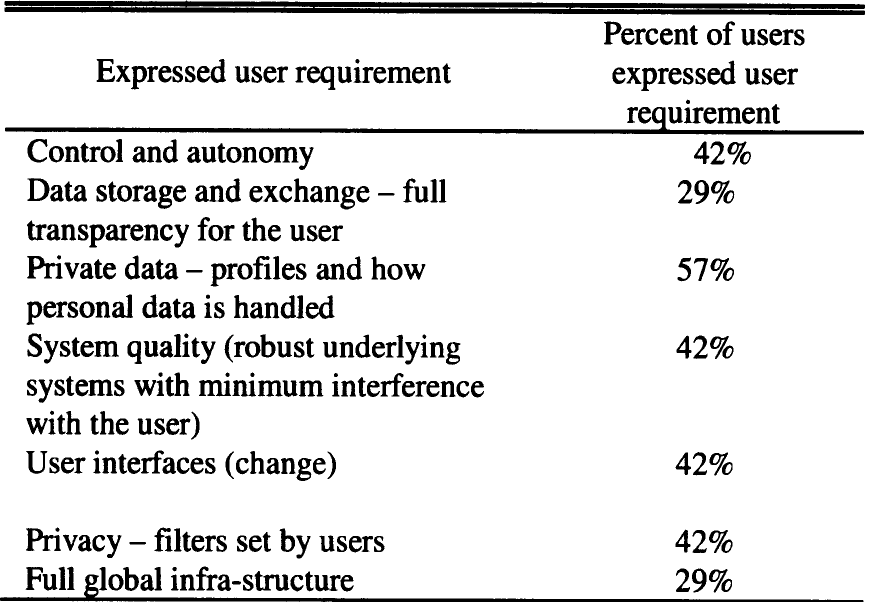
The survey quantified the sentiment of these ICT professionals, highlighting a clear trend toward privacy and autonomy over new features.
- 57% of participants identified "Private Data Management" as their highest concern.
- 42% of participants emphasized "Autonomy," expressing frustration that current systems attempt to "steer" their social interactions.
- The Zero-Payment Rule: There was a near-unanimous rejection of pay-to-play models for social networking, suggesting that future platforms must find innovative, non-intrusive value exchanges.
Critical Analysis & Future Outlook
This paper, while focused on a Danish cohort, provides a prophetic look at the "Social Web 3.0" era. It correctly predicted that trust would become the primary currency of the internet.
Limitations: The sample size is small (7 users) and localized to Denmark. Cultural variations in privacy (e.g., the "Danish flavour" of skepticism mentioned by the authors) might not apply globally.
The Takeaway: The "Next Generation" is not just a technical upgrade; it is a philosophical shift. Developers should focus on building "underlying and supporting" systems that stay out of the user's way. The future of social is not more engagement; it is better-controlled, more meaningful autonomy.