
NextMe: Fusing Social Interplay and Cellular Traces for Precision IoT Localization
NextMe: Localization Using Cellular Traces in Internet of Things
NextMe is a novel localization and location prediction scheme for the Internet of Things (IoT) that leverages cellular phone traces. It introduces the concept of "social interplay" extracted from mobile call patterns to improve prediction accuracy at the cell tower/region level, outperforming traditional regularity-based models.
TL;DR
Predicting human movement is notoriously difficult due to the "random walk" nature of our spontaneous decisions. NextMe bridges this gap by discovering a hidden signal in our digital lives: Social Interplay. By analyzing cellular call patterns, the researchers achieved a 12% boost in localization accuracy, enabling fine-grained region-level prediction for the 1–6 hour window without requiring GPS coordinates.
Problem & Motivation: The "Randomness" of Human Life
Most modern Location-Based Services (LBS) assume we are creatures of habit. While we do follow routines, traditional models like Markov-based schemes or NextPlace struggle when we deviate from our schedules.
The authors identified two major roadblocks in current research:
- Data Limitations: Many models require GPS, but most cellular data is "symbolic" (e.g., "Cell Tower 5188").
- Missing Context: Periodic models ignore the why of movement. Often, a phone call is the immediate precursor to a physical meeting (co-location), representing a "social trigger" that regularity models miss.
Methodology: The Architecture of NextMe
The core innovation of NextMe is the identification of Critical Cellular Call Patterns (CCCP). The authors found that if two users have multiple calls within a short interval, the probability of them co-locating in the next few hours spikes significantly.
1. Data Preprocessing & "Region" Mapping
Since cell towers overlap and IDs are symbolic, NextMe converts overlapping Voronoi-like areas into distinct "Regions." This handles cell handover noise and makes non-coordinate data "computable."
2. The Hybrid Predictor
NextMe doesn't just use social data; it is an ensemble system:
- Periodicity-Based Module: Uses Fourier transforms and KL-Divergence (KLD) to map out "Integral Periodic Behavioral Patterns."
- Social Interplay-Based Module: Activated only when a Critical Call (CC) is detected. It uses a Poisson distribution to calculate when and where a pair will meet.
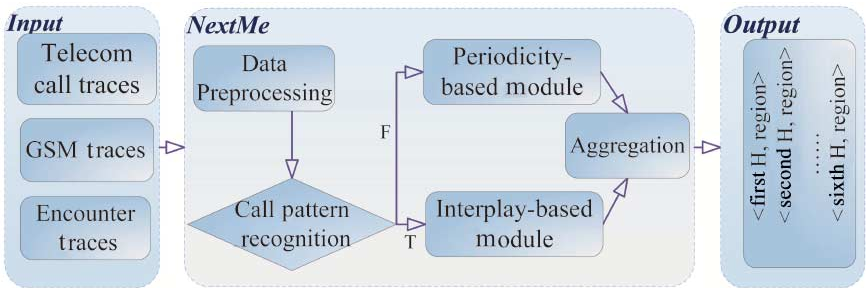 Fig 1: The NextMe architecture, highlighting the switch between periodicity and social interplay modules.
Experiments & Results: Proving the Social Link
The researchers tested NextMe against the Perio (Periodicity only) and CBP (Collective Behavioral Patterns) models using the MIT Reality Mining Dataset.
Key Findings:
- Superior Accuracy: NextMe consistently outperformed baselines across the 1–6 hour prediction horizon.
- The Passive vs. Active Divide: Interestingly, for "passive" users (those with few calls), regularity models work well. However, for "active" users—who are usually the hardest to track—the social interplay module provided the most significant gains.
- Quantifiable Impact: Social signals contributed an average of 12% improvement in accuracy, reaching up to 20% for certain highly social pairs.
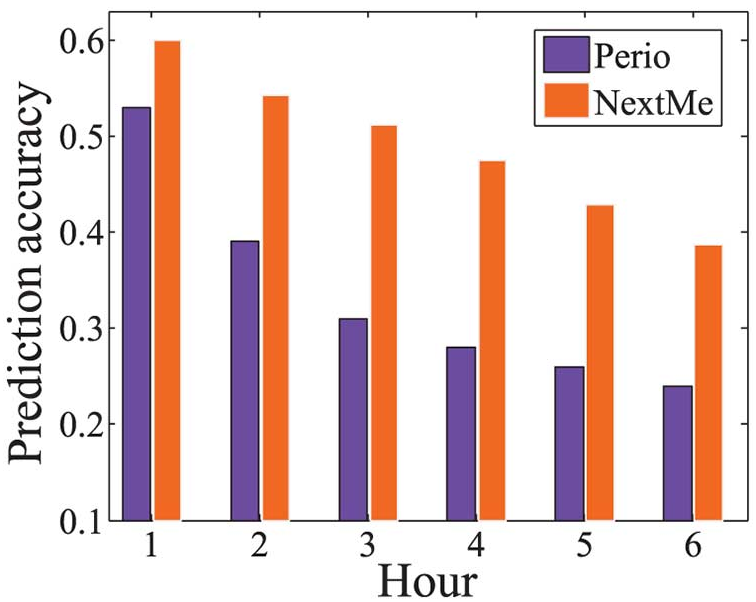 Fig 2: Prediction accuracy decay over time. NextMe maintains a higher baseline due to its ability to capture short-term social triggers.
Critical Analysis & Conclusion
Takeaway
NextMe proves that telecommunication traces are more than just metadata; they are a window into human intent. By formalizing "social interplay" into a mathematical model (Poisson-based CC detection), the paper provides a roadmap for operators to provide high-value LBS (like traffic forecasting or targeted QoS) using existing infrastructure.
Limitations & Future Work
While robust, the current model primarily focuses on calls. The authors acknowledge that modern communication has shifted towards Instant Messaging (IM) and social apps. Future iterations will need to incorporate data from short messages and app-based interactions to maintain relevance in a 5G/6G world.
Keywords: IoT, Cellular Traces, Social Interplay, Location Prediction, MIT Reality Mining.