
NF-Crowd: Breaking the O(n) Cost Barrier in Decentralized Crowdsourcing
NF-Crowd: Nearly-free Blockchain-based Crowdsourcing
This paper introduces NF-Crowd, a suite of blockchain-based crowdsourcing protocols that achieves an O(1) cost lower bound regardless of the crowd's scale. By leveraging off-chain execution with on-chain enforcement, it reduces the cost of a typical Crowdsourcing Contest with Open Community Review (CC-OCR) to under $2 on Ethereum, significantly outperforming prior O(n) decentralized solutions.
TL;DR
The promise of "decentralized everything" often dies at the feet of Ethereum's gas fees. In crowdsourcing, where hundreds of participants might submit entries or votes, traditional O(n) transaction costs can make a "trustless" project 4x more expensive than a centralized platform. NF-Crowd changes this by shifting the heavy lifting off-chain and using Merkle roots and security deposits to maintain a constant O(1) cost—roughly $1.16—no matter how many people join the project.
The "Gas-Limit" Problem: Why Decentralization is Expensive
In a typical centralized platform like 99designs, the intermediary takes a flat 15-20% cut. In existing decentralized models (like CrowdBC or Zebralancer), every participant must pay a gas fee to "talk" to the smart contract.
The authors identify two fatal bottlenecks:
- TYPE n × 1 (Incremental Growth): transactions for users (e.g., 1,000 designers submitting 1,000 files).
- TYPE 1 × n (Execution Growth): A single transaction whose complexity grows with the crowd (e.g., a smart contract looping through 1,000 votes to find a winner).
Both of these lead to O(n) scaling, which is the enemy of mass adoption.
The Methodology: How NF-Crowd Reaches O(1)
The core philosophy of NF-Crowd is Enforceable Off-chain Execution. Instead of the blockchain being the engine of the contest, it acts as the judge and vault.
1. Off-chain Aggregation with Merkle Anchors
Instead of every designer submitting their entry to the blockchain, they send their signed entry to the Client (Uploader). The Client packages these into chunks, builds a Merkle Tree, and only uploads the 32-byte Merkle Root to the chain. This effectively converts thousands of submissions into a single O(1) operation.
2. Rationality-Driven Security
Participants must lock an Ξdeposit. If the Client tries to exclude a valid entry, the designer can submit a "Countermeasure" transaction. If a reviewer tries to vote twice, any honest observer can submit a doubleVotes proof to the contract. The contract then slashes the offender's deposit to cover the cost of the reporting transaction.
3. Off-chain Verdicts
Finding a contest winner involves sorting through votes. NF-Crowd lets the client calculate the winner off-chain and post the result. If the result is incorrect, any participant can trigger an "On-chain Audit" that forces the smart contract to recount the votes and punish the lying client.
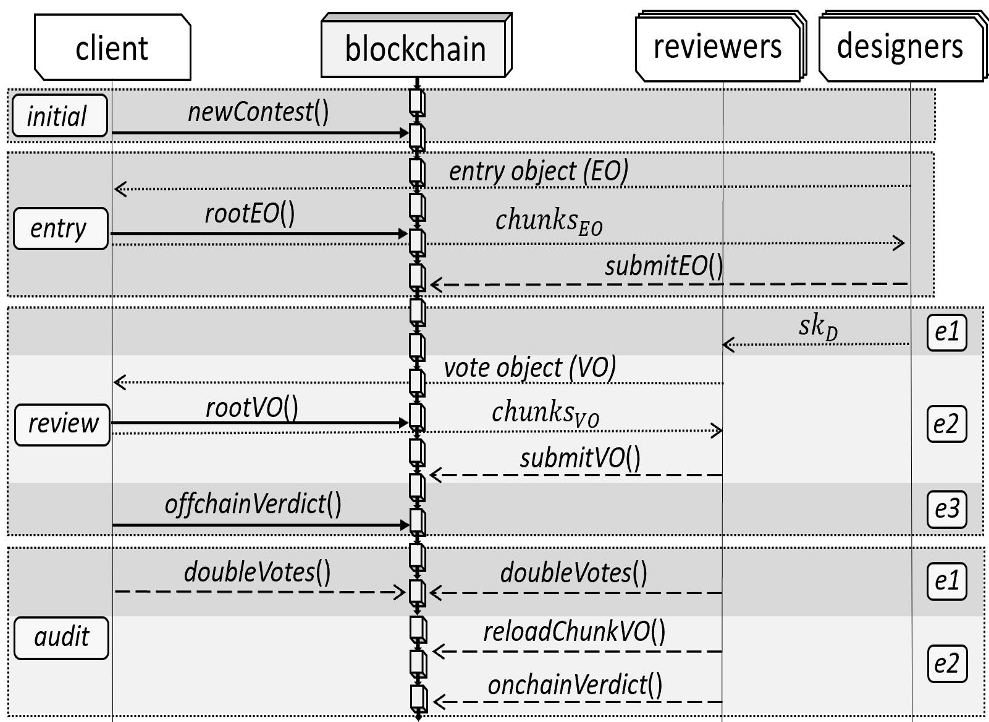 Fig 1: The NF-Crowd workflow showing the interplay between off-chain communication (dotted lines) and on-chain security (solid lines).
Experimental Results: 600
The authors tested their protocol on the Ethereum Kovan testnet. The comparison is staggering:
- Strawman Protocol: At 1,000 participants, the cost exceeds $600, nullifying the economic benefit of using crypto.
- NF-Crowd: Remains flat at **n$.
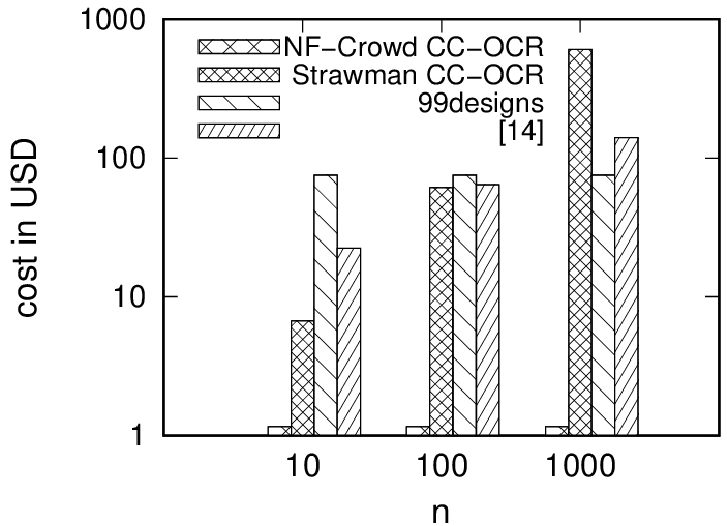 Fig 2: Cost comparison between NF-Crowd, traditional decentralized protocols, and centralized platforms (99designs).
Deep Insight: The Value of Honest Minorities
One of the strongest theoretical guarantees of NF-Crowd is that it only requires one honest participant to ensure the project completes correctly. This "honest minority" assumption makes the system robust against collusion between the client and a majority of the crowd. As long as one person is willing to point out a lie through a Merkle proof, the truth prevails.
Conclusion and Limitations
NF-Crowd demonstrates that we don't necessarily need complex Layer-2 rollups or ZK-SNARKs to scale multi-party interactions. Simple game theory and Merkle trees are sufficient.
Limitations:
- The protocol assumes a degree of Synchrony (messages arrive within a known time bound).
- It places a higher non-monetary workload on the Client (managing off-chain data).
However, for high-stakes design contests or data labeling tasks, these are small prices to pay for a system that is virtually free to scale.