
Beyond Numbers: Characterizing Social Relationships via Conversation Topics
Towards an NLP-Based Topic Characterization of Social Relations
This paper explores using NLP-based keyword extraction to characterize social relationships from Facebook message content. Leveraging methods like tf-idf and TextRank, the researchers built a custom application called "Talk Doctor" to extract conversation topics and evaluate if these keywords accurately represent the interpersonal bond between users.
TL;DR
How do you define a friendship? Is it just the number of messages sent, or is it what you talk about? Research from TU München suggests that the latter—represented by NLP-extracted keywords—provides a surprisingly accurate fingerprint of social bonds. By testing unsupervised algorithms on real Facebook data, they achieved a ~70% human approval rating for keyword-based relationship summaries.
The "Tie Strength" Problem: Why Metadata Isn't Enough
Historically, social network analysis (SNA) has treated relationships as "pipes" with varying diameters (tie strength). We measure how often people talk, but rarely the flavor of the communication.
The authors argue that previous attempts to value relationships on a numeric scale failed because humans struggle to assign absolute numbers to emotional closeness. Instead of asking "How close are you on a scale of 1-10?", we should ask "What defines your interaction?". The intuition here is that conversation topics are the latent variables of social dynamics.
Methodology: The "Talk Doctor" Pipeline
The authors developed a Facebook app to scrape messages and apply three distinct unsupervised scoring mechanisms to extract the "essence" of a relationship.
1. The Preprocessing Hurdle
Social media text is "noisy." The authors implemented:
- N-gram Language Identification: Filtering for English/German.
- PoS Tagging: Focusing on Nouns and Adjectives (the "content" carriers).
- Slang Filtering: Using Regex to catch variations like
l+o+0+l+(LOL) which traditionally break idf calculations.
2. Scoring Algorithms
The study compared three primary methods to see which aligned best with human intuition:
- tf-idf: Penalizes words common across all the user's friends, highlighting what is unique to this specific relationship.
- TextRank (Undirected): A PageRank-style algorithm where words are nodes, and edges represent co-occurrence. It finds "central" concepts in the text structure.
- TextRank (Directed): Similar to the above, but accounts for the flow/order of words.
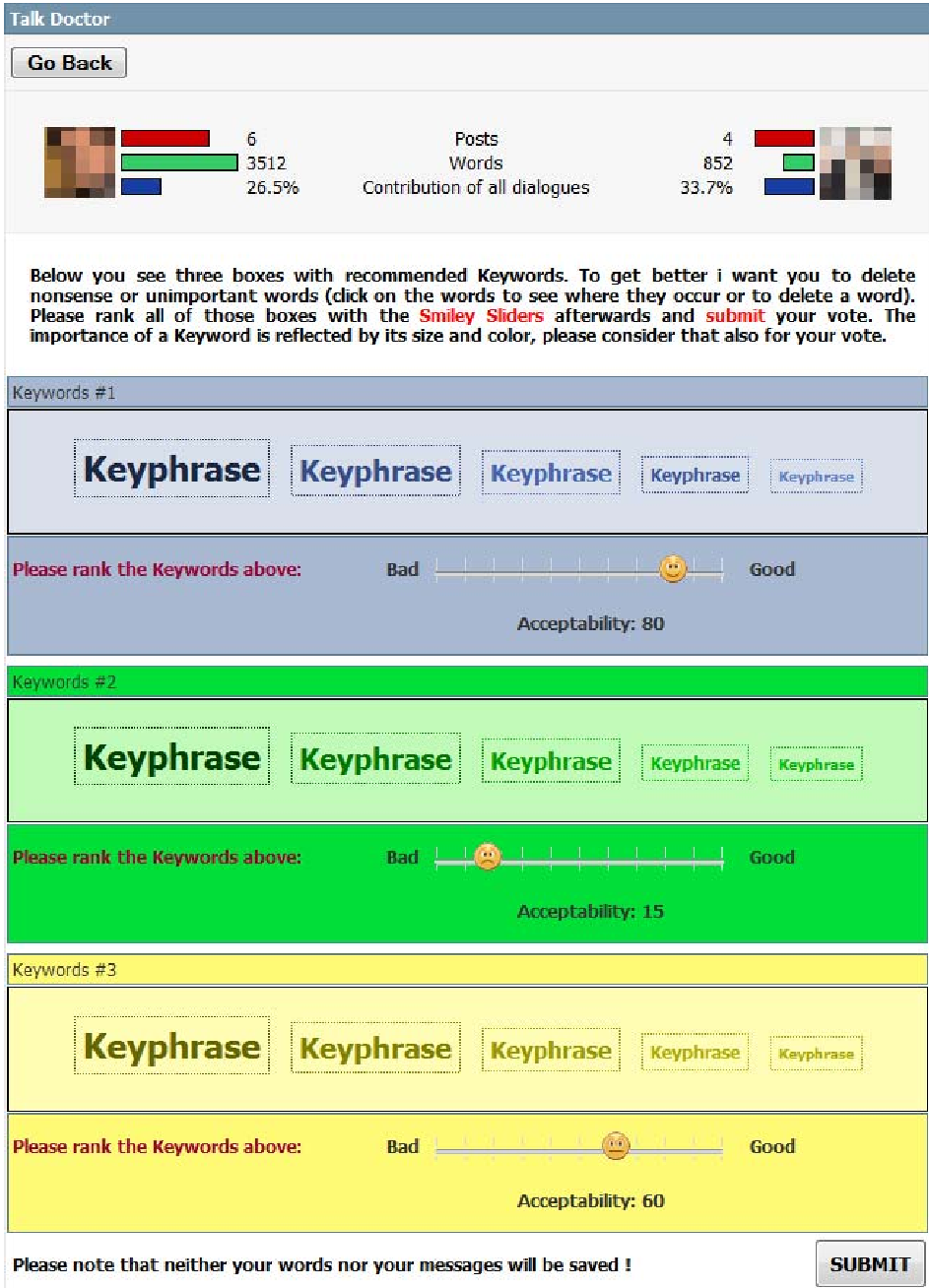 Figure 1: The user interface of "Talk Doctor," where participants rate the quality of extracted keyword sets.
Experimental Results: Humans vs. Algorithms
The study collected data from 275 distinct relationships. The results (Table I) provide a clear winner in terms of robustness:
- Undirected TextRank (72.43%) and tf-idf (72.07%) were nearly tied for the highest quality.
- Directed TextRank (67.76%) performed worse, likely because it is more sensitive to the fragmented and "grammatically loose" nature of chat messages.
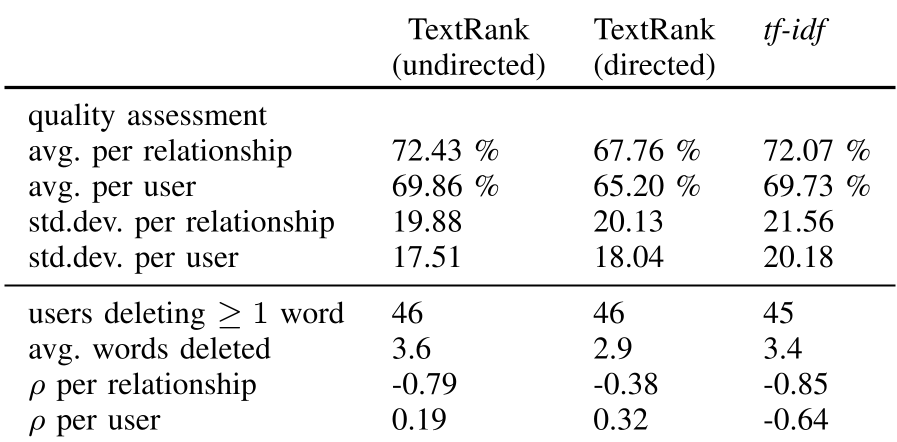 Table 1: Human assessment scores across different scoring models. Note the standard deviation suggesting high variability in how individuals perceive keyword "quality."
Key Insight: The "De-noising" Effect
Interestingly, the authors found that applying a secondary "document frequency" filter—which discounts words that appear too frequently across a user's entire message history—significantly boosted the scores of graph-based methods (TextRank). This suggests that social relationships are defined by their deviations from the "conversational background noise."
Critical Analysis & Takeaways
Strengths
The paper successfully validates that topic-based characterization is cognitively "valid" for users. This opens the door for Social Tagging, where relationships are indexed by themes (e.g., "University," "Hobby: Gaming," "Family") rather than just a weight.
Limitations
- Privacy Paranoia: The study struggled with recruitment because users are (rightfully) hesitant to allow apps access to private messages. This remains the biggest barrier to content-based social analysis.
- Unsupervised Limits: While 70% is good, it lacks the precision of supervised models. However, without a standard "relationship ontology," supervised learning remains difficult.
Future Outlook
The next step for this tech is moving from keywords to Relational Embeddings. With modern LLMs, we could transform these keywords into high-dimensional vectors that allow us to calculate "Social Proximity" based on semantic overlap, revolutionizing how we handle recommendation engines and community detection.
Takeaway: Your relationships are not just lines on a graph; they are specific libraries of shared vocabulary. Capturing that vocabulary is the key to truly understanding human social structure.