
NMHP: Scaling Private Social Discovery via Multi-hop Matrix Confusion
NMHP: A Privacy Preserving Profile Matching Protocol in Multi-hop Proximity Mobile Social Networks
The paper introduces NMHP, a multi-hop profile matching protocol designed for Proximity-based Mobile Social Networks (PMSNs). It utilizes a lightweight confusion matrix transformation and a dot product-based similarity calculation to enable private friend discovery across multiple network hops without relying on a Trusted Third Party (TTP).
TL;DR
NMHP (Novel Multi-Hop Protocol) is a decentralized privacy-preserving protocol for "friend discovery" in mobile networks. By replacing heavy-duty public-key cryptography with a lightweight confusion matrix mechanism and extending the matching range beyond the immediate physical vicinity to multi-hop neighbors, it achieves both high security and high performance on resource-constrained mobile devices.
Background: The Proximity Paradox
Proximity-based Mobile Social Networks (PMSNs) allow us to meet people based on shared interests (e.g., "both like Jazz and Python programming") via Bluetooth or Wi-Fi. However, this creates a paradox: to find a match, you must share your profile, but your profile contains sensitive data you don't want to expose to strangers.
Current solutions fail in two ways:
- The Heavyweight Trap: They use Homomorphic Encryption (HE), which is too slow for a smartphone to process in real-time.
- The 1-Hop Limit: They only look at people standing right next to you. If your "soulmate" is 20 meters away (just out of Bluetooth range), you’ll never find them.
The Core Insight: Matrix Confusion & Relays
The authors of NMHP propose a two-pronged strategy to solve this. Instead of encrypting data with complex math, they obfuscate it.
1. The 1-Hop Matching Phase (Lightweight Math)
The protocol transforms a user's interests into a matrix . To hide the actual values, it applies a Confusion Transformation using large primes and random matrices . This ensures that even if an attacker intercepts the data, they cannot reverse-engineer the original profile.
 Figure 1: The conceptual flow of mobile users discovering each other via profile matching.
2. The Multi-Hop Expansion
NMHP allows a 1-hop neighbor to act as a Secure Agent. The agent forwards the masked profile to the next layer of users. Crucially, because the profile is already obfuscated (confused), the agent can facilitate the match without ever knowing what the initiator's actual interests are.
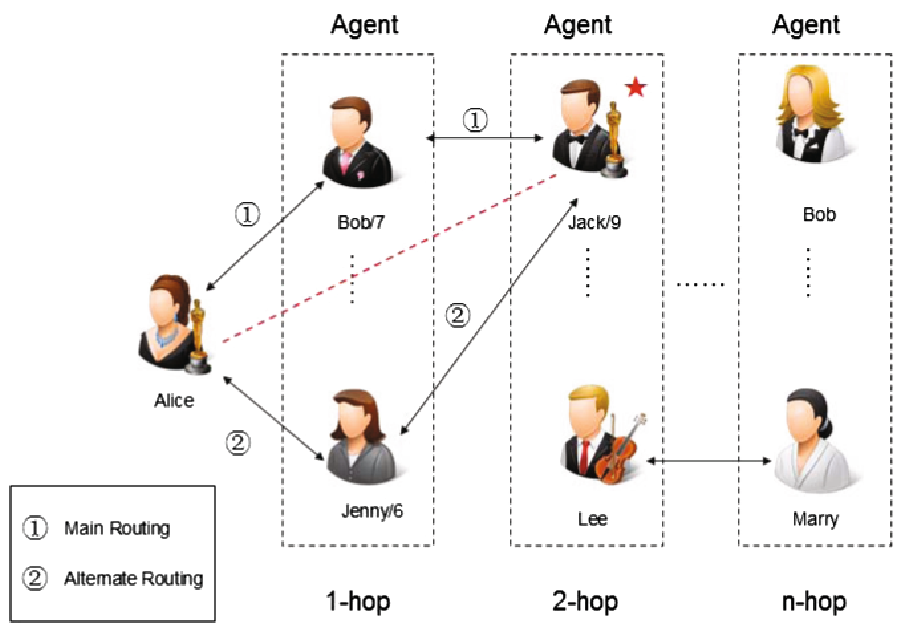 Figure 2: The multi-hop relay mechanism allowing Alice to find Jack through Bob.
Methodology: How Similarity is Calculated
The protocol follows a structured exchange:
- Initialization: Users set their weights (1-10) for specific attributes.
- Transformation: The initiator creates a confusion matrix .
- Dot Product: The responder computes the product of and their own matrix .
- Similarity Result: The initiator receives a result vector and, using a private key/prime, extracts the similarity value .
Performance: Efficiency vs. Security
The true value of NMHP lies in its efficiency. As shown in the comparison table below, NMHP avoids the exp (exponentiation) operations that plague other models like WAS or Fine-grained protocols.
| Operation | NMHP (Ours) | WAS [11] | Fine-grained [19] |
|---|---|---|---|
| Initiator (Online) | Multiplications + Additions | Exponentiations | Exponentiations |
| Complexity | Low (O(n)) | High | High |
By shifting the burden from modular exponentiation to simple matrix multiplications, NMHP allows for near-instantaneous matching even as the number of attributes () grows.
Critical Analysis & Takeaways
Why it works: NMHP leverages the physical intuition that in a mobile environment, distance is a barrier to communication but not necessarily to social compatibility. By using neighbors as "privacy-preserving routers," it builds a more connected social graph.
Limitations:
- Node Density: If the network is too sparse, the multi-hop relay fails.
- Incentive: The protocol assumes neighbors are willing to act as agents (HBC model); however, in a real world, users might need incentives (like tokens) to use their battery for others' friend discovery.
Future Outlook: NMHP provides a robust framework for decentralized social apps. Future iterations could integrate Trust Scores for agents to further harden the protocol against malicious relays that drop packets or provide fake results.
Conclusion
NMHP breaks the trade-off between privacy and performance. It proves that with clever matrix transformations and a multi-hop mindset, we can build social networks that are both expansive and inherently private.