
[Preprint 2024] NOBLE: Accelerating Transformers with Nonlinear Low-Rank Branches
NOBLE: Accelerating Transformers with Nonlinear Low-Rank Branches
This paper introduces NOBLE (Nonlinear lOw-rank Branch for Linear Enhancement), a transformer architectural augmentation that adds a permanent, nonlinear low-rank branch to linear layers. Unlike LoRA, NOBLE is designed for pretraining from scratch, using a specialized "CosNet" (double-layer learnable cosine activation) to achieve up to 1.47x step speedup and reaching SOTA-level eval loss with significantly fewer training steps.
TL;DR
NOBLE (Nonlinear lOw-rank Branch for Linear Enhancement) is an architectural upgrade for Transformers that adds a permanent nonlinear low-rank branch to every linear layer. Unlike LoRA, which is for fine-tuning, NOBLE is designed for pretraining from scratch. By using a specialized "CosNet" activation, it allows models to reach baseline performance 32% faster, yielding up to 1.22x wallclock speedup and significantly lower final loss.
Core Positioning: This is not just a parameter-efficient fine-tuning (PEFT) trick; it is an architectural redesign that treats the model as a hybrid system—linear for global trends and nonlinear/low-rank for fine-grained residuals.
The Motivation: Why Linear Layers Aren't Enough
The "Workhorse" of the Transformer is the linear projection (). Whether in Attention (Q, K, V) or the Feed-Forward Network (FFN), these layers are limited to affine transformations. While we have nonlinearities between layers, the individual projections remain conceptually "flat."
The authors noticed a gap: while LoRA (Low-Rank Adaptation) is great for fine-tuning, simply adding a linear low-rank branch during pretraining is useless because just collapses into a single matrix. To make a low-rank branch meaningful during pretraining, it must be nonlinear.
Methodology: NOBLE and the Power of CosNet
The NOBLE architecture augments a standard layer into:
The Secret Sauce: CosNet
After testing ReLU, GELU, and Tanh, the authors found that Cosine-based activations performed best. They proposed CosNet, which is a two-layer "sandwich" of learnable cosine functions:
- Learnable Frequency () and Phase (): Allows the model to adapt to specific data periodicities.
- Mixing Matrix (): A small matrix that allows interaction within the bottleneck space.
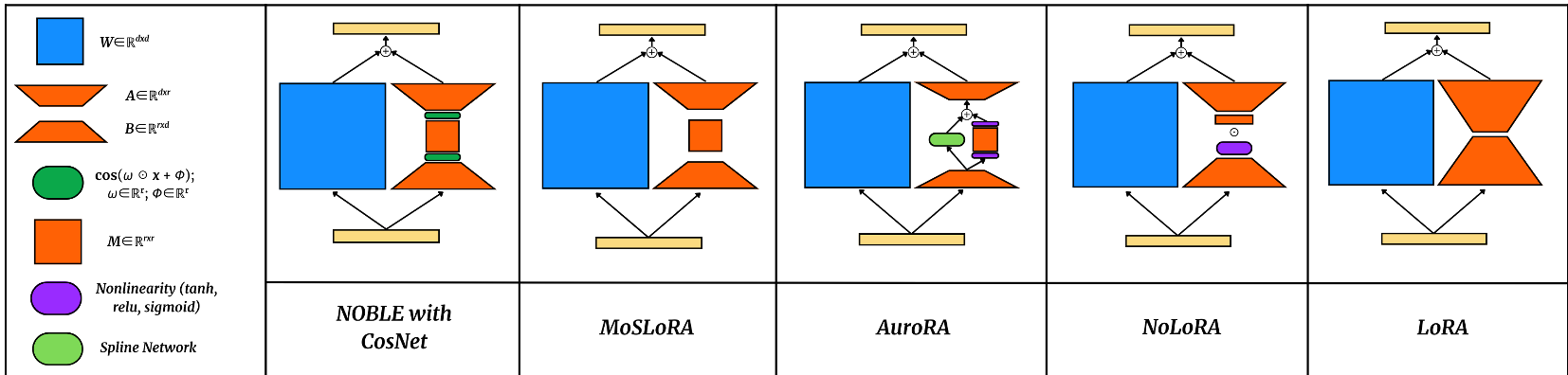 Figure 2: (a) shows the integrated CosNet branch compared to standard LoRA and other nonlinear variants.
Implementation Details for Stability
- Near-Zero Initialization: starts almost at zero, letting the main weights () lead the early training.
- Learning Rate Scaling: They use a higher learning rate for the low-rank parts (inspired by P) to ensure the bottleneck learns fast enough to be useful.
Experiments: Faster Training, Lower Loss
The results across LLMs (250M to 1.5B parameters), BERT, and Vision tasks are striking.
1. Large-Scale Language Modeling (1.5B)
On OpenWebText, a 1.5B parameter model with NOBLE reached the same loss as the baseline in 1.37x fewer steps. Even though each step is slightly slower (due to the extra branch), the net saving in real-world time (wallclock) is ~20%.
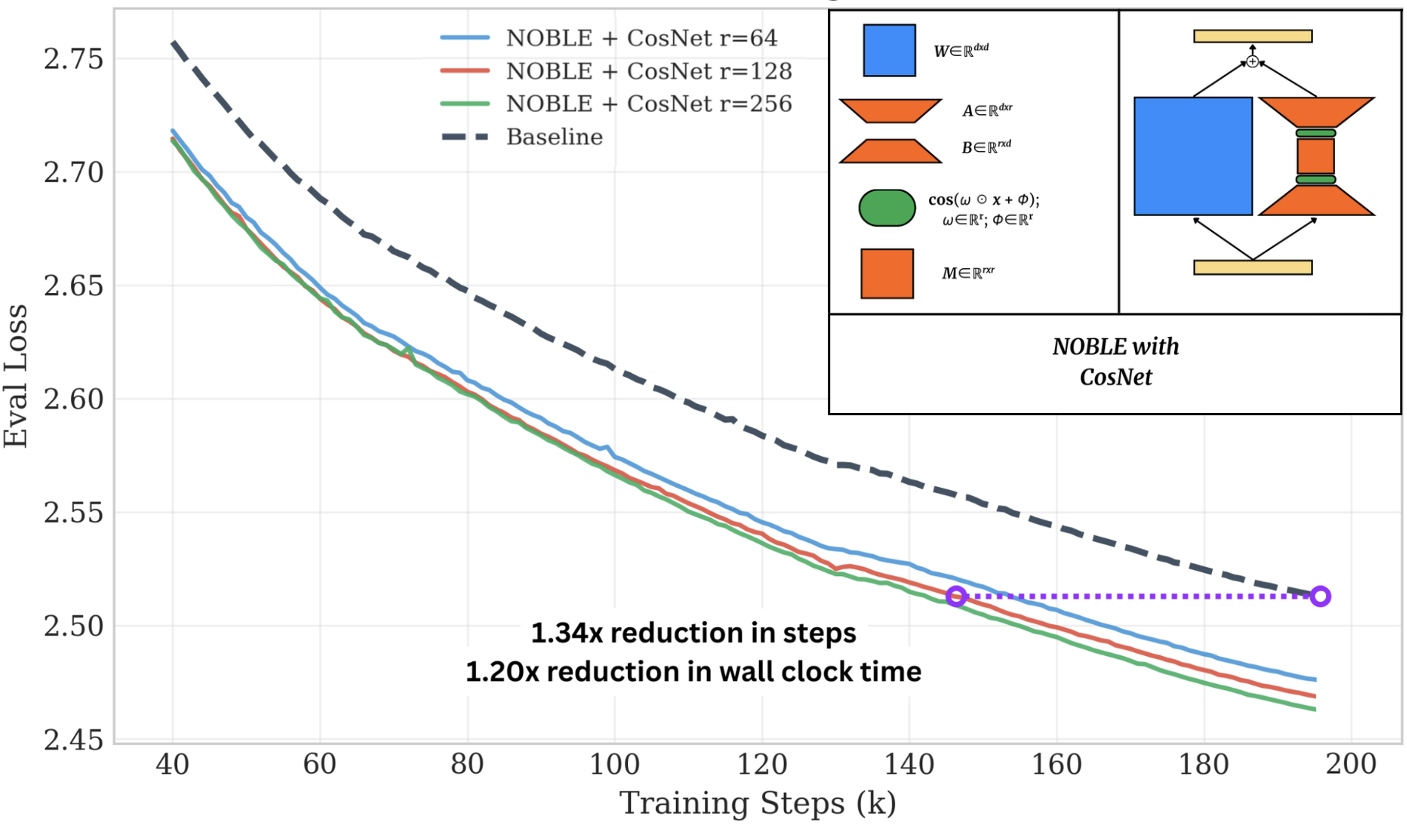 Figure 1: Notice how the solid NOBLE lines consistently stay below the dashed baseline.
2. Autoregressive Image Modeling
The benefits aren't limited to text. When training a Transformer to predict VQGAN image tokens, NOBLE similarly improved convergence and final loss.
Deep Insight: NOBLE as a High-Frequency Learner
Why does a Cosine branch help so much? The authors offer a brilliant intuitive explanation through the lens of Spectral Bias.
- Linear Pathway: Approximates the smooth, low-frequency trends of the data.
- Cosine Bypass: Specializes in the "high-frequency residuals"—the sharp transitions and intricate local structures.
This also explains a key limitation: Mixup and CutMix augmentations. These techniques artificially "smooth" the data. The authors found that when targets are smoothed by Mixup, the cosine branch has no "sharpness" to capture, and NOBLE’s advantage disappears.
Critical Analysis & Conclusion
Takeaway
NOBLE is a rare "free lunch" in pretraining (if you don't mind a slight inference overhead). It provides a more expressive inductive bias by allowing the model to decompose the learning task into "base" and "residual" components using periodic activations.
Limitations
- Inference Latency: Unlike LoRA, you cannot "merge" the weights because of the nonlinearity. You pay a ~10% FLOPs price at inference.
- Regularization Conflict: If your pipeline relies heavily on Mixup/CutMix, NOBLE might not be for you.
Future Outlook
As we scale to trillions of tokens, training efficiency is more valuable than inference parameter count. NOBLE suggests that we should move away from purely "monolithic" linear layers toward hybrid, multi-branch architectures that can fit complex data distributions more aggressively.