
Beyond Vagal Tone: "Peakness" as a New Biomarker for Pediatric Asthma Risk
Nocturnal Heart Rate Variability Spectrum Characterization in Preschool Children With Asthmatic Symptoms
This study proposes a novel spectral index called "peakness" (℘) to characterize the nocturnal High Frequency (HF) component of Heart Rate Variability (HRV) in preschool children. It aims to identify early physiological markers of asthma risk, demonstrating that high-risk children exhibit significantly more concentrated spectral power around the respiratory frequency.
TL;DR
Diagnosing asthma in children under five is notoriously difficult due to their inability to perform standard lung function tests. This paper introduces a new HRV-based metric—Peakness (℘)—which measures how "concentrated" a child's heart rate response to breathing is during the night. The study finds that children at high risk for asthma have a less adaptable, more "peaked" heart rate spectrum, suggesting that a loss of physiological complexity is an early warning sign of the disease.
The "Cooperation Gap" in Pediatric Asthma
In adult medicine, diagnosing asthma is straightforward: you ask the patient to blow into a spirometer. In preschool children, this is nearly impossible. Clinicians are forced to rely on parental history and the "Modified Asthma Predictive Index" (mAPI), which are qualitative and retrospective.
The authors pivot to the Autonomic Nervous System (ANS). Since the parasympathetic branch (PSNS) controls both the heart rate and the constriction of the airways, any early "glitch" in the asthma-prone lungs should, theoretically, be mirrored in the heart's rhythm—specifically in the Respiratory Sinus Arrhythmia (RSA).
Methodology: Measuring "Peakness"
Traditional HRV analysis looks at the amount of power in a frequency band (e.g., how much High Frequency power exists). This paper argues that the shape of that power distribution matters more.
The Peakness Index (℘)
The core innovation is the Peakness index. If the heart rate fluctuates perfectly in sync with a single breathing frequency, the spectrum shows a sharp, narrow peak (High Peakness). If the system is adaptable and complex, the power is more spread out (Low Peakness).
The authors implemented three versions of this index:
- : Using ECG for heart rate and Impedance Pneumography (IP) for breathing.
- : Using only ECG (deriving the breath rate from the ECG itself).
- : Using only the breathing signal.
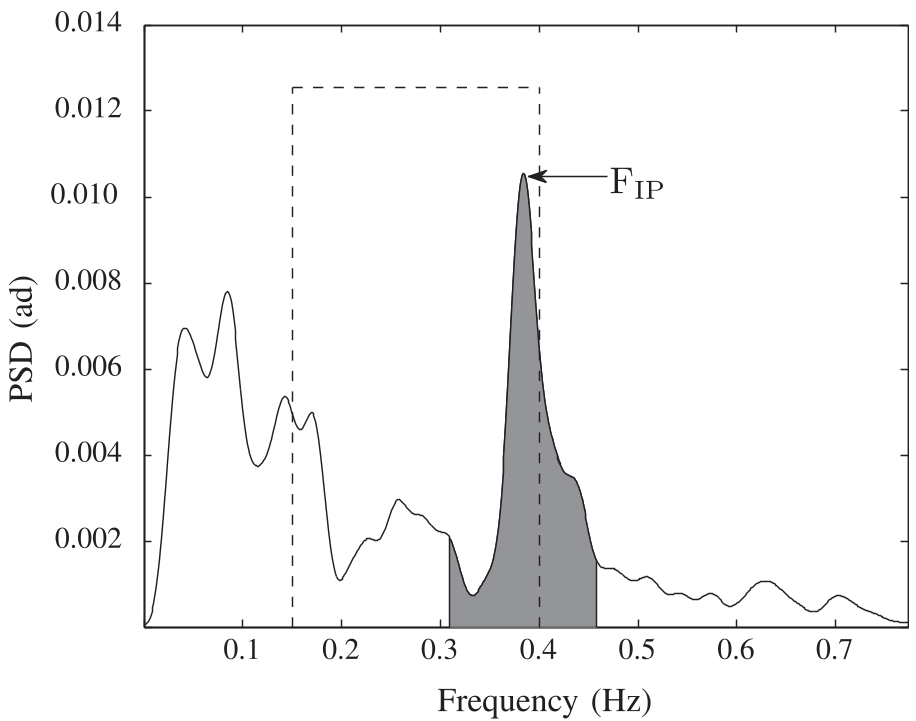 Figure 1: Example of the PSD showing the focused 0.15 Hz HF band centered on the respiratory frequency, used to calculate Peakness.
Results: The Signature of High Risk
The study analyzed 34 children during their sleep (23:00 to 05:00). The most significant findings occurred between 2:00 AM and 4:00 AM, a period typically associated with high vagal activity and increased asthma symptoms.
- Higher Regularity: High-risk (HiR) children had significantly higher peakness values (). Their biological systems were "locked" into a more rigid pattern.
- Reduced Balance: HiR children also showed lower normalized Low Frequency (LF) power, indicating a tilt toward parasympathetic dominance but with a "lack of adaptability."
- ECG Sufficiency: The ECG-derived version () performed almost as well as the combined version, meaning a simple heart rate monitor might be enough for screening.
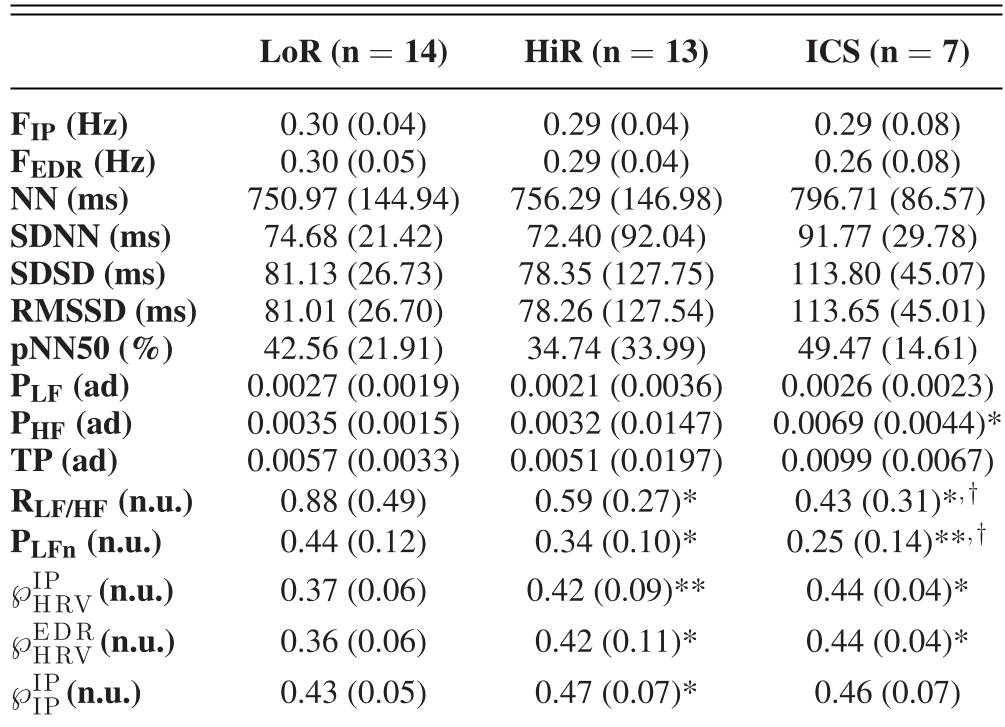 Table 1: Comparison of indices between Low-Risk (LoR), High-Risk (HiR), and Corticosteroid (ICS) groups. Note the significant difference in Peakness (℘).
Insight: The "Decomplexity" of Disease
Why does a "peakier" spectrum mean a child is at risk? The authors lean on a profound physiological theory: Healthy systems are complex; diseased systems are simple.
In healthy children, the interaction between the lungs and heart is dynamic and chaotic, allowing the body to adapt to various stressors. In children prone to asthma, this system becomes "stereotyped" and regular. This "decomplexification" suggests that the parasympathetic nervous system is losing its ability to finely tune the airway caliber, leading to the rigid, high-peaked spectral signature observed in the study.
Critical Analysis & Future Work
The study’s greatest strength is its non-invasiveness. By using nocturnal Holter recordings, it bypasses the need for patient cooperation.
Limitations:
- Sample Size: With only 34 children, the results are provocative but require a larger cohort for clinical validation.
- Lack of Long-term Follow-up: The study uses "risk indices" rather than confirmed future asthma diagnoses. A prospective study tracking these children for 5+ years would prove if "Peakness" truly predicts the development of chronic asthma.
Conclusion
This research moves HRV analysis from simple "volume" measurements (power) to "texture" analysis (Peakness). By identifying that high-risk children have a more rigid cardiac-respiratory coupling, we move one step closer to a passive, sleep-based screening tool for the world's most common chronic childhood disease.