
UAC-Rank: Why Your "Quiet" Influencers Might Be Better Than Social Hubs
A node activity and connectivity-based model for influence maximization in social networks
This paper introduces the UAC-Rank algorithm and two activity-based diffusion models (AbIC and AbLT) for social network influence maximization. By integrating node connectivity (out-degree) with historical node activity (interaction frequency), the method significantly outperforms traditional connectivity-only models, achieving up to 244% higher influence spread in real-world communication datasets.
TL;DR
In the world of viral marketing, we've long obsessed over connectivity—the number of followers or friends a user has. However, this paper argues that Activity Level is just as crucial. By introducing UAC-Rank and activity-driven diffusion models (AbIC/AbLT), the authors prove that frequent interactors drive significantly more influence spread (up to 2.4x) than dormant hubs.
The Problem: The "Dormant Hub" Fallacy
Most existing Influence Maximization (IM) algorithms treat social networks as static maps. If Node A has 1,000 followers and Node B has 100, Node A is almost always chosen as a "seed."
But what if Node A hasn't posted in a month, while Node B interacts with their circle daily?
- Statics vs. Dynamics: Traditional Independent Cascade (IC) models use a fixed probability for all edges.
- The Reality: Marketing campaigns are time-critical. A node with fewer connections but high interaction frequency spreads information faster and more reliably.
Methodology: Fusing Connectivity and Activity
The researchers propose a dual-pronged approach to capture the "real" behavior of users.
1. The UAC-Rank Metric
Instead of just looking at out-degree, the algorithm calculates a score based on a weighted combination of:
- Node Activity Weight (NAW): The sum of all initiated interactions in a specific time span.
- Out-degree: The count of outgoing structural links.
2. Activity-Based Diffusion Models (AbIC & AbLT)
The authors re-engineered the classic IC and LT models. In the AbIC model, the propagation probability () is no longer a constant but a ratio of the specific interaction count between two nodes divided by the highest interaction count in the entire network.
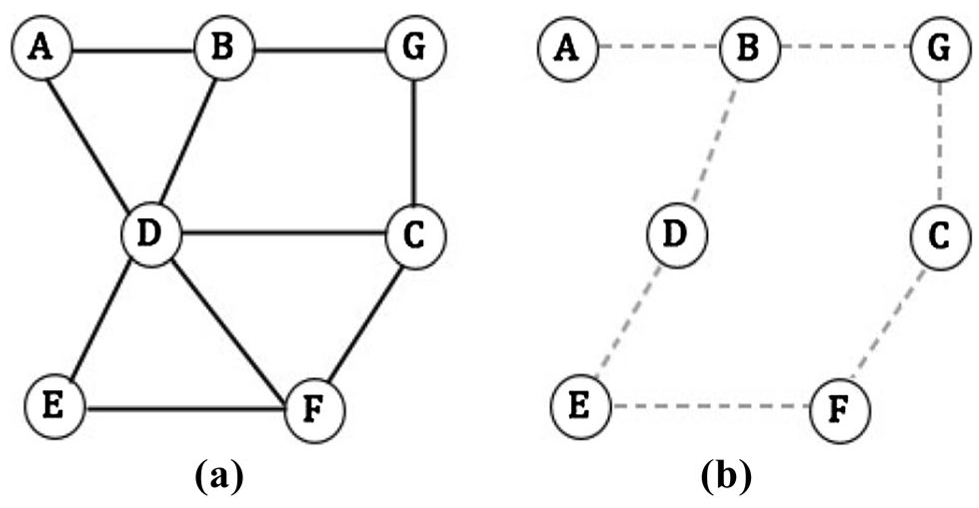 Figure 1: The logic flow for generating the weighted activity network and the UAC-Rank algorithm.
Experiments: Superior Spread Across Scenarios
The team tested their models on four diverse datasets: UC Irvine messages, Math Overflow interactions, Facebook wall posts, and a manufacturing company's email network.
Key Comparison: AbIC vs. IC
When the same seed nodes were simulated through the new activity-aware model (AbIC) versus the traditional model (IC), the results were staggering. In the UC Irvine dataset, the influence spread was 244% higher once activity was taken into account.
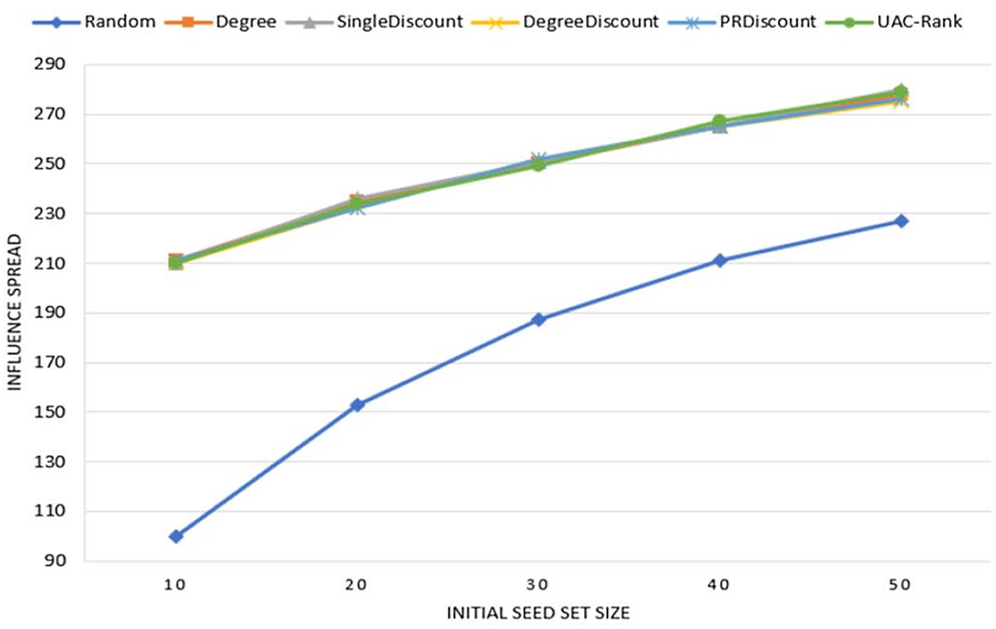 Figure 2: Performance comparison showing UAC-Rank outperforming Random, Degree, and PRDiscount heuristics in influence spread.
Efficiency Benchmark
Despite the added complexity of tracking interactions, UAC-Rank maintains a computational complexity of , where is the seed set size. This makes it practical for medium-to-large-scale social networks without requiring the massive overhead of iterative greedy simulations.
Deep Insight: Beyond the Topology
The core takeaway is that Network Value Degree.
The "Rich-Club" phenomenon (where high-degree nodes connect to each other) often creates redundancy. UAC-Rank effectively mitigates this by discounting the influence of a node's neighbors once that node is influenced, ensuring the seed set is not just active but also strategically distributed.
Limitations & Future Work
While powerful, the model relies on having access to interaction logs (temporal edges), which may not always be public. The authors suggest that future iterations could incorporate Topic-level influence—recognizing that a user might be highly active in "Tech" but dormant in "Fashion."
Conclusion
This paper shifts the paradigm of influence from potential (what could spread based on links) to performance (what actually spreads based on history). If you are planning a campaign, look for the "chatty" users, not just the "popular" ones.