
Strategizing Social Influence: The Intersection of Node Centrality and Optimal Control
7833_Using Node Centrality and Optimal Control to Maxim
This paper presents a framework to maximize information diffusion in social networks by jointly optimizing seed selection and time-varying resource allocation (advertising). Using the Susceptible-Infected (SI) epidemic model and Pontryagin’s Maximum Principle, the authors develop an optimal control system that categorizes nodes by centrality measures to achieve superior spread across real-world networks like Facebook and Slashdot.
TL;DR
Maximizing the spread of information in a social network is not just about who you start with, but how and when you support the message over time. This paper moves beyond static "seed selection" to a dynamic "optimal control" framework. By grouping nodes by centrality, the authors demonstrate that the best strategy flips based on your budget: use influencers when poor, and support the "underdogs" when rich.
Problem & Motivation: The Gap in Influence Maximization
Most benchmark studies in influence maximization treat the problem as a "one-shot" game: find the best nodes to start a viral trend and then step back. However, real-world campaigns (like movie promotions or charity drives) involve continuous advertising spend throughout the period.
Previous attempts to use Optimal Control Theory to solve this often simplified the world by assuming everyone is equally likely to meet everyone else (homogeneous mixing). This ignores the reality of social networks where some people are hubs and others are outliers. The authors bridge this gap by mapping epidemic differential equations directly onto real-world adjacency matrices.
Methodology: Engineering the Spread
The authors model information as a Susceptible-Infected (SI) process. The core innovation lies in the Joint Seed-Control Problem, where both the initial seeds and the subsequent advertisement intensity are optimized simultaneously.
1. Grouping by Centrality
To make the math tractable for large networks, nodes are clustered into groups based on metrics like:
- Degree: Number of direct connections.
- Pagerank: Importance relative to connected neighbors.
- Closeness/Betweenness: How "central" a node is in the network's geometry.
2. The Optimality System
Using Pontryagin’s Maximum Principle, the authors derive a "Hamiltonian" that balances the reward (total people reached) against the cost (advertising spend).
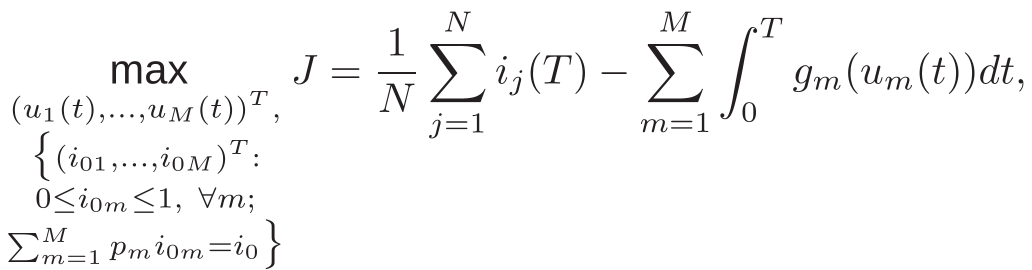 The objective function maximizes the final infected fraction while penalizing the integral of control costs.
Key Insights: The Anatomy of a Campaign
The numerical results from the forward-backward sweep algorithm reveal two fascinating physical intuitions:
1. The "Front-Loading" Effect
Theorem III.1 proves that for quadratic costs, the optimal control is non-increasing. Intuition: It is always better to infect someone early. An early infection turns a node into a "worker" who helps spread the message for the remainder of the campaign duration.
2. The Resource Pivot
The paper uncovers a strategic "phase shift" based on budget:
- Scarce Resources ( is high): The optimizer targets high-centrality nodes. You need the "super-spreaders" to do the heavy lifting for you because you can't afford to reach everyone.
- Abundant Resources ( is low): The optimizer targets low-centrality nodes. Since the budget is high, the central nodes will eventually get the message anyway through the natural epidemic. The money is best spent "filling the gaps" by directly targeting isolated nodes.
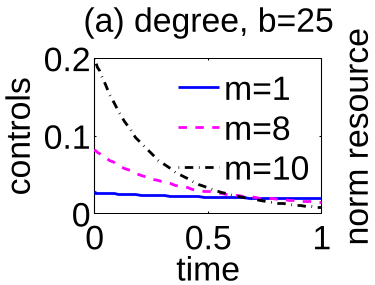 Comparison of control shapes: Central nodes (Group 10) receive intense early effort, while non-central nodes (Group 1) receive more uniform, long-term support.
Experimental Validation
Testing across Facebook and Slashdot datasets, the authors found that Degree Centrality—the simplest metric to calculate—performed remarkably well compared to computationally expensive metrics like Betweenness. This is a massive win for practitioners: you don't need a global map of the network; local connection counts are often "good enough" for near-optimal control.
Critical Analysis & Conclusion
Takeaway
This work elevates influence maximization from a static selection problem to a dynamic resource management problem. It provides a rigorous proof that the "influencer marketing" obsession is only the correct strategy when your budget is limited.
Limitations
- Static Network: The model assumes the social network doesn't change during the campaign. In reality, links are temporal and dynamic.
- SI Model: The SI model assumes people never "forget" or stop spreading the message. Future work should look at SIR (Recovered) or Maki-Thompson rumor models for a more realistic decay of interest.
Future Outlook
This framework is highly extensible. The transition from complex calculations to via grouping makes it feasible for massive networks, potentially allowing real-time adjustments to social media ad campaigns.