
Unlocking Social Network Structures: A Factor Graph Approach to Node Classification
Node Classification in Social Network via a Factor Graph Model
This paper proposes a Factor Graph Model (FGM) for node classification in social networks, integrating node-level attributes with complex topological relationships. By utilizing PLSA for topic-based feature extraction and Loopy Belief Propagation for inference, the model achieves state-of-the-art performance on DBLP and Weibo datasets, significantly outperforming traditional classifiers.
TL;DR
Researchers have developed a Factor Graph Model (FGM) that bridges the gap between individual node attributes and network topology. By combining Probabilistic Latent Semantic Analysis (PLSA) for content features and Factor Factors for diverse social relationships, the model significantly outperforms traditional SVMs and basic relational neighbors in predicting node categories across DBLP and Weibo datasets.
Problem & Motivation: Beyond Independent Data
In the realm of traditional machine learning, objects are often assumed to be Independent and Identically Distributed (IID). However, social networks break this assumption. A user’s identity is defined not just by what they post, but by who their friends are (Homophily) and what common interests they share (Co-citation).
Existing methodologies often fall into two traps:
- Feature-centric: Using standard classifiers like SVM that ignore the graph structure entirely.
- Relation-centric: Using simple neighborhood averages (like wvRN) that ignore the specific characteristics (attributes) of the nodes themselves.
The authors argue that a unified graphical model is necessary to capture these dual influences, especially when only a small fraction of the network is labeled.
Methodology: The Factor Graph Framework
The core of the proposed solution is a Factor Graph that models the joint distribution of all node labels given the network .
1. Attribute Factors
Instead of raw profile data, the authors use PLSA to extract latent topics from node-associated text. This captures the "interests" or "domains" of a user/paper as a probability distribution.
2. Relation Factors
The model accommodates multiple relationship types. For instance, in a Weibo network, "User A follows B" is a primary relationship, while "User A and B follow the same public accounts" acts as a secondary, deeper connection.
3. Architecture Visualization
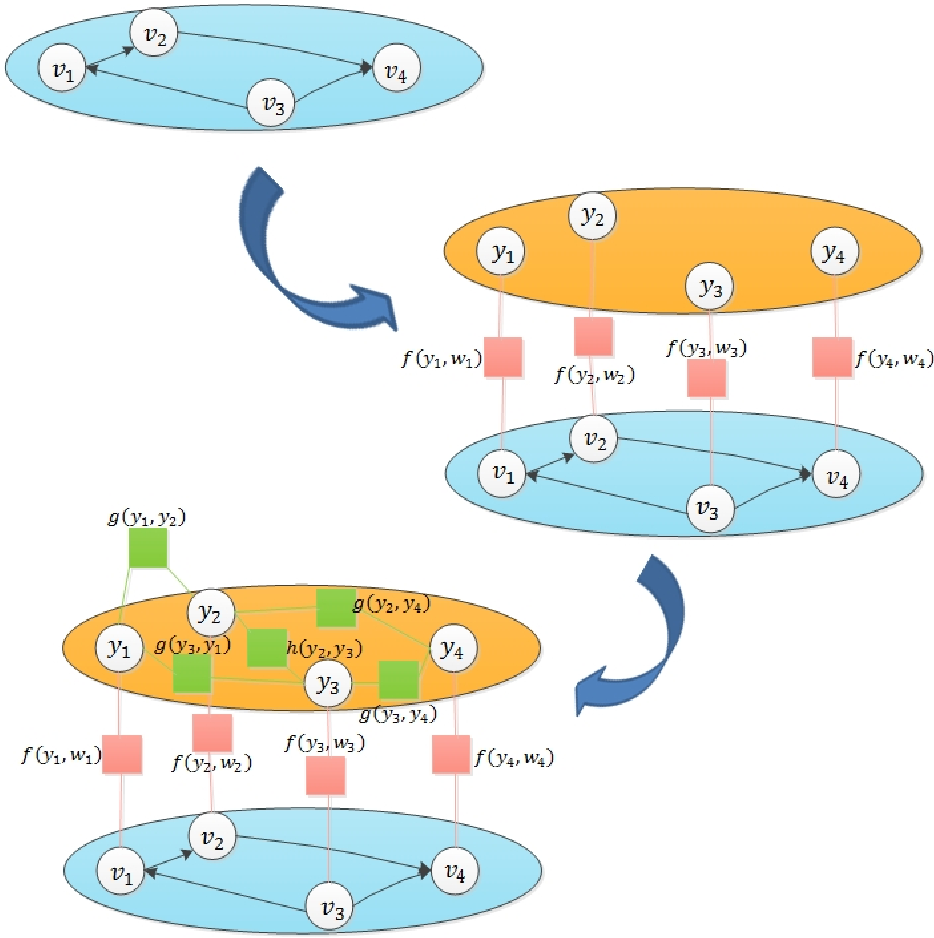 Figure 1: Representation of the graphical model where variable nodes (labels) are influenced by attribute factors and inter-node relationship factors.
The inference is handled via Loopy Belief Propagation (LBP), an approximate algorithm capable of passing messages through cyclic graphs effectively, allowing the model to learn global dependencies from local updates.
Experiments & Results: Robust Performance
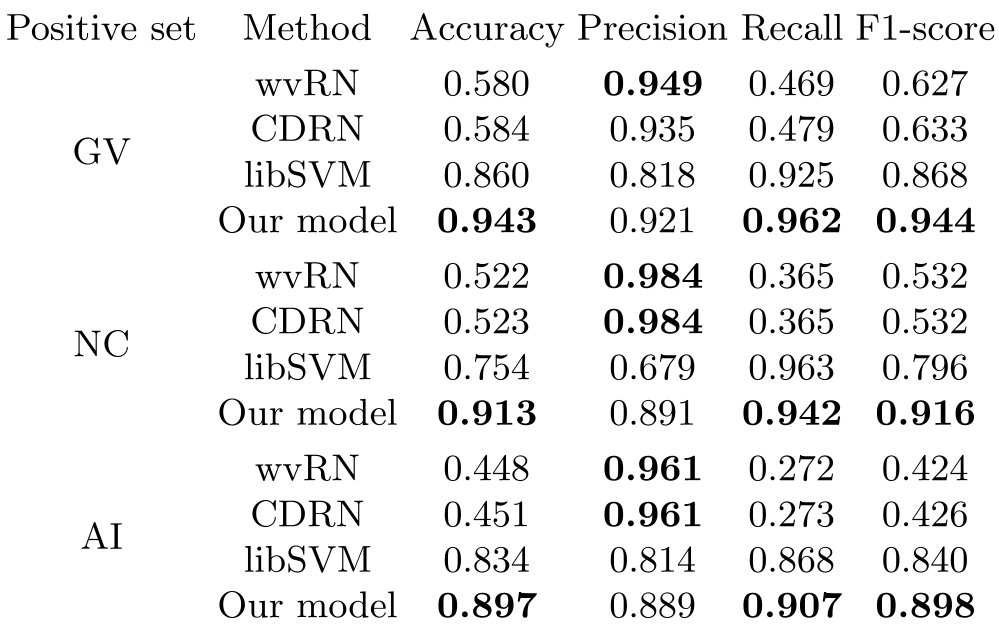
The model was tested against two primary baselines: libSVM (attribute-only) and wvRN/CDRN (relation-only).
SOTA Comparison
In tasks like classifying DBLP papers into "AI," "Database," or "Networks," the Factor Graph Model showed a clear lead.
- Accuracy: Reached up to 94.3% in some tasks.
- F1-Score: Outperformed libSVM by up to 12%, proving that the connectivity information provides a critical "context" that attributes alone lack.
The Power of Semi-Supervised Learning
A critical finding was the model's performance with limited data. Even with only 10% of labels, the FGM maintained strong F1-scores, whereas traditional methods were highly sensitive to the labeling ratio.
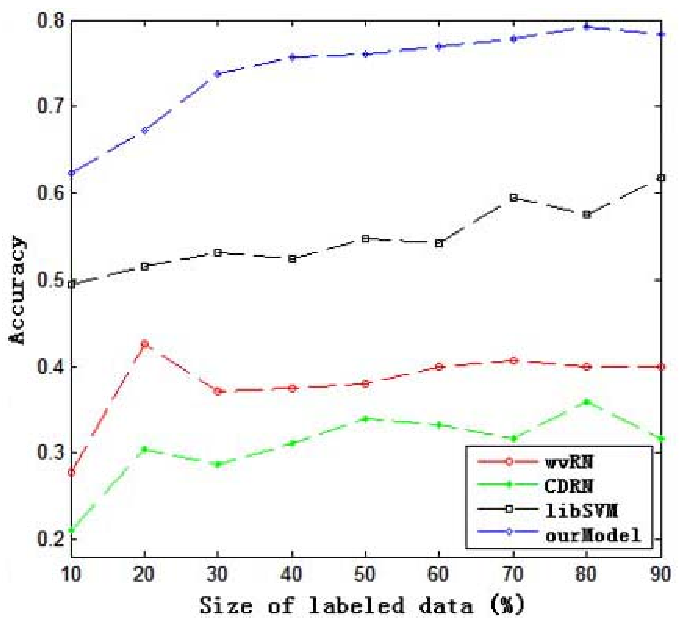 Figure 2: Our model (S and M) shows a much more stable and higher performance curve as the ratio of labeled data varies.
Critical Insight & Conclusion
The success of this factor graph approach lies in its flexibility. By treating relationships as distinct factors, researchers can encode various social science theories directly into the mathematical model.
Takeaways:
- Node context matters: A node's label is effectively a "consensus" between its own features and the labels of its neighbors.
- Multiple Links: Differentiating between "Follow," "Mention," and "Common Interest" provides a granular view of social influence that improves classification accuracy.
Limitations & Future Directions: The current work focuses primarily on binary classification. As social networks grow more complex, extending this to multi-class scenarios and improving the computational efficiency of LBP for "huge-scale" networks (millions of nodes) will be the next frontier in graph-based machine learning.