
Node Embeddings: Bridging Natural Language Processing and Social Network Analysis
Node Embeddings in Social Network Analysis
This paper introduces a novel application of Skip-gram distributed representations to Social Network Analysis (SNA). The method, termed "Node Embeddings," maps graph nodes into a high-dimensional vector space based on node attributes and structural links, facilitating efficient computation for community detection and structural comparison tasks in the DBLP citation network.
Executive Summary
TL;DR: This paper bridges the gap between NLP-style representation learning and Social Network Analysis (SNA). By adapting the Skip-gram model to treat network links and node attributes as "context," the authors create 200-dimensional Node Embeddings. These embeddings enable efficient, large-scale analysis of community homogeneity, inter-field distances, and the identification of "Community Connectors" in the DBLP citation graph.
Positioning: Published in 2015, this work sits at the dawn of the Graph Representation Learning era, serving as a critical precursor to mainstream methods like DeepWalk and Node2vec by emphasizing the fusion of attributes and topology.
Problem & Motivation: Beyond Graph Traversal
In 2015, the primary bottleneck in SNA was scalability. Analyzing a network like DBLP with millions of nodes using traditional metrics (like Betweenness Centrality) was computationally prohibitive. Furthermore, existing methods often ignored the rich metadata (attributes) attached to nodes, focusing solely on the edges.
The authors' insight was profound: if words can be represented by their "context" in a sentence, nodes can be represented by their "context" in a graph. This allows for a shift from discrete graph math to continuous vector space math, where similarity is a simple dot product or Euclidean distance.
Methodology: Adapting Skip-gram for Graphs
The core innovation lies in the definition of a node's context. For a node , the context is redefined as:
The Objective Function
The model optimizes the following log-likelihood to ensure that a node and its context have high similarity while being distinct from randomly sampled "negative" noise:

By training this via stochastic gradient descent, the resulting vectors encode the "DNA" of a node's position and characteristics within the social ecosystem.
Experiments: Dissecting the Computer Science Landscape
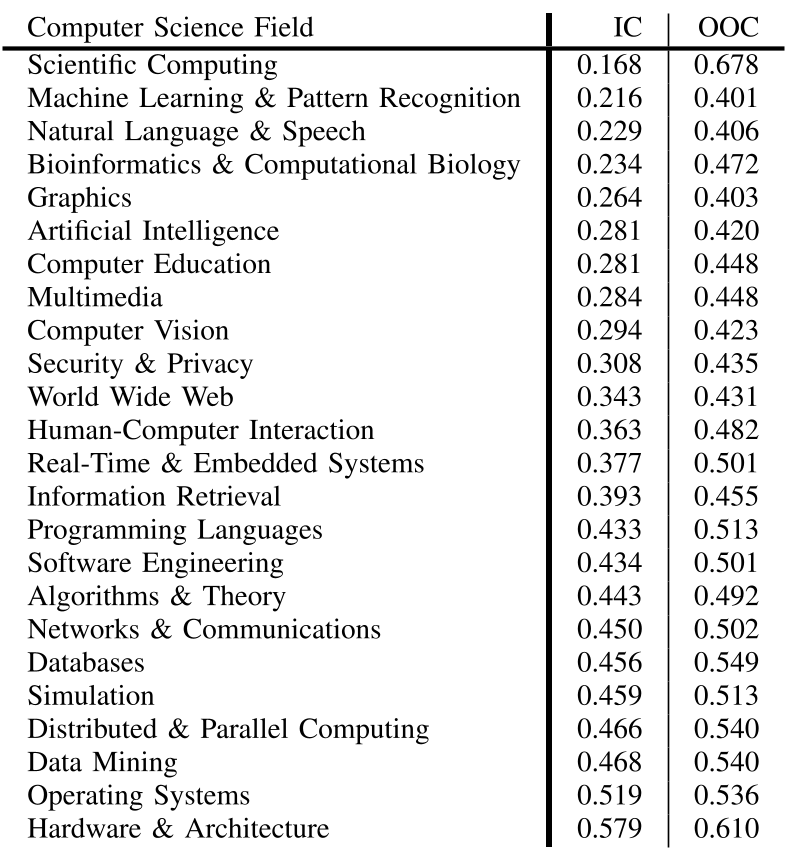
The authors applied this to a massive DBLP dataset (2.2M papers, 1.2M authors). They assigned authors to 24 research fields and quantified the "closeness" of these scientific communities.
1. Community Homogeneity
The study found that Machine Learning & Pattern Recognition and Natural Language & Speech are highly focused (low IC scores), meaning researchers in these fields share a very similar "citing behavior." Conversely, Hardware & Architecture showed high diversity, likely because its outputs are applied across almost every other sub-discipline.
2. Identifying "Community Connectors"
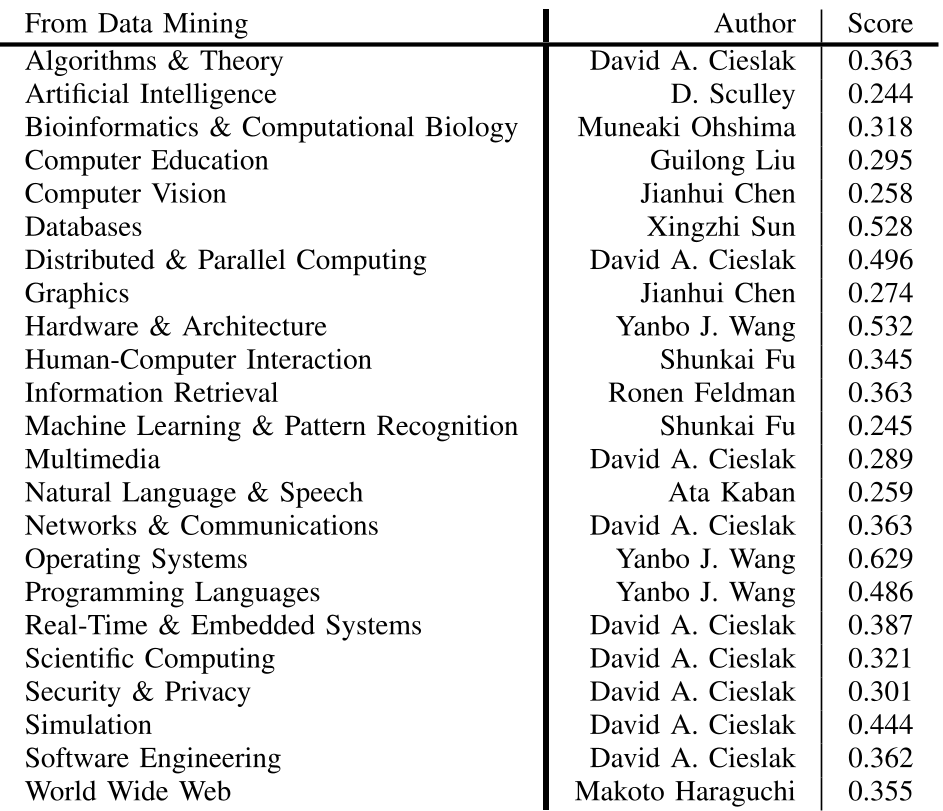
One of the most valuable outputs of node embeddings is the ability to find "Connectors"—nodes that act as bridges between disparate fields. These are often not the most "famous" people (influencers), but rather high-value outliers who facilitate the flow of information between, for example, Data Mining and Bioinformatics.
Deep Insights & Conclusion
Takeaway
The shift from symbolic graph analysis to distributed vector representations transforms SNA from a search problem into a geometry problem. This paper proved that even a "simple" adaptation of Word2vec could yield sophisticated insights into how scientific disciplines interact and evolve.
Limitations
As an early work, the "walk" strategy is relatively simple compared to modern Random Walk methods. It also treats edges as static, neglecting the temporal evolution of networks (though they hinted at this by comparing "impactful" vs. "regular" citations over time).
Future Outlook
This work paved the way for modern Graph Neural Networks (GNNs). Today, we use these embeddings not just to observe communities, but to power recommendation engines, detect fraud, and even discover new drugs by mapping molecular graphs into the same type of latent space described here.