
NOSDT: Securing the Social IoT Through Dynamic Node State Modeling
15233_Node-Oriented Secure Data Transmission Algorithm Based on IoT System in Social Networks.
The paper proposes the Node-Oriented Secure Data Transmission (NOSDT) algorithm for IoT systems within social networks. It introduces a multi-state node classification model (Malicious, Neutral, Ordinary, Friendly) and mathematical impact functions to isolate malicious actors and prioritize reliable relays, significantly improving data delivery ratios in open network environments.
TL;DR
The Node-Oriented Secure Data Transmission (NOSDT) algorithm addresses the critical vulnerability of IoT devices in open social environments. By classifying nodes into four distinct behavioral states—Malicious, Neutral, Ordinary, and Friendly—and using differential equations to model their transitions, NOSDT identifies and isolates attackers while optimizing for high-delivery "friendly" paths. Experimental data confirms it offers superior delivery ratios and stability compared to traditional opportunistic routing protocols.
Problem & Motivation: The "Chaos" of Open Social Networks
In the modern 5G/IoT era, mobile devices (smartphones, wearables) act as nodes in a vast, self-organizing social network. Unlike static industrial networks, these nodes move based on human social patterns. This openness is a double-edged sword:
- The Malicious Threat: Malicious nodes can easily infiltrate the network, injecting fake data or "black-holing" packets, which wastes energy and increases latency.
- Inefficient Replication: Classic protocols like "Epidemic" routing rely on blind flooding, which quickly exhausts cache and bandwidth.
- Dynamic Nature: A "trusted" node might become compromised (Neutral → Malicious), or a vulnerable node might become reliable after trust evaluation (Ordinary → Friendly).
The authors recognized that to secure data, they couldn't just use static blacklists; they needed a dynamic influence model that treated node security as a fluid state.
Methodology: The Math of Trust
The core of NOSDT is a system of differential equations that describe how the proportions of different node types change over time.
1. The Four-State Classification
- Class M (Malicious): Carriers of fake data; the "infected" nodes.
- Class N (Neutral): Nodes in an incubation period; they've interacted with M but aren't yet active attackers.
- Class O (Ordinary): Vulnerable nodes that might accidentally relay for M.
- Class F (Friendly): The "immune" backbone; these nodes reliably forward data despite potential exposure to malicious actors.
2. The Operational Architecture
The algorithm employs specific mathematical operators to simulate network behavior. For instance, the O-O operator uses a weighted sum of attributes to differentiate ordinary nodes, while transition operators (N-M and F-O) account for time delays () in trust loss or malicious conversion.
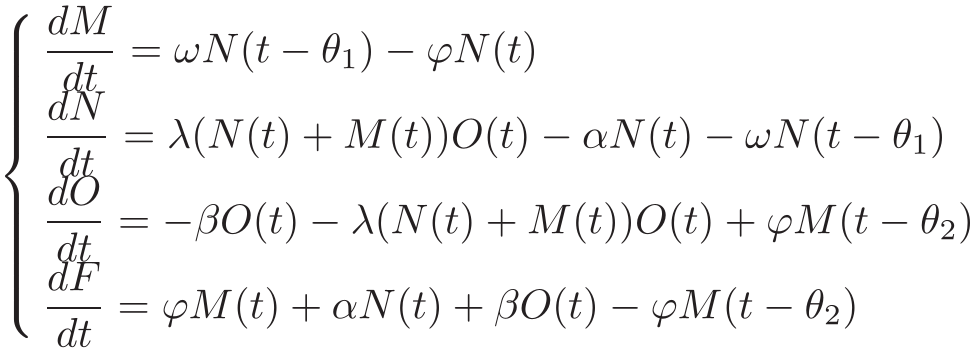 The mathematical core of the NOSDT model, governing node state transitions.
Experiments & Results: Resilience in Testing
The authors utilized the Opportunistic Network Environment (ONE) simulator with 1,000 nodes across a area.
Key Findings
- Delivery Ratio vs. Time: As the simulation progresses, NOSDT’s delivery ratio continues to climb, while protocols like Epidemic flatline. This is because NOSDT "cleanses" the network over time by labeling and avoiding malicious entities.
- Cache Management: One of the most significant results is how NOSDT handles limited resources. As node cache increases to 40MB, NOSDT achieves a significantly higher delivery ratio than EIMST or MaxProp, proving that its "social filtering" prevents the cache from being clogged with malicious "junk" packets.
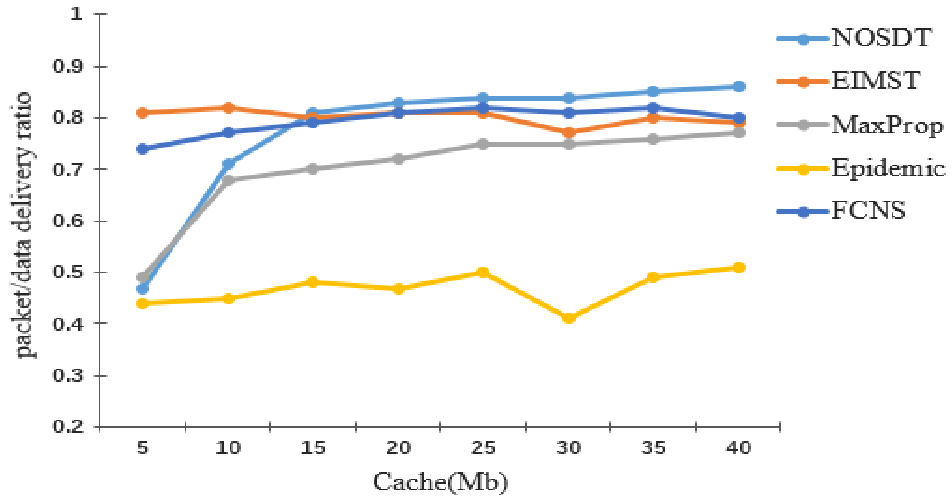 Figure 4: Impact of cache size on delivery performance. NOSDT maintains a clear lead as resources scale.
Critical Analysis & Conclusion
Takeaway
NOSDT essentially treats network security as a population dynamics problem. By focusing on the "nature" of the node rather than just the packet, it creates an adaptive defense mechanism that actually gets stronger as more network interactions occur.
Limitations & Future Work
While robust, the current model assumes a degree of randomness in parameter values (, etc.). In real-world scenarios, these parameters might be influenced by targeted sophisticated attacks rather than random distributions. The authors suggest that future work should focus on mapping specific forwarding paths and analyzing the "impact range" of malicious nodes to refine detection further.
Final Thought: For engineers building decentralised IoT applications, NOSDT provides a compelling framework for thinking about security not as a peripheral firewall, but as an inherent property of node interaction and social evolution.