
OR-LKL: Accelerating and Securing Social Learning via Observation Reuse and Soft Switching
Non-Bayesian Social Learning with Observation Reuse and Soft Switching
This paper introduces the Observation Reusing Least Kullback-Leibler (OR-LKL) algorithm, a non-Bayesian social learning framework that improves convergence speed by reusing the M most recent observations. It further proposes a robust variant (ROR-LKL) utilizing a soft switching mechanism between two independent networks to mitigate the impact of misinforming agents.
TL;DR
Non-Bayesian social learning offers a scalable way for networked agents to reach consensus on a hypothesis, but it usually suffers from sluggish convergence and vulnerability to malicious nodes. This paper introduces OR-LKL, which reuses recent historical data to achieve an speedup, and ROR-LKL, a robust architecture that switches between parallel networks to bypass misinformation.
Problem & Motivation: The Speed-Robustness Trade-off
In social learning, agents aim to identify which hypothesis best explains the world. While Bayesian methods are optimal, they are computationally intractable and require global knowledge of the network. Non-Bayesian rules are simpler but often "live in the moment," discarding previous observations immediately after an update.
The authors identify two critical gaps:
- Efficiency Gap: Using only the current observation ignores the rich information in the recent past, leading to slow belief concentration.
- Security Gap: A single "misinforming agent" can bias the entire network's belief by injecting corrupt likelihoods, making the system brittle in adversarial settings.
Methodology: The Power of Multi-Observation Optimization
The core innovation is the Observation Reusing LKL (OR-LKL). Instead of a single-step update, the agent minimizes the KL divergence relative to a window of the most recent observations:

The physical intuition here is that by providing the optimizer with more "constraints" (more data points), the resulting belief is pushed much more aggressively toward the optimal hypothesis set.
Achieving Robustness via Soft Switching
To handle misinforming agents, the authors propose Robust OR-LKL (ROR-LKL). The system maintains two social networks ( and ) that update independently. A "gateway agent" uses a convex combination parameter to merge their beliefs. If one network is compromised, the gateway uses a specialized version of the OR-LKL update (formula 13) to automatically shift the weight toward the healthy network.
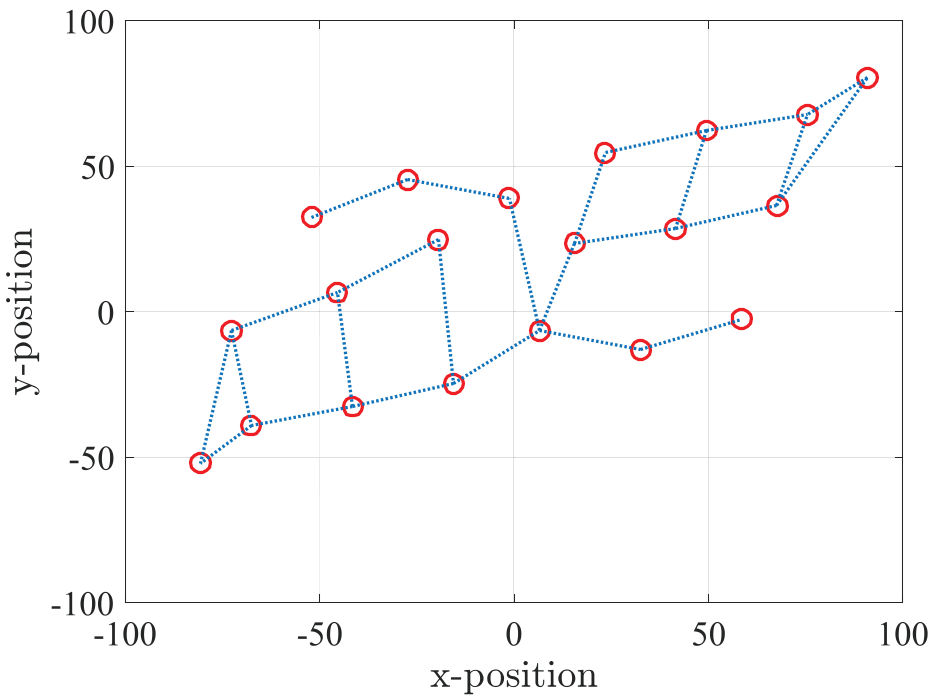 Fig 1: A representative social network configuration for the location identification task.
Experiments & Results: in Action
The authors tested their approach on a 2D source localization problem with 400 candidate grid points and 20 agents.
1. Superior Convergence Speed
Comparing OR-LKL against the standard Least KL (LKL) and Social Learning via Diffusion (SLD), the results show a massive lead in convergence depth (measured by Average KL Divergence).
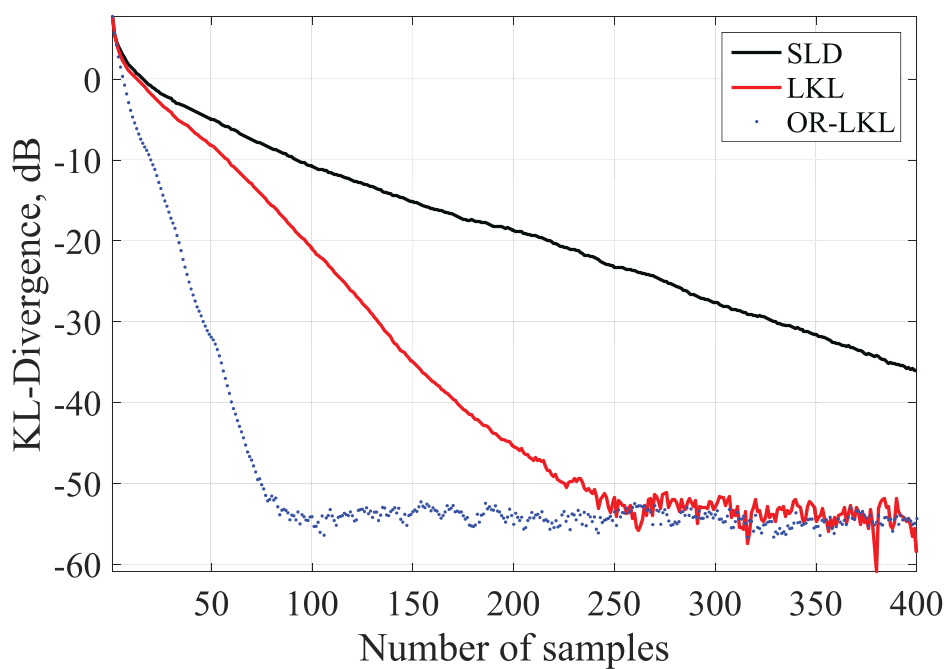 Fig 3: Note the significantly steeper decline of the OR-LKL (solid blue line) compared to standard LKL and SLD.
2. Resilience to Attacks
In scenarios where Network 1 and Network 2 were alternately attacked by misinforming agents, the ROR-LKL global belief successfully tracked the true hypothesis by "switching" away from the infected network.
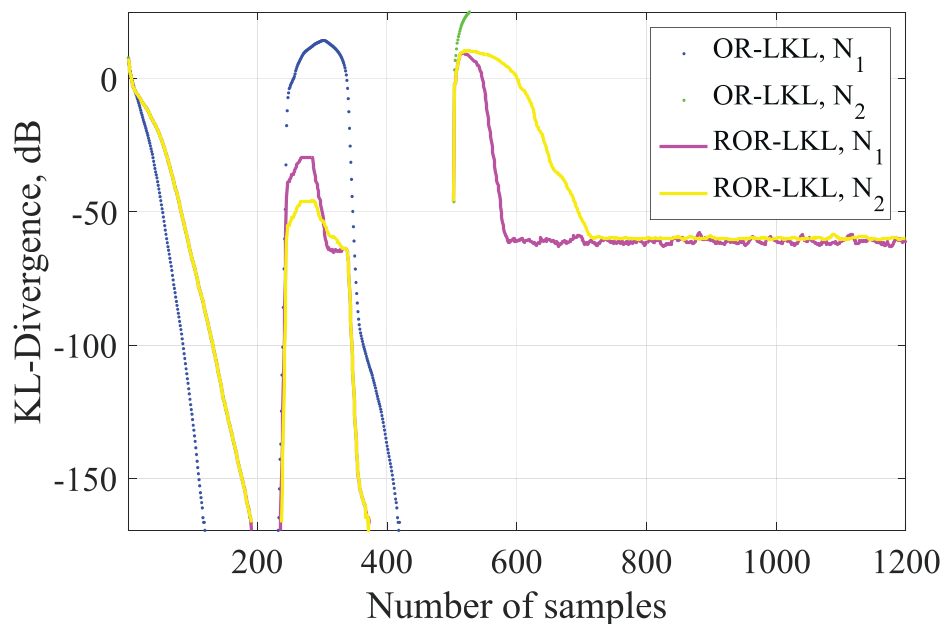 Fig 5: This demonstrates the system's ability to maintain low KL divergence even when sub-networks are being misled (spikes in local network beliefs).
Critical Analysis & Conclusion
Takeaway
OR-LKL proves that data-reusing, a technique borrowed from adaptive filtering, is remarkably effective in the distributed social learning context. The speedup makes this algorithm highly suitable for real-time signal processing where decisions must be made rapidly.
Limitations
- Gateway Reliability: The ROR-LKL assumes a "gateway agent" or a central processing unit that is honest. In a purely peer-to-peer ad-hoc network without such a node, the switching mechanism would need a decentralized consensus protocol.
- Memory Overhead: Agents must now store observations and their likelihoods for each hypothesis, which might be a constraint for memory-limited IoT sensors.
Future Outlook
This work opens the door for Active Social Learning, where agents might not just reuse old data but selectively choose which historical "memories" to emphasize to reach consensus even faster or resist more sophisticated "Sybil attacks."