
Beyond Metadata: Decoding Video Spam Through Visual Context and Latent Semantics
Non-collaborative content detecting on video sharing social networks
This paper introduces a novel visual content-based framework for detecting non-collaborative videos (ballot stuffing and spam) in social networks using the Bag-of-Topic-Differences (BoTD) approach. By combining SIFT features, Bag-of-Visual-Features (BoVF), and Latent Semantic Analysis (LSA), the method achieves an AUC of up to 95% in identifying context-dependent spam.
TL;DR
In the era of massive video sharing, "ballot stuffing" and "spam" pollute recommendation algorithms and user experience. This paper shifts the detection paradigm from analyzing who posted the video to analyzing what is inside the video. By introducing Bag-of-Topic-Differences (BoTD), the authors demonstrate that we can identify context-dependent spam with over 95% accuracy by measuring how much a response "deviates" visually from the original thread starter.
The Problem: When "Good" Videos Become "Spam"
Spam detection in social networks is notoriously difficult because it is context-dependent. A recipe for asparagus is perfectly legitimate in a cooking thread, but it becomes "spam" when posted as a response to a "Worldwide Hug Campaign."
Existing SOTA methods at the time focused on user profiles or metadata (tags, titles), which are easily spoofed. The authors identify a critical gap: nobody was looking at the actual pixel data to determine if a video-response actually belonged to the conversation.
The Solution: Bag-of-Topic-Differences (BoTD)
The researchers proposed a three-layered approach to bridge the "semantic gap":
- Low-Level Extraction: Using SIFT (Scale-Invariant Feature Transform) to capture local shapes and textures regardless of lighting or rotation.
- Mid-Level Representation (BoVF): Clustering these SIFT descriptors into "visual words" to create a histogram of the video's content.
- High-Level Context (BoTD): This is the secret sauce. Instead of just classifying the histogram, the system calculates the vector difference between the response and the "Original Video" (the landmark). This "recentralization" allows the SVM (Support Vector Machine) to learn what "irrelevance" looks like across different topics.

Why Latent Semantic Analysis (LSA)?
The authors didn't stop at simple differences. They applied LSA (via Singular Value Decomposition) to the visual words. This helps find "hidden topics"—for example, realizing that a "wheel" visual word and a "road" visual word often co-occur in automotive threads, even if the specific pixels differ.
Benchmarking the "In-The-Wild" Reality
The authors tested their method against 11,277 real YouTube videos. The results highlight a massive performance leap when context is introduced.
- Ballot Stuffing (Popularity Inflation): Because stuffing videos are often repetitive or low-quality (see Fig 1 below), a simple Bag-of-Visual-Features (BoVF) achieved an 85% AUC.
- Spam Detection: The context-free approach failed miserably (58% AUC), barely better than a coin flip. However, the BoTD approach reached 93.4% AUC, proving that the "difference" vector effectively encodes semantic irrelevance.
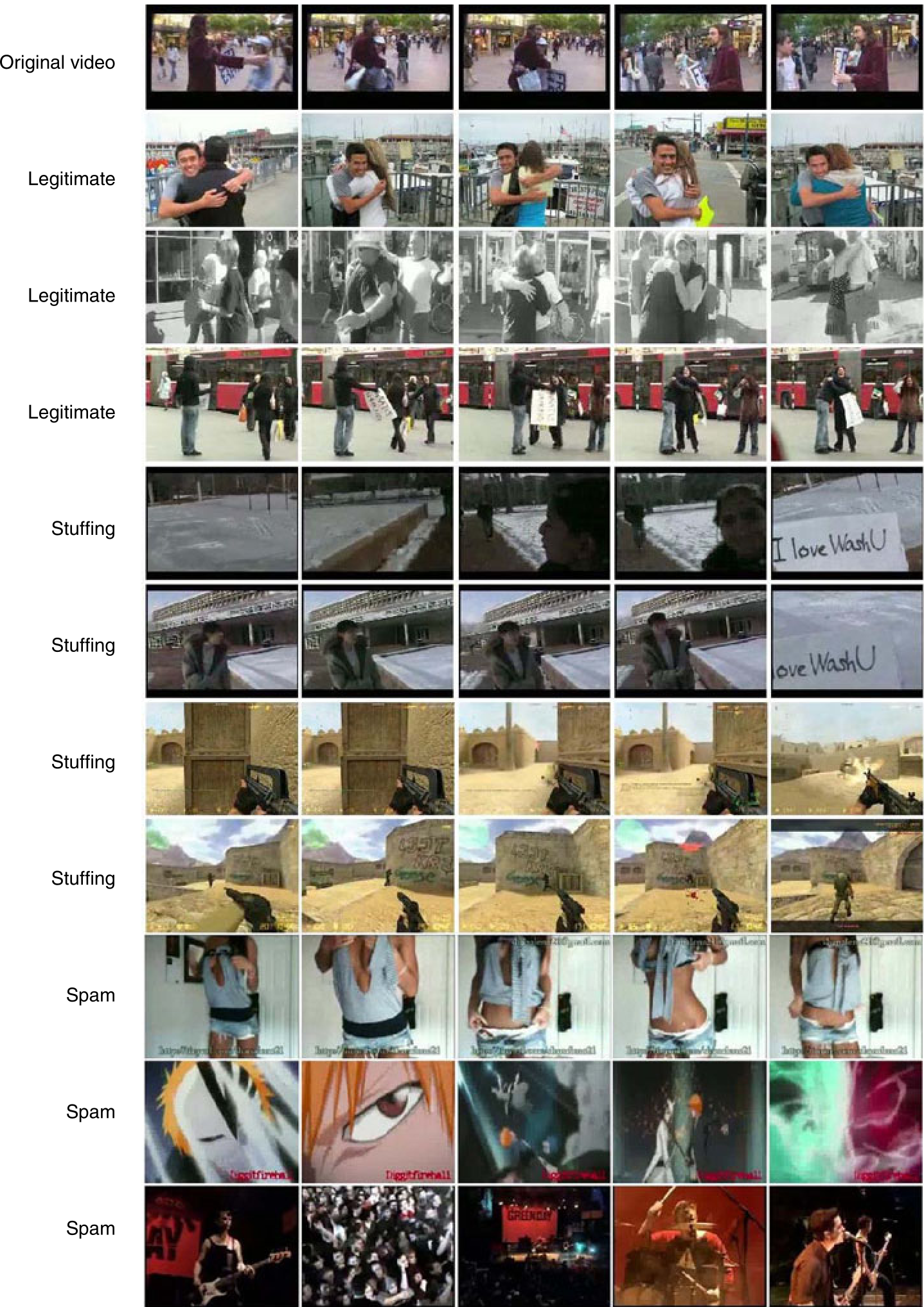 Fig 1: Notice how stuffing videos are visually stagnant, while spam is visually rich but semantically "off-topic."
Critical Insights & Future Outlook
While the BoTD method is highly effective, the authors remain realistic:
- The Precision Trade-off: At this stage, the False Positive Rate isn't low enough to delete videos automatically. It’s best used as a "flagging" system for human moderators.
- Visual-Only Limitation: The study focused solely on visual signals to prove their worth. In a production environment, combining this with audio and metadata would likely push accuracy even closer to the 100% mark.
Final Takeaway
This paper serves as a foundational reminder that in information retrieval, context is king. By transforming the problem from "What is this?" to "How different is this from the source?", the authors provided a robust blueprint for moderating increasingly complex social ecosystems.
Experimental Validation
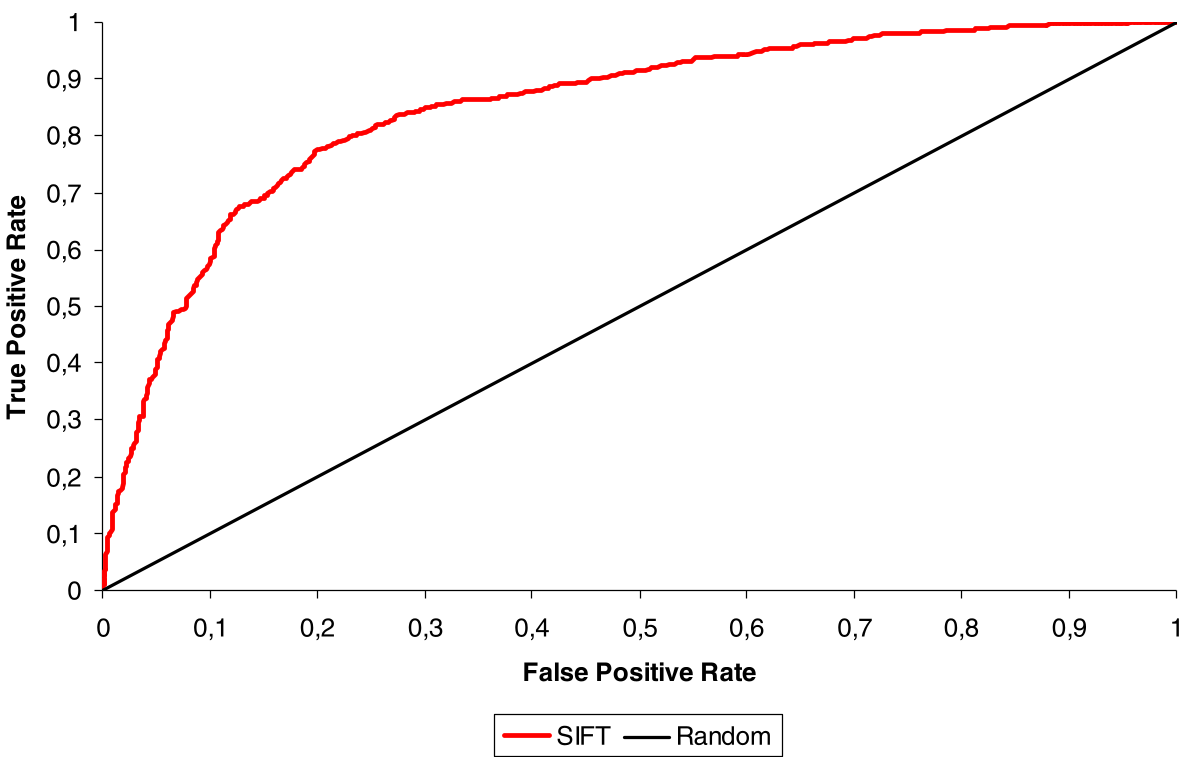 The ROC curve above illustrates the clear superiority of BoTD (top curve) over context-free methods in identifying spam.