
Beyond the Pulse: Non-Fiducial PPG Authentication for Secure Healthcare
Non-fiducial PPG-based authentication for healthcare application
This paper introduces a robust photoplethysmography (PPG) based authentication system for healthcare applications, shifting from traditional landmark-based methods to a non-fiducial approach using Coiflet wavelet transforms. By employing a two-step feature selection (KS-test and Kernel PCA) alongside unsupervised learning (k-NN), the method achieves a state-of-the-art accuracy of 99.84% and an Equal Error Rate (EER) of 1.31%.
TL;DR
Authentication in healthcare is moving beyond passwords to biometrics. This paper presents a breakthrough in Photoplethysmography (PPG)—the tech behind your smartwatch's heart rate sensor. By abandoning the struggle to find specific "landmarks" in messy pulse waves and instead using Non-Fiducial Wavelet Analysis, the researchers achieved a near-perfect 99.84% accuracy.
Problem & Motivation: The Fragility of Landmarks
Most biometric systems look for specific points: the ridge of a fingerprint or the notch in a pulse. In PPG, these are called fiducial points (like the dicrotic notch or diastolic peak).
However, the "perfect" pulse wave is a myth in clinical reality. Factors like aging, blood pressure, and motion noise can cause these notches to flatten or disappear entirely. If the algorithm can't find the notch, it can't verify the user. This "Fiducial Dependency" is the primary bottleneck for making PPG a reliable security standard.
Methodology: A Holistic View of the Waveform
The authors argue that the entire shape of the wave holds the identity, not just a few peaks.
1. Feature Extraction via Coiflet Wavelets
Instead of measuring distances between peaks, the system uses Discrete Wavelet Transform (DWT). They settled on the Coiflet mother wavelet, which decomposes the PPG signal into approximation (CA) and detailed (CD) coefficients. This captures both the general rhythm and the subtle, unique "jitters" of an individual's blood flow.
2. The Two-Step Refinement
Raw wavelet data is bulky and redundant. The paper introduces a sophisticated pipeline:
- KS-test Correlation Filter: Removes features that are too similar to each other.
- Kernel PCA (KPCA): Projects the data into a 10-dimensional space, capturing non-linear relationships that standard PCA would miss.
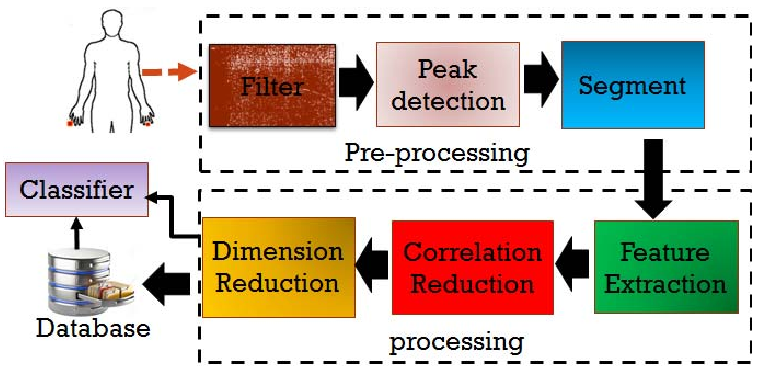 Figure 1: The proposed workflow from signal acquisition to 10D feature vector classification.
Experiments & Results: Crushing the Baseline
The study compared supervised (SVM) and unsupervised (k-NN, SOM) learning across 42 subjects from the Capnobase dataset.
The results were conclusive:
- Accuracy: Non-fiducial features hit 99.84%, while fiducial methods lagged behind at ~93%.
- Stability: The standard deviation for fiducial methods was a staggering 15.59, indicating they fail miserably on certain "noisy" subjects. Non-fiducial methods maintained a tight 2.6 deviation.
- The Winner: Unsupervised k-NN provided the best balance, proving that clustering the density of wavelet features is more effective than trying to draw a hard hyperplane with an SVM.
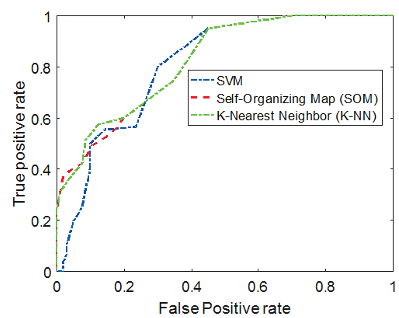 Table 1: Note the massive jump in Equal Error Rate (EER) of 1.31% (Non-Fiducial) vs 9.53% (Fiducial) for KNN.
Critical Insight & Future Outlook
The core "Aha!" moment here is that signal morphology is more robust than pulse landmarks. By using Coiflets and KPCA, the system builds a "biometric signature" that is resistant to the physiological changes that typically break PPG sensors.
Limitations: The study uses static data from healthy subjects. In a real healthcare scenario, we need to see how this holds up under acute physiological stress (e.g., a patient in pain) or high-intensity movement (Motion Artifacts).
Future Impact: This paves the way for "Continuous Authentication." Imagine a doctor wearing a wristband that keeps them logged into a medical terminal as long as their unique pulse is detected, instantly locking the screen the moment they walk away.