
Beyond Keywords: Decoding the Emotional DNA of Music Retrieval
12232_Non Keyword-Based Music Retrieval Using Social Tags.
The paper introduces a semantic-based music retrieval system designed to bridge the "Semantic Gap" between low-level audio features and high-level emotional concepts. By mapping musical characteristics to Russell's Circumplex Model of affect, the system enables users to query music libraries using natural language mood tags (e.g., "happy," "calm") rather than just metadata or keywords.
TL;DR
Music is inherently emotional, yet our search engines are often stuck in the "metadata era." This paper proposes a system that bridges the Semantic Gap by mapping acoustic features to a psychological emotional space (Valence-Arousal). The result? A retrieval system that understands that a "happy" song is defined by its rhythm and harmony, not just whether the word "happy" appears in its title.
The "Semantic Gap" in Music
Why is it so hard to find "relaxing music" without relying on user-generated tags? The fundamental problem is the discrepancy between low-level audio signals (frequencies, decibels) and high-level human concepts (joy, melancholy). Previous keyword-based systems are brittle—they only work if a human has manually tagged the song. If a song is "sad" but not tagged as such, it remains invisible to the user.
Methodology: Mapping Affect to Acoustics
The authors utilize Russell’s Circumplex Model, a 2D coordinate system where the horizontal axis represents Valence (Pleasure) and the vertical axis represents Arousal (Energy).
The Workflow:
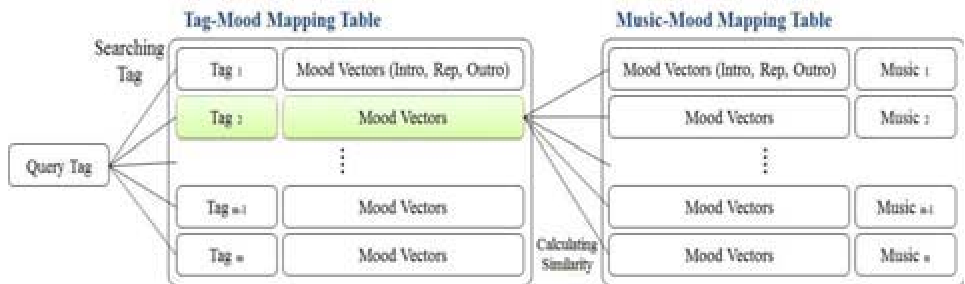
- Feature Extraction: The system analyzes the song in segments—Intro, Representation (the main body), and Outro—recognizing that emotional intensity shifts over time.
- Psychological Mapping: Musical properties (tempo, mode, timbre) are translated into V-A coordinates.
- Semantic Calculation: When a user searches for "Happy," the system looks for tracks whose V-A coordinates fall within the "High Valence, High Arousal" quadrant.
Performance: Can Machines Feel the Groove?
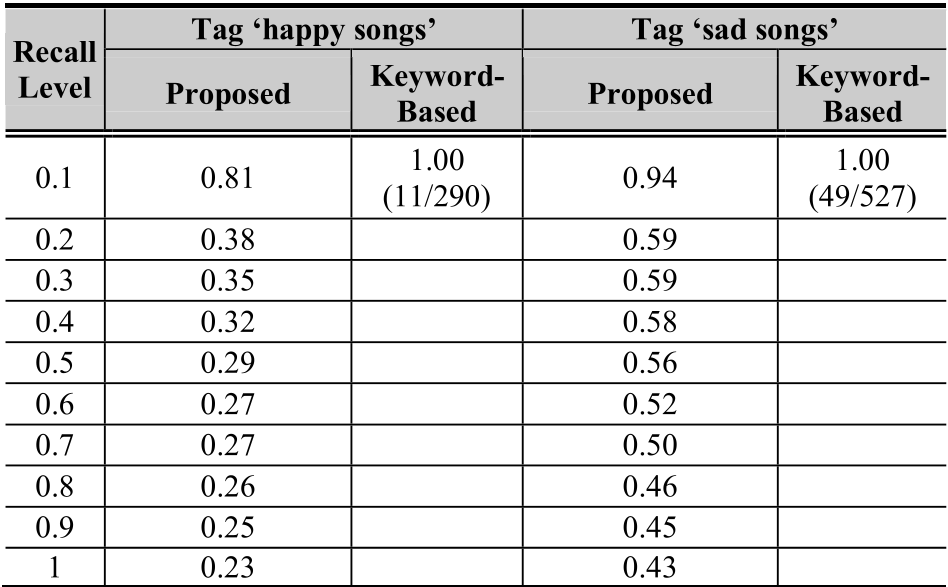
The results demonstrate a massive leap in Recall (the ability to find all relevant songs) compared to keyword matching.
Key Findings:
- Keyword Limitations: For "happy songs," the keyword approach had a precision of 1.0 but a dismal recall—it only found 11 out of 290 songs.
- Proposed System Advantage: The proposed mapping reached a recall of 0.81 at a 0.1 recall level, identifying hundreds of relevant tracks that lacked explicit tags.
- Segmentation Matters: The "Representation" (middle part) of the song was found to be the most reliable indicator of the overall mood, though the combination of all parts provided the most robust results.
Precision Across Moods
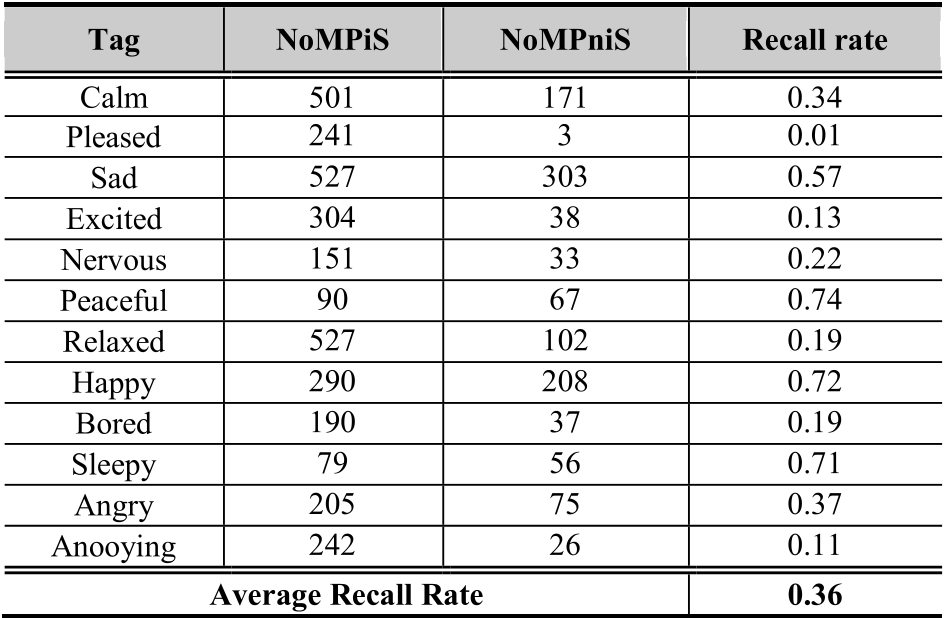
Not all emotions are created equal in the eyes of an algorithm. The system excelled at identifying:
- Peaceful: 0.74 Recall
- Happy: 0.72 Recall
- Sad: 0.57 Recall
However, it struggled with "Pleased" (0.01) and "Annoying" (0.11), suggesting that subtle or highly subjective emotions still require more granular acoustic descriptors.
Conclusion and Future Outlook
This work represents a vital step toward Affective Computing in music. By grounding retrieval in psychological models rather than just text, we move closer to a future where AI understands the soul of a composition.
Future Directions:
- Integrating Lyrics Analysis: Adding NLP to the audio analysis to resolve ambiguities in mood.
- Personalized Weights: Recognizing that "Happy" for one listener might be "Annoying" for another, allowing the V-A mapping to adapt to individual preferences.
Final takeaway: The future of music discovery isn't in better tags—it's in better understanding the relationship between sound and the human heart.