
NLCD: Decoding the Non-Linear DNA of Student Success in E-Learning
Non-linear Correlation Techniques in Educational Data Mining
This paper introduces the Non-linear Correlation Discovery (NLCD) algorithm for Educational Data Mining (EDM), specifically targeting Course Management Systems (CMS). By utilizing bitwise "AND" operations and boolean sequences, it identifies complex positive and negative correlations between student behaviors and learning outcomes, achieving high-confidence association rules (e.g., 90% confidence in assignment correlations).
TL;DR
As online education shifts from simple content delivery to complex Course Management Systems (CMS), the data produced by students has become a goldmine for pedagogical insight. This paper presents the Non-linear Correlation Discovery (NLCD) algorithm, a method that uses bitwise logic and boolean sequences to uncover hidden patterns in student behavior. By analyzing logs from South China Normal University, the authors demonstrate how specific digital footprints (like the synergy between reading and forum discussions) directly correlate with high academic performance.
The Motivation: Why Linear Mining Fails Education
Traditional data mining often treats student attributes as independent variables or simple linear chains. However, learning is inherently non-linear. A student's success isn't just about "how many times they logged in," but the synchronicity of their actions—reading, then discussing, then attempting an assignment.
Existing tools often struggle with:
- Context Blindness: General algorithms don't account for the pedagogical sequence of a course.
- Dimensionality: Educational logs are messy, containing IPs, timestamps, and diverse activity types that are hard to relate.
Methodology: The Core of NLCD
The authors propose a logic-based framework to quantify relationships. The "magic" happens through Definition 3: The correlation function of boolean sequences.
1. Boolean Mapping
Everything is converted into boolean sequences. For example, if a student possesses an attribute (like "Assignment Completed"), it's a 1; if not, it's a 0.
2. Bitwise Logical Synergy
By applying the logic "AND" () operation across these sequences, the algorithm identifies:
- Complete Positive Correlation: Actions that always move together.
- K-Negative Correlation: Specific instances where behaviors diverge.
3. The NLCD Workflow
The process follows a clean four-stage loop (see Figure 1 below): Data Collection Preprocessing Mining Interpretation.
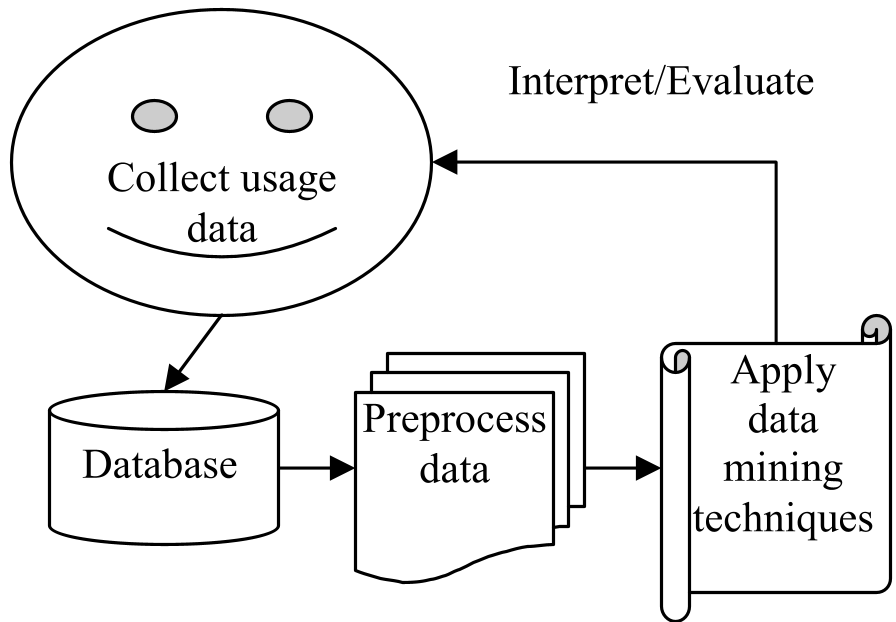 Figure 1: The standardized workflow for extracting pedagogical knowledge from CMS logs.
Experimental Evidence: What the Data Tells Us
The study used a real-world dataset (T1I5D10k) involving 378 students and 12 courses. By applying NLCD, researchers extracted high-value association rules that traditional observation might miss.
Key Finding 1: The "Success Triad"
The algorithm found that the combination of Reading (R), Discussing (D), and Excellent Performance (E) showed a support of 78% and a confidence of 89%. In plain English: active participation in social learning is a near-guaranteed predictor of an 'Excellent' grade.
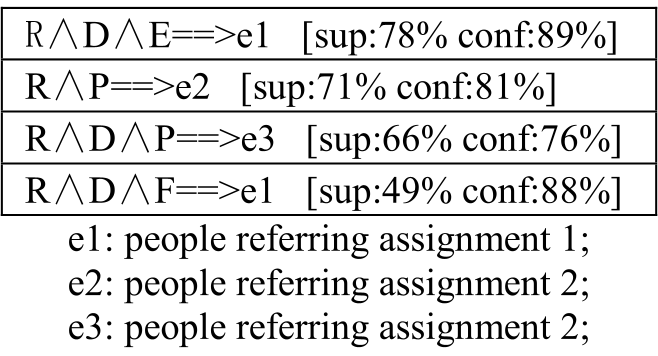 Table 6: Association rules showing the correlation between activity types and student grades.
Key Finding 2: Structural Correlation
The NLCD algorithm also identified strong links between specific assignments (e1 and e3). This suggests that some course tasks are conceptually linked, allowing instructors to redesign "bottleneck" assignments that might be hindering student flow.
Critical Analysis & Takeaways
Academic Professionalism & Insight: The NLCD algorithm's strength lies in its convergence and efficiency. By using boolean representations, it avoids the computational explosion often seen in traditional association rule mining (like Apriori) when dealing with dense educational logs.
Limitations: While highly effective at finding what is correlated, the paper does not yet explain why through causal inference. Furthermore, the reliance on manual discretization (setting cut-off points for Fail/Pass) introduces human bias into the preprocessing phase.
Future Outlook: This work paves the way for Adaptive Learning Systems. Imagine a CMS that notices a student has high "Reading" and "Discussion" sequences but a low "Assignment" sequence—the system could automatically trigger an intervention alert for the instructor before the student fails.
Conclusion: The shift toward non-linear correlation techniques marks a departure from descriptive statistics toward predictive pedagogy. For researchers and developers in the LMS/CMS space, NLCD provides a robust mathematical blueprint for building smarter, more responsive digital classrooms.