
The Fragility of Social Structures: How Non-Response Warps Network Blockmodels
Non-response in social networks: The impact of different non-response treatments on the stability of blockmodels
This paper investigates the impact of actor non-response on the stability of blockmodels in social networks. By comparing five missing data treatments—Complete-Case, Reconstruction, Modal Imputation, Null Tie Imputation, and a Hybrid approach—across simulated and real-world networks, the authors identify how different structural properties (specifically symmetry/reciprocity) dictate the most effective recovery strategy for maintaining position memberships and block structures.
Executive Summary
TL;DR: In social network analysis, a few "silent" participants (actor non-response) can completely derail the identification of underlying social structures. This paper demonstrates that there is no "one-size-fits-all" fix; whether you should delete missing actors or reconstruct their data depends entirely on the reciprocity of the existing network.
Academic Positioning: This work serves as a critical methodological audit. While most researchers focus on what a network looks like, this paper focuses on how our tools fail when the data is incomplete, providing a rigorous roadmap for treating missing data in positional analysis.
The Hidden Trap in Blockmodeling
Blockmodeling is the "macro-micro" bridge of network science. It groups individuals into positions (clusters) based on their patterns of ties, creating a simplified image of the social system.
The problem? Most data collection assumes actors are either present or absent. When an actor exists in the network boundary but refuses to answer a survey (Actor Non-Response), we lose an entire row of the adjacency matrix. The authors argue that simply "filling in zeros"—a common default in many software packages—is the most dangerous path, as it destroys the structural "signal" that blockmodeling relies on.
Methodology: The Simulation Framework
The authors didn't just speculate; they broke "known" networks to see how they could be fixed. They used two primary metrics to judge recovery:
- Adjusted Rand Index (ARI): Does the actor still end up in the correct cluster?
- ErrB (Error in Blocks): Is the global "image" (the type and location of blocks) still accurate?
They tested five treatments:
- Complete-Case (CC): Deleting the non-responders entirely.
- Reconstruction (RE): If Alice didn't say she likes Bob, but Bob says he likes Alice, assume Alice likes Bob back (forcing symmetry).
- Modal Imputation (MO): Filling gaps based on the incoming popularities (indegrees).
- REMO: A hybrid of Reconstruction and Modal imputation.
- Null Tie Imputation (NTI): The "Default" path—assuming no response means no tie.
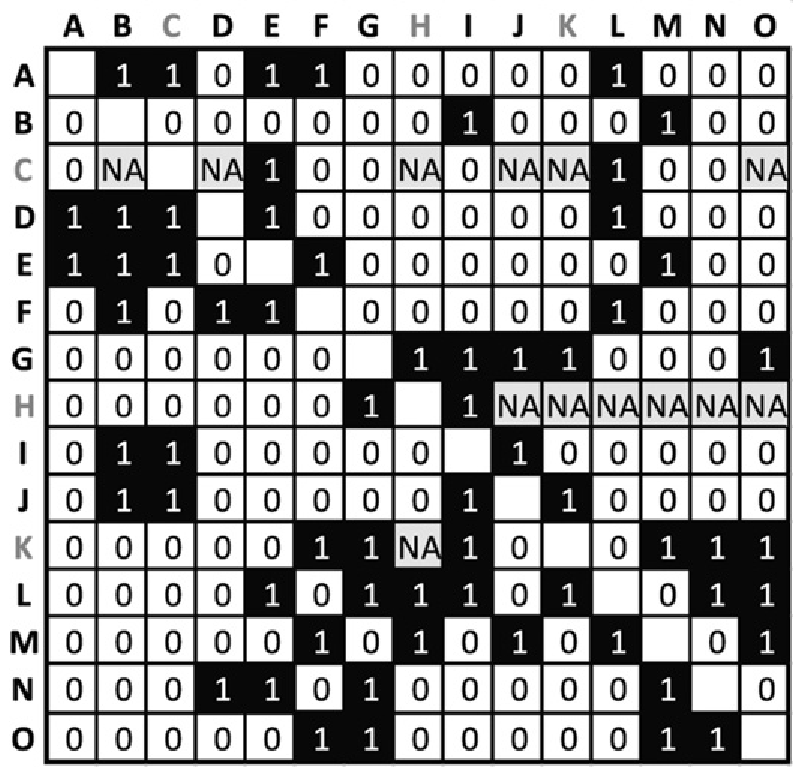 Figure 1: Distinguishing between Item Non-response (missing specific cells) and Actor Non-response (missing entire rows).
Key Insights: Symmetry is the Deciding Factor
The most significant finding of this research is the Interaction Effect between network symmetry and treatment success.
1. Symmetric Networks (e.g., Friendship, Liking)
In networks where "if I like you, you likely like me" (high reciprocity), Reconstruction is the king. By leveraging the reports of responders about non-responders, the structural integrity of the blockmodel remains remarkably stable even when 30-40% of actors are "silent."
2. Non-Symmetric Networks (e.g., Note Borrowing, Dominance)
In hierarchical or flow-based networks where ties are one-way, Reconstruction fails miserably. It introduces artificial symmetry that masks the true structure. In these cases, the Complete-Case approach (listwise deletion) actually performs best, as it preserves the "cleanliness" of the remaining sub-network.
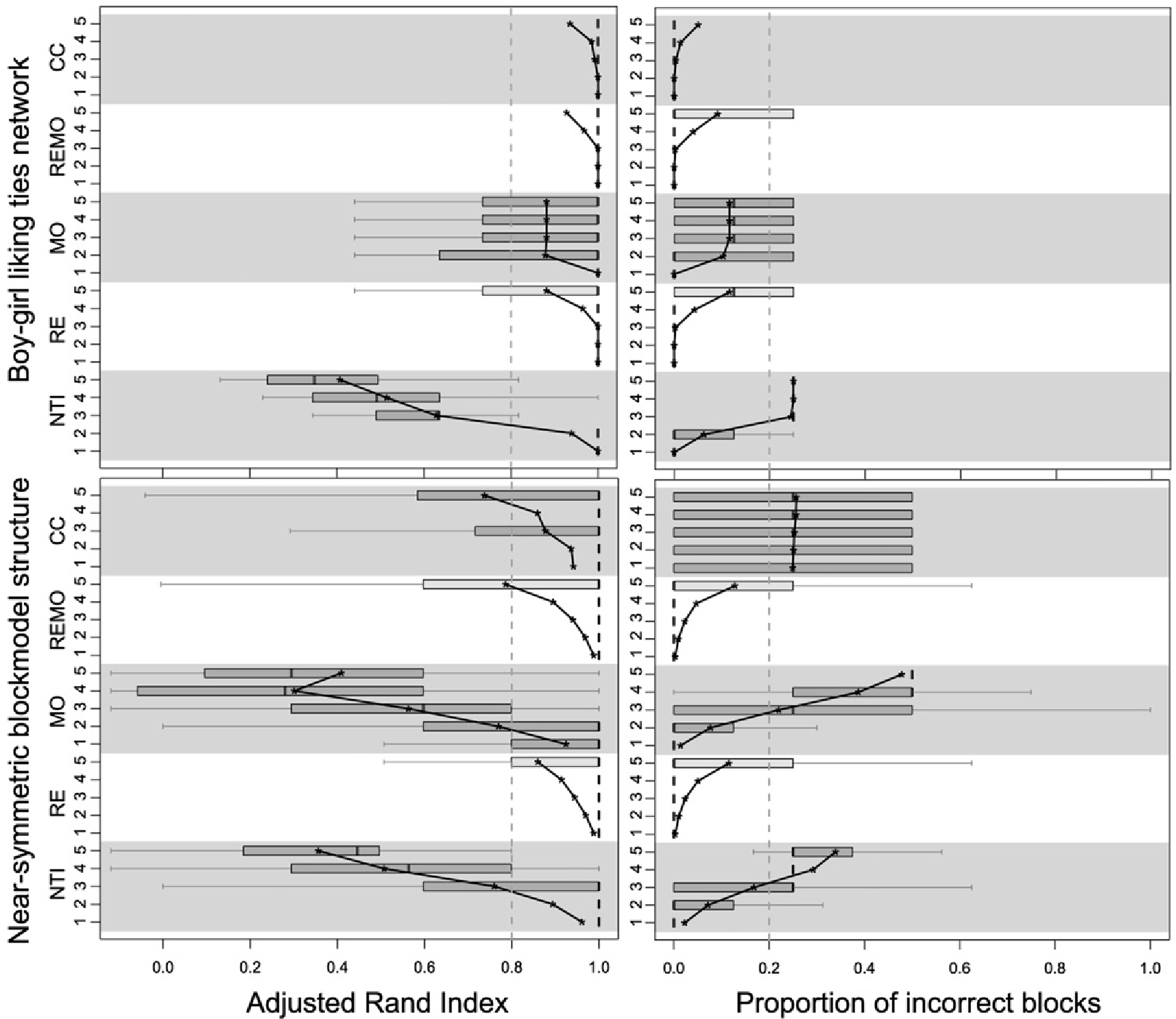 Figure 2: Boxplots showing how ARI (clustering accuracy) declines as the number of non-respondents increases across different treatments.
Critical Results: The "Never" and "When" of Data Treatment
Based on the ANOVA analysis (Table 3), the authors provide a clear hierarchy of effects:
- The "Never": Never use Null Tie Imputation. It consistently performed the worst regardless of network type.
- The "When":
- If Reciprocity > 0.7: Use Reconstruction.
- If Reciprocity < 0.5: Use Complete-Case analysis.
 Figure 3: A comprehensive guide: '+' represents optimal performance, '-' represents failure.
Conclusion: Navigating the Hazard
Blockmodeling incomplete networks is "fraught with hazard." This paper moves the field beyond simply reporting response rates to actively adjusting analysis strategies based on the nature of the ties being studied.
Future directions: The authors note that while structural equivalence is relatively robust, regular equivalence and generalized blockmodeling (more complex block types) are much more vulnerable to non-response. As we move toward larger, noisier datasets, these fundamental checks on "structural stability" will become the gatekeepers of valid social science.
Takeaway for Practitioners: Before you run your partition, check your reciprocity index. It is the compass that tells you how to treat your missing data.