
The Convenience Paradox: Why We Trade Privacy for a Smoother Digital Experience
The Role of Non-social Benefits Related to Convenience: Towards an Enhanced Model of User’s Self-disclosure in Social Networks
This paper presents an enhanced research model of user self-disclosure in social networks, primarily introducing the "Convenience-Privacy Calculus." It identifies and integrates non-social benefits—personalization, entertainment, and safety—as critical motivators alongside traditional social rewards.
TL;DR
Despite the known risks of identity theft and data misuse, billions share their personal lives on social networks. While previous research attributed this to "social rewards," this paper reveals a hidden driver: Non-social Convenience. By integrating personalization, entertainment, and security into an enhanced Privacy Calculus model, the authors explain how the "one-click" ease of modern platforms effectively tips the scales in favor of self-disclosure.
Beyond Socializing: The Hidden Motivation
In the traditional view of social networks, we share because we want to belong. We look for Reciprocity (the "I'll tell you if you tell me" dynamic) and Relationship Maintenance. However, this doesn't explain why people join platforms with no immediate social circle or why they share with total strangers.
The authors argue that we have reached a stage where social networks are no longer just communication tools; they are Utility Hubs. The motivation is shifting from "Who can I meet?" to "How easy is my life?"
The Enhanced Model: Social vs. Non-Social Benefits
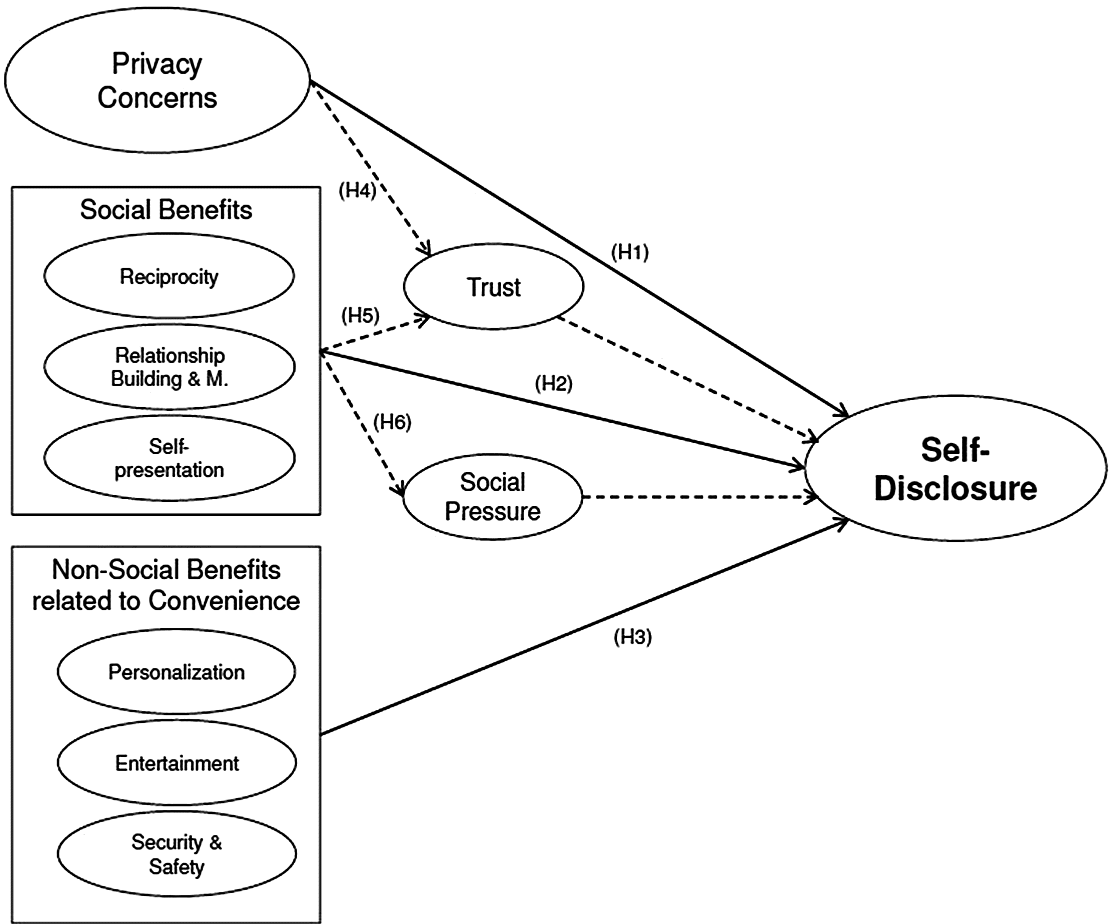
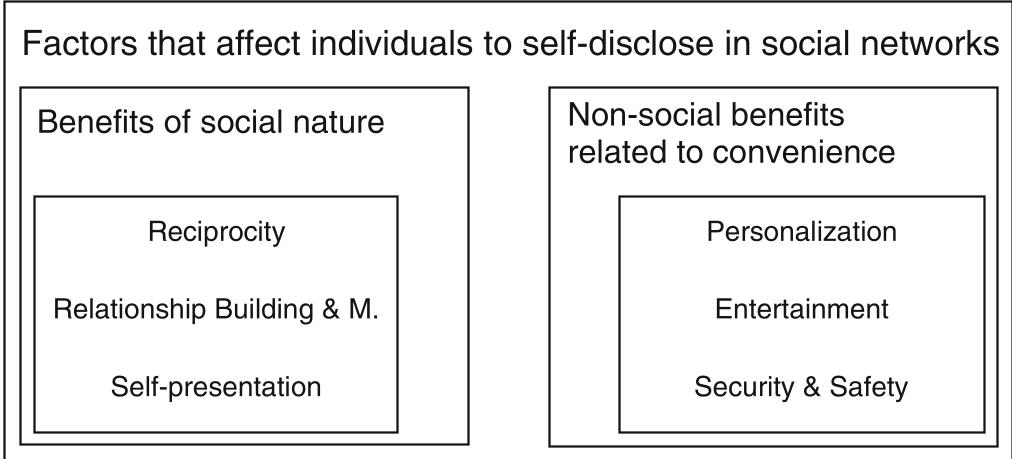
The core contribution of this work is the categorization of benefits into two distinct streams that feed into our internal "Privacy Calculus"—the mental ledger where we weigh risks against rewards.
1. Social Benefits (The Classic Drivers)
- Reciprocity: Building intimacy through mutual vulnerability.
- Self-Presentation: Managing the digital "mask" we wear to influence how others perceive us.
2. Non-Social Benefits (The Convenience Factor)
This is where the paper breaks new ground. Convenience is defined as the economization of time and effort.
- Personalization: Big Data analytics turn your private info into tailored content. Users actually prefer personalized communication because it cuts through the digital noise.
- Entertainment: Social networks are "purely hedonic." The convenience of having videos, music, and games in a single app (the "one-click" approach) is a massive disclosure driver.
- Security/Safety: Surprisingly, disclosing data can lead to a sense of safety, whether through platform-specific security features or the broader contribution to public safety monitoring.
The Role of Mediators: Trust and Social Pressure
The paper doesn't just look at benefits; it looks at the "glue" that holds the model together:
- Trust: Acts as a buffer. If you trust the provider, your Privacy Concerns (H1) feel less threatening, making disclosure easier.
- Social Pressure: Even if the personal benefit is low, the fear of missing out (FOMO) or group expectations can force a hand in sharing information.
Critical Insight: The Big Data Trade-off
The authors highlight a fascinating circular logic in modern IS: Personalization comes at the price of an increased privacy trade-off. To get the convenience of a "smart" feed, you must feed the machine more data. The paper notes that 90% of users are "lurkers" (passive consumers). For these users, the Non-social Benefits (entertainment and personalization) are likely the primary reason they stay on the platform, not social interaction.
Future Outlook and Limitations
While the model is logically robust, it is currently theoretical. The authors call for empirical testing beyond the typical "student sample" to see if older generations or working professionals value convenience over privacy in the same way.
As we move toward an era of AI-integrated social platforms, the "Convenience" factor will likely become the dominant variable in the self-disclosure equation. The question remains: at what point does the cost of privacy exceed the value of a curated feed?
Takeaway for the Industry
If you are building a platform, don't just focus on "connecting people." Focus on reducing friction. Convenience is the most efficient way to encourage user participation, often more effective than traditional social features.