
Beyond Diminishing Returns: Mastering Crowd Influence in Social Networks
17071_Non-Submodularity and Approximability Influence Maximization in Online Social Networks.
This paper investigates the Social Influence Maximization Problem (SIMP) in hypergraphs to model "crowd influence" in Online Social Networks (OSNs). It proposes the Capped Greedy (CG) algorithm, which overcomes the non-submodularity of the problem, achieving a provable approximation ratio of 1 - e^(-1/(Δ+1)) by leveraging the structural properties of scale-free networks.
TL;DR
In the world of viral marketing, we usually assume that adding more "influencers" gives us diminishing returns. This paper argues that's wrong. Because of crowd psychology, group influence is often "super-additive." The authors model this using hypergraphs and provide a new set of algorithms that achieve SOTA performance on non-submodular influence tasks by exploiting the scale-free nature of social networks.
The "Crowd Psychology" Gap
Most social influence research relies on the Independent Cascade Model. In standard graphs, this model is submodular: the more seed nodes you have, the less "extra" value each new node adds.
However, the authors point out a critical human behavior: we are more likely to adopt a behavior if a group influences us simultaneously, rather than just isolated individuals. This is "Crowd Influence." In mathematical terms, this breaks submodularity. The marginal gain can actually increase as you add more seeds, making the problem significantly harder (NP-hard and theoretically inapproximable for general graphs).
Methodology: Taming the Hypergraph
To solve this, the researchers represent crowd influences as hyperedges. A hyperedge connects a set of "heads" (influencers) to a "tail" (the target). The influence only triggers if all heads are active.
The Secret Weapon: Supermodularity (Δ)
The authors define Supermodularity (Δ) as a measure of how much the problem violates submodularity.
- If Δ = 0, the problem is a standard submodular greedy task.
- In general hypergraphs, Δ can be huge.
- The Insight: In real-world OSNs (which follow a power-law distribution), they prove that Δ is small and grows much slower than the network size ().
The Algorithms
They propose two primary improvements over the Naive Greedy (NG) approach:
- Improved Greedy (IG): Instead of picking one node, it picks a node plus a subset of its "modularity set" (nodes that help it trigger hyperedges), achieving a ratio.
- Capped Greedy (CG): Further optimizes by testing different "caps" on the group size, pushing the approximation ratio to .
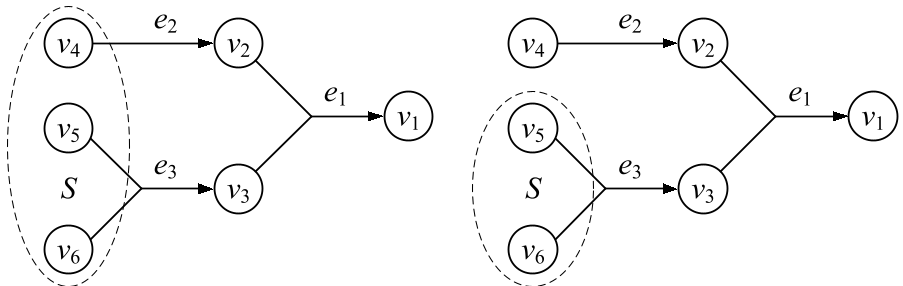 Fig 1: Reachability in Hypergraphs. Influence only flows if the entire "crowd" (head set) is influenced.
Experiments & Results
The authors tested their theories on real-world datasets like academic citations and online forums.
Performance Boost
The Capped Greedy (CG) algorithm consistently outperformed all baselines. Notably, it achieved ~20% more influence than the standard Naive Greedy algorithm used in industry today.
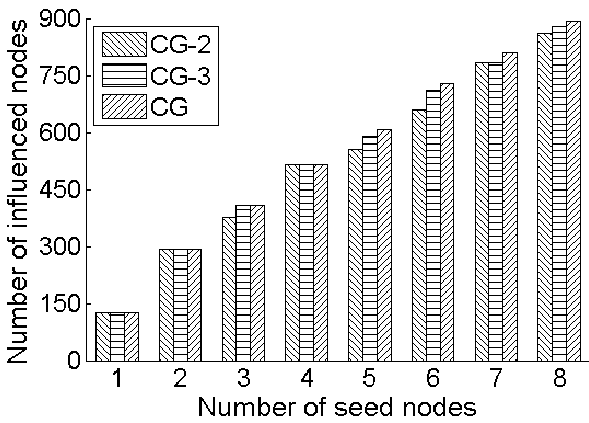 Fig 2: Comparison across Forum and Board datasets. CG (the top line) consistently reaches more users with fewer seeds.
The Efficiency Paradox
While CG is theoretically slow (exponential relative to Δ), the authors found that in real OSNs, humans rarely have more than 2-3 "critical" influential neighbors who act as a crowd. By capping the search at (CG-3), they achieved nearly identical results to the full algorithm but with a fraction of the compute time.
| Dataset | Naive Greedy | Capped Greedy | Performance Gain |
|---|---|---|---|
| Forum | 31m | 155m (CG-3) | +20% |
| Citation | 85m | 423m (CG-3) | +15% |
Critical Insight: Why This Matters
The real value of this paper isn't just a faster algorithm; it's the mathematical proof that social structures naturally limit complexity. Even though non-submodular problems are "impossible" in the abstract, the fact that our friends aren't randomly distributed (they form clusters and follow power laws) means we can use sophisticated set-based greedy strategies to optimize marketing campaigns that were previously thought too complex to model.
Limitations & Future Work
The current model assumes hypergraph weights are known, which usually requires significant historical data mining. Future research could investigate how to perform Online Learning of these hyperedges while simultaneously optimizing the seed set—a "Bandit" version of the hypergraph SIMP.