
Beyond the Triangle: Clique-Guided Clustering for Modern Social Networks
Non-TI Clustering in the Context of Social Networks
This paper introduces a clique-guided clustering approach designed for social networks where similarity measures often violate the Triangle Inequality (TI). By leveraging the Commuting Quantum Query Language (CQQL) for similarity measurement and the Bron-Kerbosch algorithm for clique detection, the method achieves more cohesive community structures than traditional distance-based algorithms.
TL;DR
In the complex web of social interactions, the "Triangle Inequality" is often a myth—just because you share a mutual friend doesn't mean you share a bond. This paper presents a novel clustering approach that abandons the rigid constraints of traditional Euclidean distance in favor of clique-guided structures and Quantum Logic-based similarity, effectively capturing the "messy" reality of social networks.
The "Triangle" Trap in Social Data
Most clustering algorithms (like K-medoids or DBSCAN) operate on a fundamental geometric assumption: the Triangle Inequality (TI). This rule states that the distance between two points cannot be greater than the sum of the distances through a third point ().
In social networks, this logic fails. Consider a "star" topology where a central friend connects two isolated groups and . In a TI-based system, if is close to and is close to , the system forces and to be somewhat close. This "forced proximity" results in clusters with low internal cohesion, where members have nothing in common despite being in the same group.
Methodology: The Quantum and Graph Logic
The authors solve this by introducing two key shifts in perspective:
1. CQQL: Moving Beyond Fuzzy Logic
Traditional Boolean logic is too binary, while Fuzzy Logic often suffers from "value dominance" (where a single high value drowns out nuances). The authors use Commuting Quantum Query Language (CQQL). By treating similarities as quantum conditions, they can aggregate multiple attributes (Gender, Major, Residence) into a similarity score that doesn't inherently obey TI.
2. From Distances to Cliques
Instead of calculating "centroids," the method treats the dataset as a graph.
- Thresholding: A similarity matrix is converted into an adjacency matrix.
- Maximal Cliques: Using the Bron-Kerbosch algorithm, the system identifies "cliques"—subsets of nodes where every single member is connected to every other member.
 Figure 1: Comparison between traditional distance clusters and social network "friendship" clusters.
Experimental Showdown: Single-Linkage vs. Non-TI
The researchers tested their approach against traditional SOTA baselines.
- Hierarchical (Single-Linkage): Suffered from the "chaining effect," where nodes were added to a cluster based on a single bridge, even if they were distant from the rest of the group.
- DBSCAN: Mixed disparate groups because the distance epsilon () was too permissive in non-TI space.
- Proposed Method: Successfully identified overlapping communities (where node belongs to multiple cliques), which perfectly mirrors real-world social dynamics where individuals inhabit multiple social circles simultaneously.
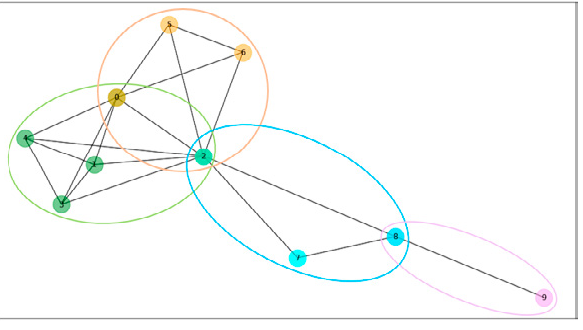 Figure 2: Dendrogram showing how traditional methods aggregate nodes vs. the cohesive clusters found by the Clique method.
Critical Insight & Future Outlook
The brilliance of this work lies in its admission that overlap is a feature, not a bug. In traditional K-means, an object must belong to one cluster. In this clique-guided approach, a node can bridge two communities, providing a much higher "Relational Fidelity."
Limitations: The primary bottleneck is the Bron-Kerbosch algorithm. Finding cliques is NP-hard, meaning this specific implementation may struggle with millions of users. However, the authors suggest "weakening" the clique condition in future work (e.g., using s-cliques) to improve scalability.
Conclusion
This paper serves as a vital reminder for data scientists: Don't force your data into a Euclidean box if it doesn't live there. By embracing non-TI similarity and graph theory, we can build social AI that understands communities as they actually exist—dense, overlapping, and beautifully complex.