
Automated 3D Behavioral Mapping: Rethinking Early Diagnostic Screening for Developmental Disorders
A nonintrusive system for behavioral analysis of children using multiple RGB+depth sensors
The paper introduces a non-intrusive behavioral analysis system for children using multiple Microsoft Kinect RGB+D sensors. By integrating 3D point cloud reconstruction with region covariance-based tracking, the system enables the automated monitoring of preschoolers to detect early neuromotor markers of developmental disorders like autism and schizophrenia.
TL;DR
Researchers have developed a non-intrusive system using multiple RGB+Depth (Kinect) sensors to automate the behavioral analysis of preschoolers. By reconstructing 3D trajectories and calculating spatial occupancy grids, the system provides clinicians with objective data to identify early neuromotor precursors of disorders like autism and schizophrenia, moving beyond the limitations of manual video annotation.
Background & Motivation: Beyond the Expert's Eye
Early intervention is the "holy grail" of developmental psychiatry. Historical research shows that subtle body movements, eye gaze speeds, and facial expressions in toddlers can predict the later onset of psychiatric conditions. However, the status quo is bottlenecked by "painstaking examinations": experts must manually watch and tag thousands of hours of raw 2D video.
Existing computer vision systems (like Pfinder or W4) often fail in this domain because:
- Erratic Motion: Children don't follow structured paths; they sit, twirl, crawl, and wrestle.
- Occlusions: In a busy classroom, children constantly hide behind furniture or each other.
- Dimensional Loss: 2D video collapses the complex 3D physics of neuromotor "soft signs" into flat pixels.
Methodology: Fusing 3D Point Clouds with Covariance Tracking
The authors deploy four Kinect sensors to the Shirley G. Moore Lab School. Their pipeline bridges the gap between raw depth data and behavioral insight through three critical phases:
1. 3D Space Reconstruction
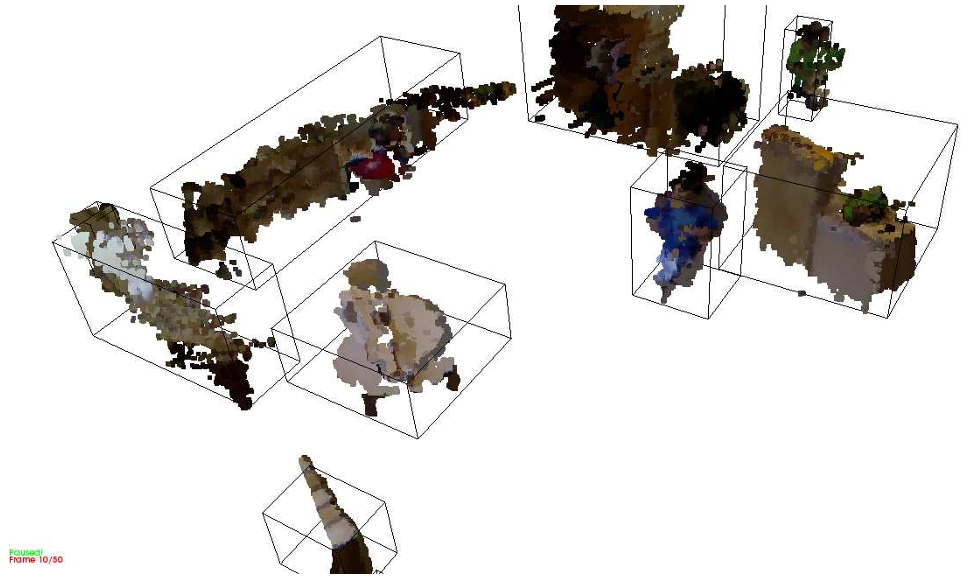
Since Kinects aren't hardware-synchronized (no genlock), the system uses a temporal binning algorithm (Equation 1) to align frames into 1/30th-of-a-second intervals. Using intrinsic camera matrices, it projects 2D pixels into a unified 3D inhomogeneous world point cloud ().
2. Multi-Stage Filtering and Segmentation
To isolate "targets" (children) from "noise" (chairs, floors), the system applies a 4-stage filter:
- Floor Removal: Z-axis height filtering.
- Voxel Downsampling: Discretizing space into 2cm³ cubes to reduce compute load.
- Outlier Removal: Removing sparse points using statistical distance thresholds.
- Euclidean Clustering: Grouping remaining points into 3D bounding boxes.
3. Log-Covariance Descriptor Tracking
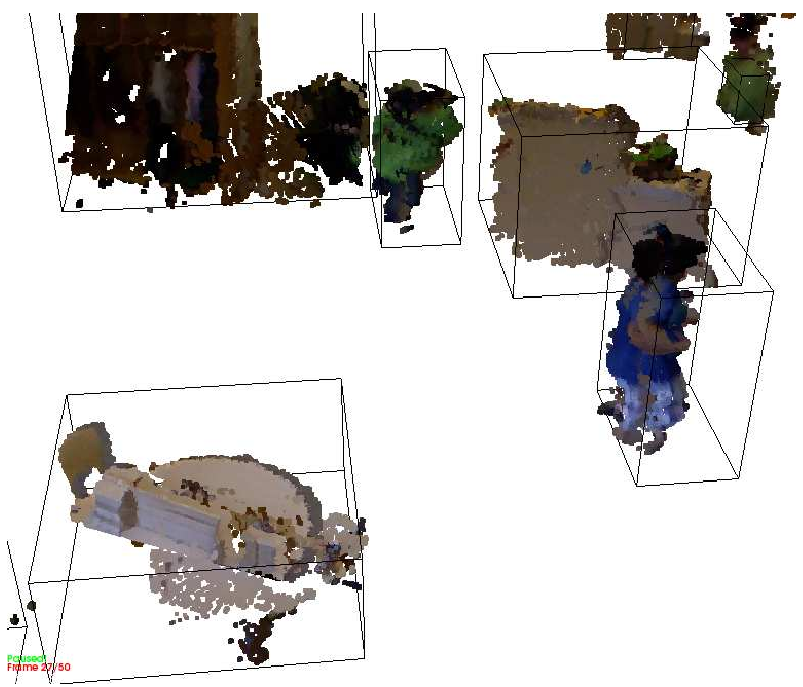
This is the system's "brain." Instead of just tracking a point, it calculates a 22-dimensional covariance matrix for each child, incorporating spatial coordinates, RGB color channels, and depth intensity.
To make this computationally feasible for real-time tracking, the authors compute the Log of the descriptor () to project it into a vector space suitable for Kalman Filter updates. This allows the system to recognize the same child even when they move from one sensor's field of view to another.
Results: Quantifying Repetitive Behavior
The system introduces the Occupancy Grid (), a matrix representing the ratio of a child's presence in specific tiles of the room. This is a direct mathematical proxy for identifying repetitive behaviors—a hallmark of OCD and Autism.
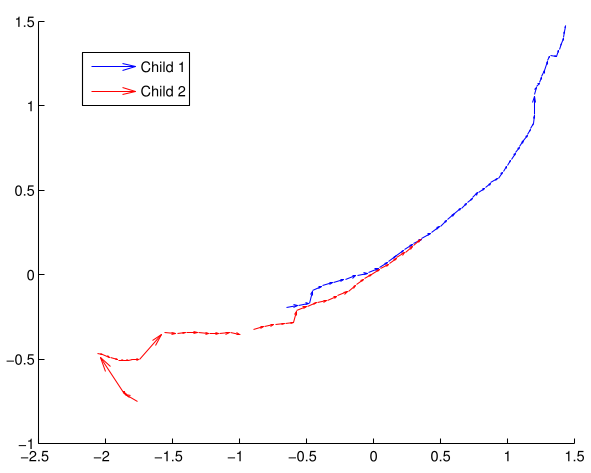
In experimental trials with two children running across a classroom, the system successfully:
- Maintained IDs across multiple sensors.
- Generated heatmaps showing "normal" vs. "stagnant" or "repetitive" movement patterns.
Strategic Insight & Future Work
The true value of this work lies in its scalability. By using inexpensive consumer hardware (Kinect), the authors have created a "data mining" pipeline for psychology.
Future Implications:
- Social Hierarchy Mapping: Using co-location data to analyze leader/follower dynamics.
- Articulated Movement Analysis: Moving from tracking "blobs" to tracking "limbs" to detect subtle tremors or choreoathetoid movements associated with schizophrenia.
- Multi-modal Expansion: Integrating audio to correlate verbal interactions with physical movement.
While the current system still faces challenges with temporal synchronization across separate hosts, it sets a robust foundation for a new era of "Quantitative Psychiatry," where diagnosis is based on thousands of hours of objective 3D data rather than brief, subjective clinical observations.