
Nonlinear Source Separation and Parameterized Fusion: Redefining Satellite Image Classification
Nonlinear separation source and parameterized feature fusion for satelite image patch exemplars
This paper introduces a holistic remote sensing classification framework that integrates Nonlinear Bayesian Source Separation, multi-scale feature fusion (Wavelet, Curvelet, and Gabor), and SVM classification. The core achievement is the transition from raw spectral band classification to latent source classification, achieving a SOTA accuracy of 89% on complex satellite patch exemplars.
TL;DR
Classic satellite image classification is often "blinded" by the inherent correlation between spectral bands. This paper proposes a sophisticated pipeline that first unmixes these bands using a Nonlinear Bayesian approach (via neural networks) and then fuses texture-rich descriptors (Gabor, Wavelets, Curvelets) using a parameterized weight model. The result? A jump from 64% to 89% classification accuracy on heterogeneous Tunisian landscapes.
Background Positioning
In the landscape of Remote Sensing (RS), we are moving from simple pixel-based analysis to complex patch exemplar classification. Current SOTA methods often struggle with the "nonlinear mixing" of land cover types. This work positions itself as a robust pre-processing and feature engineering breakthrough, proving that what you feed into a classifier (SVM) matters more than the classifier itself.
Problem & Motivation: The "Mixing" Headache
Why is satellite imagery hard to classify?
- High Correlation: Spectral channels often mirror each other's data, leading to redundancy.
- Nonlinear Interference: The way light reflects off a forest and is captured by a sensor isn't a simple linear sum; it's a complex, nonlinear physical phenomenon.
- Prior Work Limitations: Linear tools like PCA or JADE (Joint Approximate Diagonalization of Eigen matrices) simply cannot "untangle" these nonlinear dependencies.
The authors' intuition: If we can mathematically estimate the "pure" latent sources before extracting features, we provide the classifier with a much cleaner signal.
Methodology: The Source-to-Feature Pipeline
1. Nonlinear Bayesian Source Separation
The authors model the observation as a nonlinear function of latent sources : Using a two-layer perceptron and Bayesian inference, they minimize mutual information to recover independent Gaussian sources. This effectively "decorrelates" the data from a coefficient of 0.65 down to a near-perfect 0.03.
2. Multi-Scale Feature Fusion
Instead of picking one descriptor, the authors use a weighted triplet:
- Wavelets (): For multi-resolution analysis.
- Curvelets (): Specifically for capturing edge and contour information.
- Gabor (): For textural orientation.
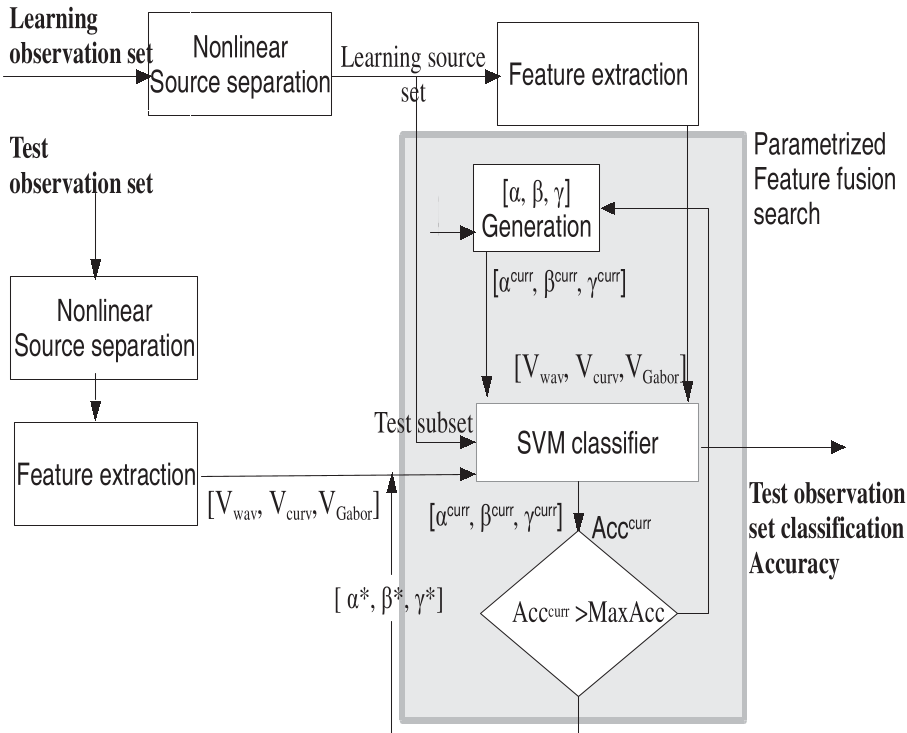 Fig 1: The proposed framework integrating source separation, extraction, and parameterized fusion.
Experiments & Results: Proving the Hype
The testing took place over the north-east of Tunisia, a region known for heterogeneous patterns like wetlands, urban areas, and agricultural parcels.
The "Source" Advantage
Before any complex fusion, just switching from Raw Bands to Latent Sources increased classification accuracy from 64% to 81%. This proves that Nonlinear Source Separation is a powerful "Information Purifier."
Finding the "Sweet Spot"
Through an iterative search, the authors discovered the optimal weighting for feature fusion:
- This specific configuration attained the peak accuracy of 89%.
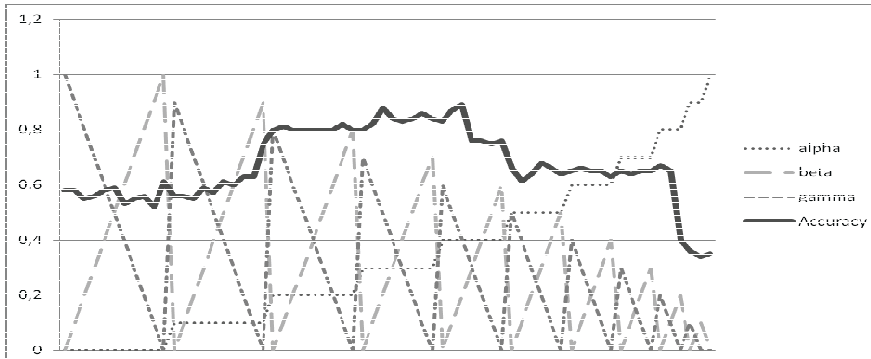 Fig 2: Classification accuracy across different coefficient sets for Wavelet, Curvelet, and Gabor features.
Critical Analysis & Conclusion
Takeaway
The paper successfully demonstrates that addressing the physical reality of nonlinear mixing in satellite sensors yields better results than simply applying a more "powerful" classifier to dirty data. The use of Source Separation as a pre-processing step is a significant takeaway for the RS community.
Limitations
- Computational Cost: Using a neural-network-driven Bayesian inference for source separation on every patch can be computationally expensive compared to linear methods.
- Parameter Search: The parameters were found via a discretization grid (step 0.1). A more continuous optimization (like Gradient Descent) might yield even better results.
Future Outlook
The authors plan to extend this to Hyperspectral data, where the number of bands is much higher and the nonlinear mixing problem is even more pronounced. This framework could potentially become a standard "cleaning" pipeline for next-generation orbital sensors.