
Expanding the Boundaries of Repetitive Learning Control: Beyond Linear Inverse Dynamics
A larger family of nonlinear systems for the repetitive learning control
This paper presents a generalization of Repetitive Learning Control (RLC) for a broad family of uncertain nonlinear systems in normal form. By utilizing the Demidovich condition and the theory of convergent systems, the author proves that a simple PID-like feedback law combined with a saturation-based periodic estimator achieves global output tracking for systems with nonlinear, non-output-dependent inverse dynamics and uncertain control gain functions.
TL;DR
This technical communique proves that a simpler, PID-structured Repetitive Learning Control (RLC) can stabilize a much larger family of nonlinear systems than previously documented. By leveraging Convergent Systems theory and the Demidovich condition, the research eliminates the need for linear inverse dynamics, allowing for uncertain, non-output-dependent nonlinearities and state-dependent control gains.
Context: Why Traditional RLC Falls Short
Repetitive Learning Control has long been the "go-to" for systems performing periodic tasks (like a robotic arm on an assembly line or a satellite tracking a cyclic orbit). However, the mathematical "comfort zone" for RLC has historically been narrow.
Most proofs for tracking convergence rely on:
- Linear Inverse Dynamics: Assuming the internal "zero dynamics" behave like linear stable filters.
- Output-Dependent Nonlinearities: Assuming that any nonlinear "glitches" only depend on what we can measure (the output).
- Known Control Gains: Assuming we know exactly how much "push" the control input gives the system.
Cristiano Maria Verrelli's work breaks these constraints, showing that if the system satisfies a specific geometric property (the Demidovich condition), we can still achieve perfect tracking even when the system's "insides" are messy and nonlinear.
Methodology: The Power of Convergence
The core innovation lies in the transition from simple stability to system convergence. A convergent system is one where all solutions, regardless of initial conditions, eventually forget their past and converge to a unique "steady-state" solution determined by the input.
The Demidovich Condition
The author uses the Demidovich condition as a litmus test for convergence. Mathematically, it requires the Jacobian of the internal dynamics to satisfy: This ensures that the internal states () will track a periodic trajectory if the reference signal () is periodic, solving a major hurdle in proving that a periodic control input even exists for nonlinear plants.
Flexible Control Architecture
The proposed control law is remarkably simple, resembling a filtered PID controller with a "memory" component:

The term represents the "learning" part. It looks at what happened one period () ago and adjusts the current input to cancel out periodic disturbances.
Experimental Validation
To prove the theory, the paper simulates a system with second-order nonlinear internal dynamics. A critical test is introduced at , where a system parameter () switches abruptly.
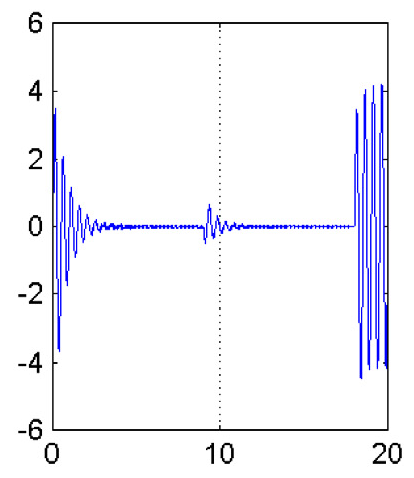
As seen in the simulation plots:
- Subplots (b) and (c): The tracking errors ( and ) plummet toward zero almost immediately after the parameter switch, demonstrating the "learning" speed.
- Subplot (d): The control effort recovers the complex periodic profile required to stay on track.
- The "Ablation" Proof: After , when the learning mechanism is disabled (), the errors explode, proving that the nonlinear compensation is the "secret sauce" of the controller’s success.
Critical Insight & Conclusion
The brilliance of this work is its minimality. Instead of proposing a massive, computationally expensive neural-adaptive controller, Verrelli shows that with the right mathematical grounding (Demidovich), a classical PID-based repetitive structure is sufficient for even "difficult" nonlinear plants.
Takeaway for Engineers: If you can prove your system's internal dynamics are convergent (using the Jacobian check), you don't need complex AI-driven control to handle periodic tasks. A well-tuned repetitive learner with a saturation block will provide better, more predictable performance with guaranteed stability.
Limitations: The requirement for "available state feedback" ( coordinates) means you still need good sensors or a high-quality observer. Future research could potentially loosen this to pure output feedback for this broader class of systems.