
NF2D SSR: Rethinking Fuzzy Clustering for Incomplete Data via Latent Factors and Self-Representation
Nonnegative Latent Factor-Incorporated Fuzzy Double c-Means Clustering for Incomplete Data
This paper introduces NF2D SSR, a novel clustering framework specifically designed for incomplete datasets. It integrates Nonnegative Latent Factor (NLF) analysis for high-precision data imputation with Fuzzy Double c-Means clustering leveraging Sparse Self-Representation (SSR) to capture global data structures.
TL;DR
Clustering real-world data is often hindered by missing values. NF2D SSR (Nonnegative Latent Factor-Incorporated Fuzzy Double c-Means with Sparse Self-Representation) solves this by first using NLF to "fill the gaps" with high precision and then using SSR to understand the global "skeleton" of the data. This dual-pronged focus on local recovery and global structure leads to superior clustering accuracy, especially in high-sparsity scenarios.
Problem & Motivation: The "Missing Data" Bottleneck
In the era of big data, missing information is the rule, not the exception. Standard algorithms like Fuzzy c-Means (FCM) operate under the assumption of completeness. When data is missing, researchers usually resort to:
- Deletion: Deletes valuable information.
- Simple Imputation: Mean/zero filling ignores correlations between attributes.
- Statistical Imputation (EM/KNN): Often fails to capture the latent manifold or suffers from slow convergence.
The authors' insight is that clustering for incomplete data is a two-stage optimization problem: the quality of the "completion" determines the upper bound of the "clustering."
Methodology: The NF2D SSR Framework
The proposed method consists of two sophisticated phases:
1. NLF-based Imputation
Instead of simple averages, the model uses Nonnegative Latent Factor (NLF) analysis. It factorizes the sparse target matrix into two lower-dimensional nonnegative matrices and . By training on only known elements using Mini-Batch Gradient Descent (MBGD), it extracts latent dependencies between entities to predict missing values with minimal error (MAE/RMSE).
2. Fuzzy Double c-Means with SSR
Once the data is complete, the model doesn't just cluster based on Euclidean distance. It employs Sparse Self-Representation (SSR).
- The Insight: SSR uses the sample set itself as a dictionary to find how each sample can be represented by others. This reveals the Global Data Distribution.
- The Objective Function: The model minimizes a dual-center objective that looks at both the original data space and the "discriminate feature space" (the SSR coefficient matrix).
(Note: Refer to Algorithm 1 and 2 in the paper for the specific iterative update rules of , , and .)
Experiments & Results
The authors tested the model on five real-world datasets (Abalone, Facebook, etc.) and the MNIST handwritten digit dataset.
Quantitative Performance
The NLF imputation showed a clear advantage over EM and KNN, particularly as the "sparsity" (missingness) increased.
- Incomplete Data Recovery: The NLF model achieved lower MAE across almost all benchmarks.
- Clustering Accuracy: On the Parkinson Speech dataset (D5), the combined NF2D SSR approach provided more stable and higher NMI (Normalized Mutual Information) compared to standard FCM.
Image Segmentation Case Study
The most striking result came from segmenting MNIST digits with 70% missing pixels.
- EM/Regression: Resulted in noisy outlines and "interference pixels."
- NF2D SSR: Successfully recovered the digit shapes and provided clear segmentations.
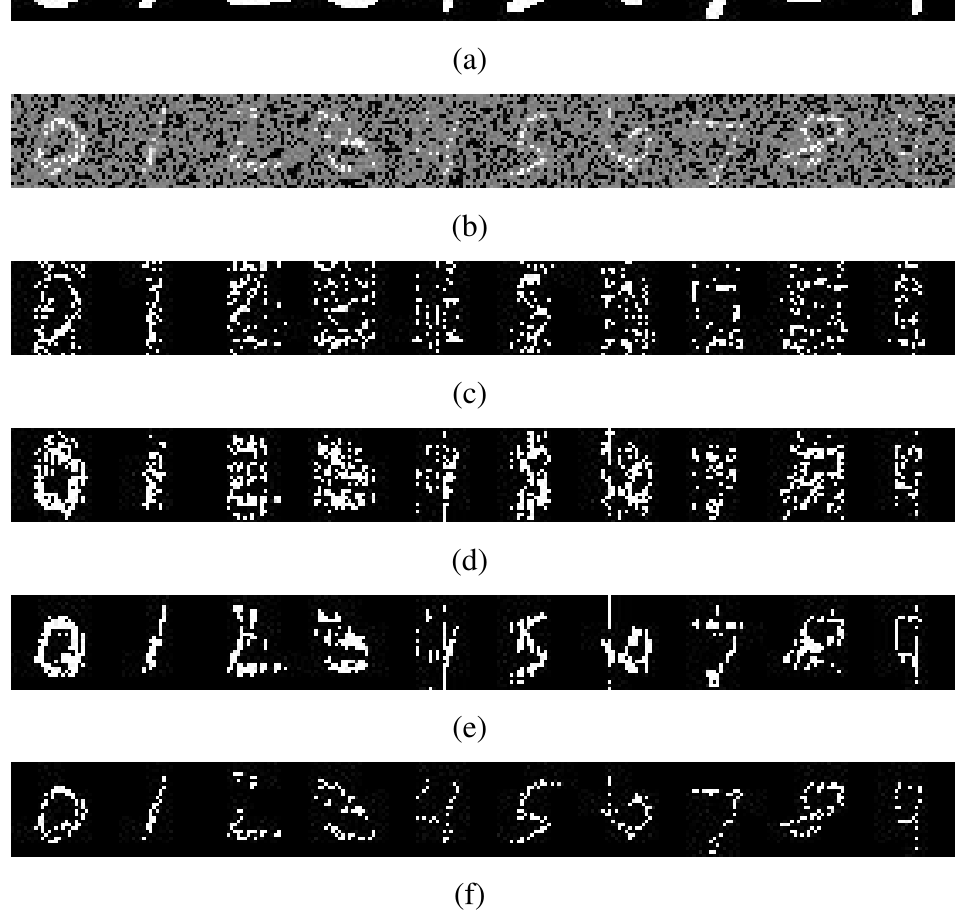 Fig 1. Comparison of image recovery. (f) shows the clear advantage of the NLF-based approach.
Critical Analysis & Conclusion
Takeaway: The core value of this work is the realization that global structure (via SSR) is a powerful regularizer for clustering. When the data is noisy or incomplete, relying solely on local distances is insufficient.
Limitations:
- The computational complexity is , making it potentially expensive for extremely large-scale datasets compared to simple k-means.
- The choice of the balancing parameter and fuzzification coefficient requires careful tuning (though the paper provides sensitivity analysis).
Future Outlook: Integrating Local Feature Weighting could further enhance performance, allowing the model to ignore noisy or irrelevant attributes during the fuzzy partition phase.