
TRNDA: Refined Feature Extraction via Trace Ratio and Nonparametric Gradients
Nonparametric Discriminant Analysis Based on the Trace Ratio Criterion
This paper introduces TRNDA (Nonparametric Discriminant Analysis based on the Trace Ratio criterion), a robust linear feature extraction method. It combines weighted local gradients for inter-class separation and k-farthest neighbor pulling for intra-class compactness, achieving SOTA results on face recognition benchmarks like ORL, XM2VTS, and Yale B.
Executive Summary
TL;DR: TRNDA is a sophisticated linear feature extraction framework that overcomes the rigid assumptions of classical LDA. By utilizing distance-weighted local gradients and the mathematically rigorous Trace Ratio optimization, it achieves superior robustness against outliers and non-Gaussian data distributions in complex face recognition tasks.
Context: This work sits in the lineage of Manifold Learning and Discriminant Analysis. It specifically targets the flaws of the Nonparametric Maximum Margin Criterion (NMMC) and Push-Pull Marginal Discriminant Analysis (PPMDA) by redefining how class "compactness" and "separability" are calculated and optimized.
Problem & Motivation: Beyond the Gaussian Assumption
Classically, Linear Discriminant Analysis (LDA) has been the workhorse for dimensionality reduction. However, LDA operates on two fragile assumptions:
- Gaussianity: It assumes data in each class follows a normal distribution.
- Rank Constraints: It can only find meaningful features (where is the number of classes).
In real-world scenarios (e.g., face recognition with lighting/pose variations), these assumptions fail. Previous remedies like NMMC improved this by focusing on local boundaries, but they are often "distracted" by outliers—extreme points that distort the scatter estimates. Furthermore, they typically solve a Ratio Trace problem (), which is a simplified approximation of the more accurate Trace Ratio ().
Methodology: The Core of TRNDA
TRNDA introduces two major innovations in constructing the local class structure:
1. Robust Scattering Design
Instead of treating all neighbors equally, TRNDA employs Heterogeneous Neighborhoods with a specific weighting function: This ensures that neighbors farther from the query point have less influence, effectively neutralizing the impact of outliers during the "push" phase of separation.
2. Geometric Compaction
For intra-class compactness, it identifies the farthest homogeneous neighbors and pulls them closer. This "global-local" view prevents the model from only focusing on the closest points, thereby tightening the distribution of the entire class.
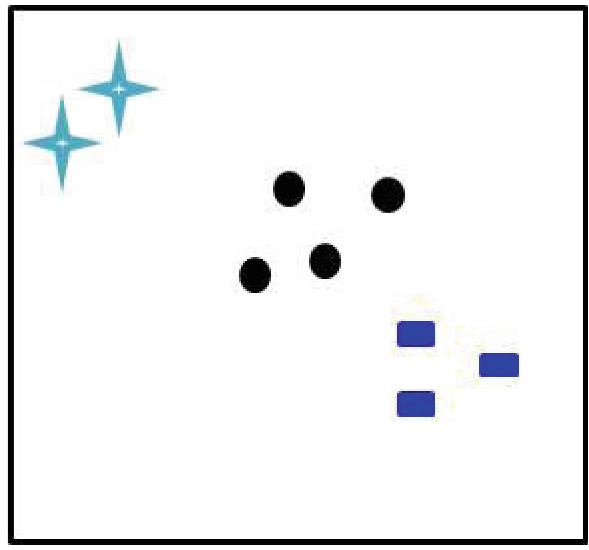 Figure 1: Geometric interpretation of how TRNDA pushes heterogeneous points and pulls homogeneous points.
3. Trace Ratio Optimization
Unlike standard eigenvalue problems, the Trace Ratio does not have a closed-form solution. TRNDA uses a successive orthogonal projection algorithm to find , ensuring that each extracted feature is orthogonal and preserves the original data relationships in the projected subspace.
Experiments & Results
The authors tested TRNDA against a battery of baselines including MFA, PPMDA, and NMMC across three iconic datasets: ORL, XM2VTS, and Yale B.
Key Performance Metrics:
- ORL Dataset: Reached 98.83% accuracy, demonstrating resilience to expression and pose changes.
- XM2VTS (Large variation): TRNDA showed its true strength here, jumping to 75.02% compared to NMMC’s 69.67%, a significant delta in a challenging "large pose" environment.
- Yale B (Lighting conditions): Even without histogram equalization, TRNDA handled extreme illumination better than marginal methods like PPMDA.
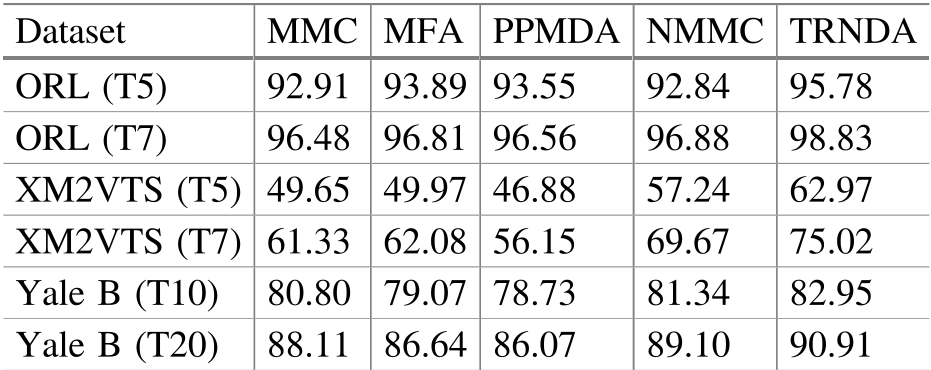 Table 1: Maximum average recognition rates showing TRNDA’s dominance across multiple training samples (T5, T7, etc.).
Critical Analysis & Conclusion
Takeaway
TRNDA proves that feature weighting and orthogonal trace ratio optimization are essential for robust nonparametric analysis. It effectively bridges the gap between local manifold preservation and global class discriminability.
Limitations
The primary trade-off is computational complexity. As noted in the results, TRNDA "needs more time to reach the maximum value" due to the iterative nature of the trace ratio algorithm compared to simple eigenvalue decomposition.
Future Outlook
While this paper focuses on linear projections, the logic of weighted local gradients and trace ratio optimization could be extended to Kernel methods or even integrated into the loss functions of Deep Metric Learning (e.g., refining Triplet Loss with trace ratio constraints).