
nDTCM: Capturing the Pulse of Evolving Topical Communities via Bayesian Nonparametrics
Nonparametric models for characterizing the topical communities in social network
The paper introduces the Nonparametric Dynamic Topical Community Model (nDTCM), a Bayesian framework designed to track evolving "topical communities" in social streams. It utilizes a Hierarchical Recurrent Chinese Restaurant Franchise (HRCRF) to achieve SOTA predictive performance on DBLP and Enron datasets without predefined cluster counts.
TL;DR
Social networks are not static entities; they are "streams" where users, interests, and group structures evolve concurrently. This paper presents the Nonparametric Dynamic Topical Community Model (nDTCM), which eliminates the need to pre-specify the number of communities or topics. By employing a "rich-gets-richer" temporal scheme, the model tracks the birth, death, and semantic drift of communities in real-time social data.
Background: Why Status Quo Fails
Most prior works in community discovery suffer from two fatal flaws:
- Fixed Complexity: They require researchers to guess the number of communities () and topics (), which is nearly impossible in massive, streaming datasets.
- Static Assumption: They ignore that a community's interest in 2010 might be entirely different from its focus in 2020 (Semantic Drift).
The authors argue that a Topical Community is a first-citizen object defined by the intersection of participants and interests. To model this dynamic reality, we need a mathematical framework that grows and shrinks with the data.
Methodology: The HRCRF Engine
The core innovation lies in the Hierarchical Recurrent Chinese Restaurant Franchise (HRCRF).
1. The Power of "Infinite" Tables
Instead of a fixed matrix, think of the model as a franchise of restaurants (communities). New customers (words/users) can sit at existing tables (popular topics) or start a new table (a new topic birth). This is governed by the Dirichlet Process, which naturally mimics the power-law distribution found in social networks.
2. Temporal Decay and Memory
To handle time, nDTCM introduces a time-decaying kernel. The popularity of a topic today is a weighted sum of its popularity in recent epochs (). This formula ensures that the model "remembers" recent trends while allowing old, inactive communities to "die out" gracefully.
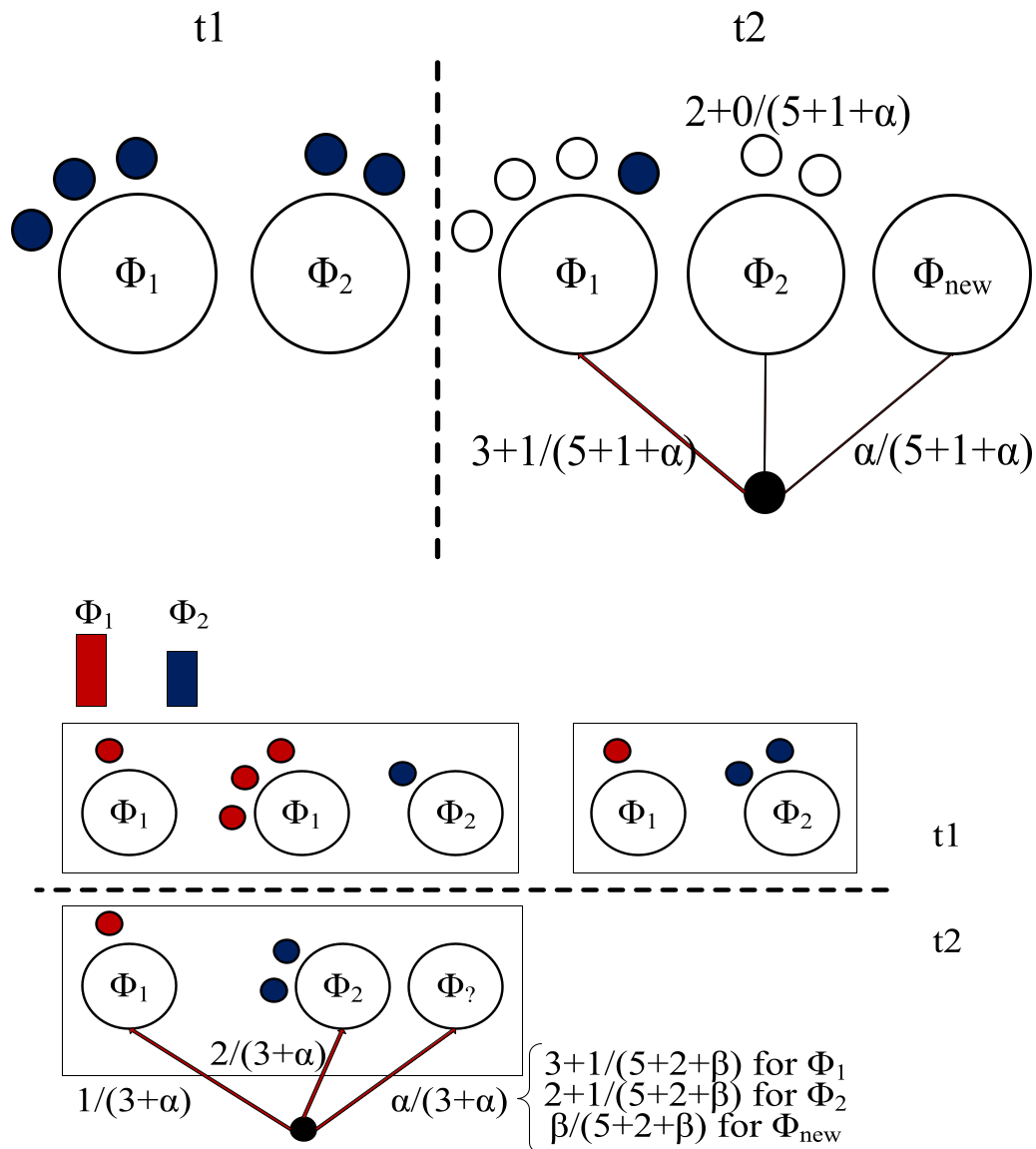 Fig 1: The hierarchical structure where latent communities (top level) and latent topics (bottom level) are coupled and evolve across time steps.
Experiments & Results
The authors validated nDTCM on two massive datasets: DBLP (Academic papers) and Enron (Emails).
SOTA Performance
nDTCM consistently achieved lower Perplexity (a measure of how well the model predicts new data) compared to parametric baselines like CUT and COCOMP. Notably, as the social stream progressed, nDTCM's ability to "forget" irrelevant history and "adapt" to new topics became its primary competitive advantage.
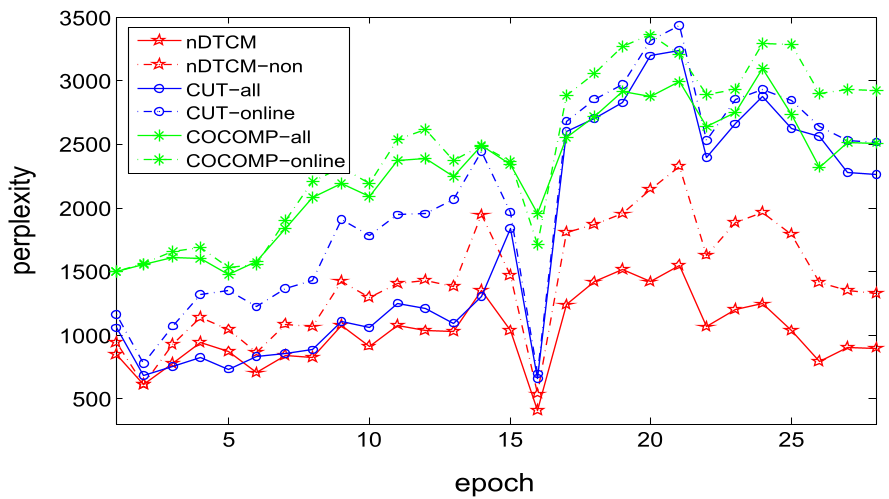 Fig 2: Performance (Perplexity) of nDTCM vs. baselines across successive epochs. Lower is better.
Visualizing Semantic Drift
One of the most compelling parts of the study is the qualitative analysis of academic pivots like Jiawei Han. The model successfully tracked how Han's "Community-0" (Structured Data) evolved and how he branched out into "Community-57" (Information Networks) as the field of Data Mining shifted over two decades.
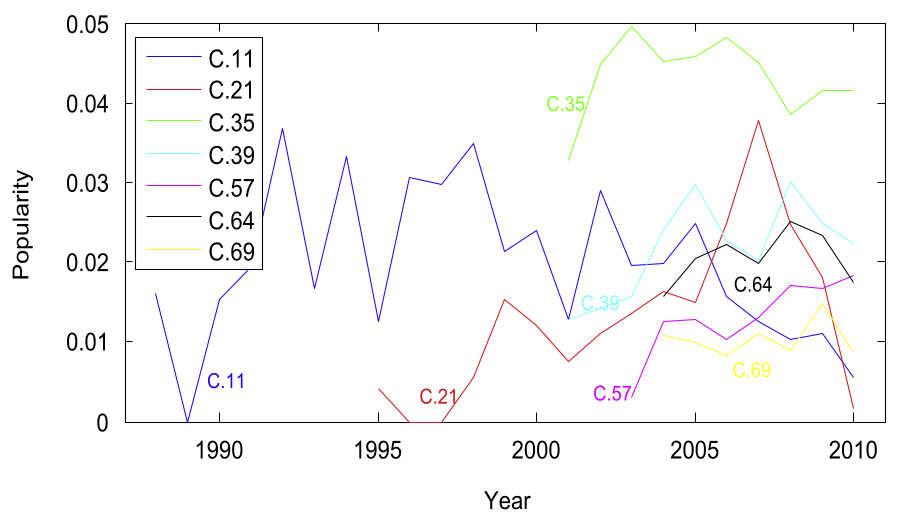 Fig 3: Visualization of word-topic drifts, showing how the vocabulary within specific communities changes over the years.
Deep Insight: Beyond Just Clustering
The industry value of nDTCM lies in its Online Posterior Inference. Unlike batch-processing models that need to re-scan the entire history when new data arrives, nDTCM uses a Metropolis-Hastings sampling approach that only looks at a sliding window of time. This makes it theoretically viable for real-time monitoring of social media trends or corporate communication shifts.
Conclusion & Limitations
Takeaway: nDTCM proves that nonparametrics are not just a theoretical curiosity but a necessary tool for dynamic social media analysis.
Limitations: The model relies heavily on word co-occurrence. For extremely sparse or short texts (like 140-character tweets), the authors suggest that augmenting the model with Word Embeddings (e.g., Word2Vec) could further stabilize the community detection.
Future Outlook: The integration of Hawkes Processes to model continuous-time events (rather than discrete year/month epochs) represents the next frontier for this research.