
Nonvisual Geosocial Interaction: Tracking Friends Through the "Virtual Probe"
Nonvisual, Distal Tracking of Mobile Remote Agents in Geosocial Interaction
The paper introduces a "Mobile Collaborative Virtual Environment" (MCVE) for eyes-free tracking of remote agents using mobile sensors (GPS, magnetometers, accelerometers). It proposes a "Virtual Probe" method based on Monte Carlo sampling to represent sensing uncertainty during distal social interactions.
TL;DR
Imagine finding a friend in a crowded park without ever looking at your phone screen. Researchers Steven Strachan and Roderick Murray-Smith have developed an "eyes-free" tracking system that uses mobile sensors and a probabilistic "Virtual Probe" to let users "feel" and "hear" the location of remote agents. By embracing the chaos of GPS and compass uncertainty rather than hiding it, they've created a functional framework for distal social interaction.
The Problem: The Myth of Precision
Most location-based apps treat GPS coordinates as absolute truths. However, anyone who has seen their blue dot jump across a street knows this is a lie. When we try to point our phones at a remote target, small errors in compass bearing or position result in massive misses at a distance.
The authors argue that overly prescriptive mechanisms—those that hide uncertainty—actually prevent users from developing effective strategies for interaction. Furthermore, the reliance on visual maps makes mobile social networking cumbersome in active, real-world scenarios.
Methodology: The Monte Carlo Virtual Probe
The core innovation is the Virtual Probe. Instead of a single laser-like pointer, the system projects a "cloud" of possible future positions based on:
- Current GPS position and heading.
- Sensor noise (uncertainty in magnetometers/accelerometers).
- Environmental constraints (buildings, roads).
How it Works:
- Scanning (Bearing): The user points the device in a direction. The compass heading determines the orientation of the probe.
- Probing (Distance): By tilting (pitching) the phone forward or backward, the user "pushes" the virtual probe further into the environment (0 to 30 meters).
- Feedback: When the probe "collides" with another agent in the virtual space, the device triggers audio panning (left/right) and vibrotactile feedback.
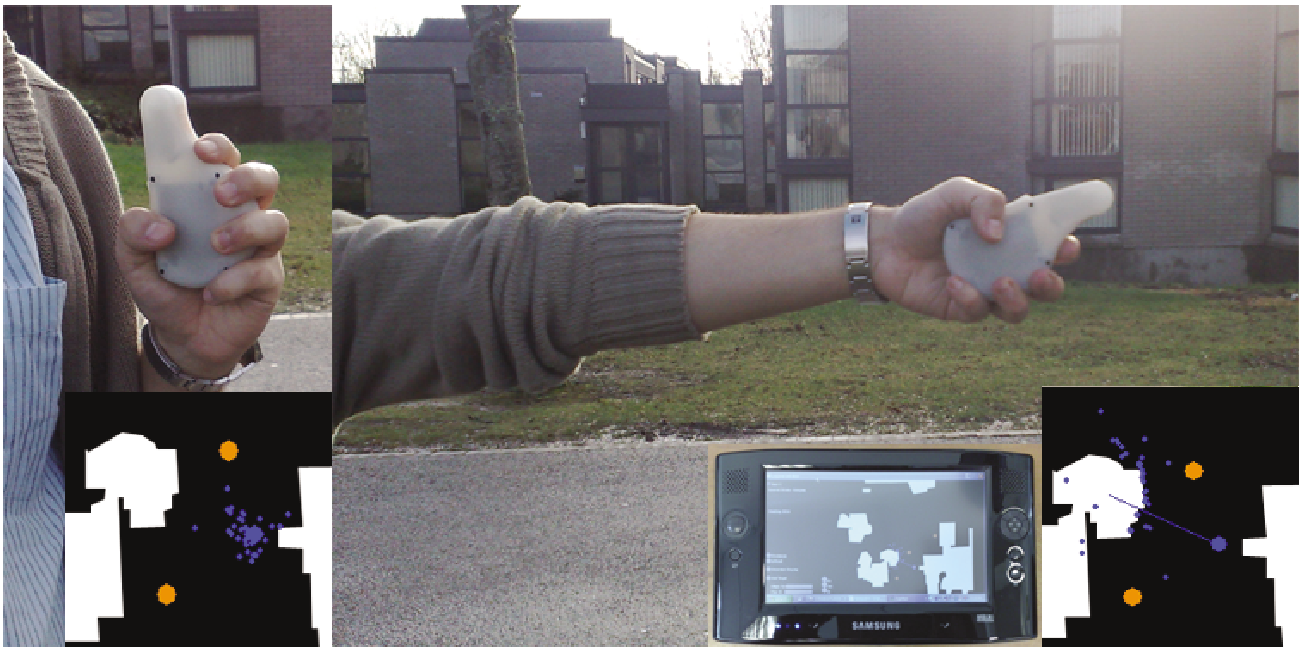 Figure 1: Comparison between a deterministic projection (Left) and the probabilistic Monte Carlo distribution (Center/Right) used to represent the probe.
Experiments: Blindfolded Tracking
To test feasibility, the researchers blindfolded 13 participants and asked them to track a simulated agent through three phases:
- Random Walk: The agent moves unpredictably.
- Attention Check: The agent "hops" to see if the user can detect sudden gestures.
- Goal-Directed: The agent leads the user to a specific destination.
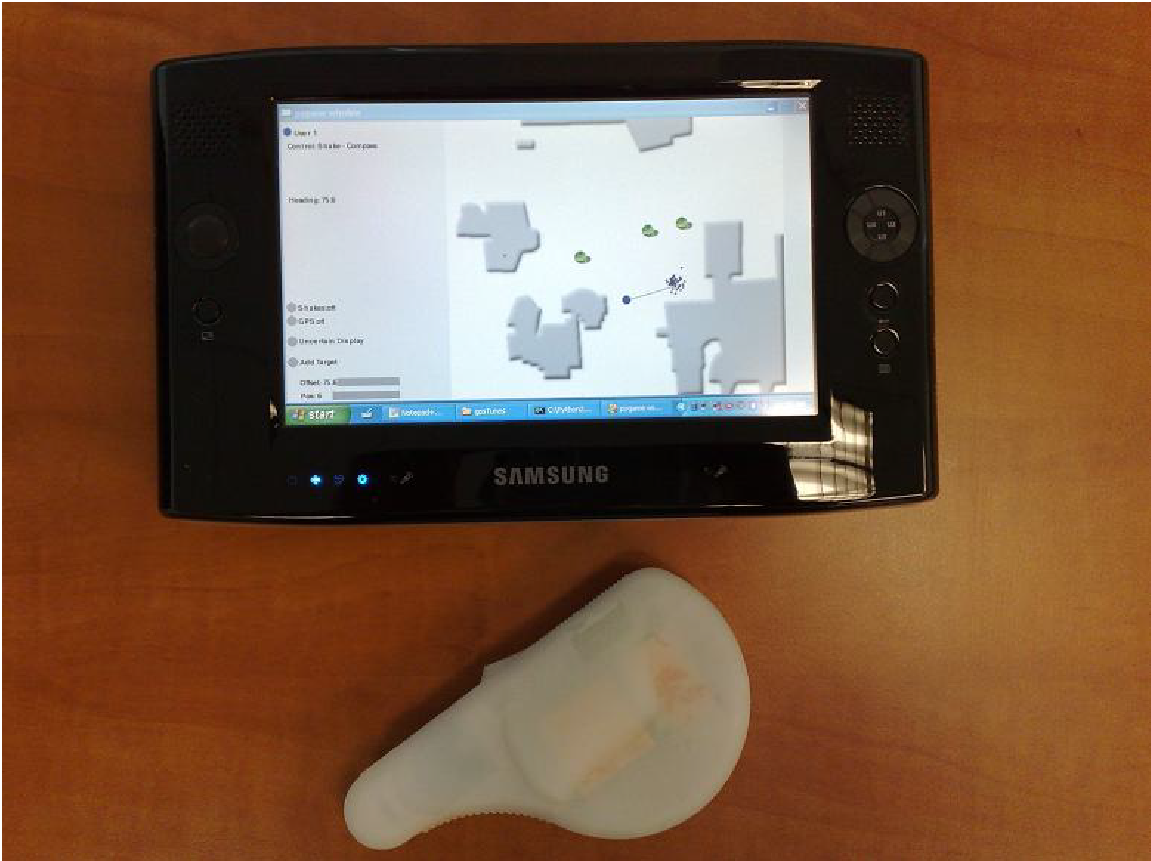 Figure 2: The mobile setup using a Samsung Ultra-Mobile PC and specialized inertial sensors.
Results: Performance & Pain Points
The results were encouraging but revealed a significant cognitive gap. While participants were excellent at tracking the bearing (left/right) of the agent, they struggled with distance (forwards/backwards).
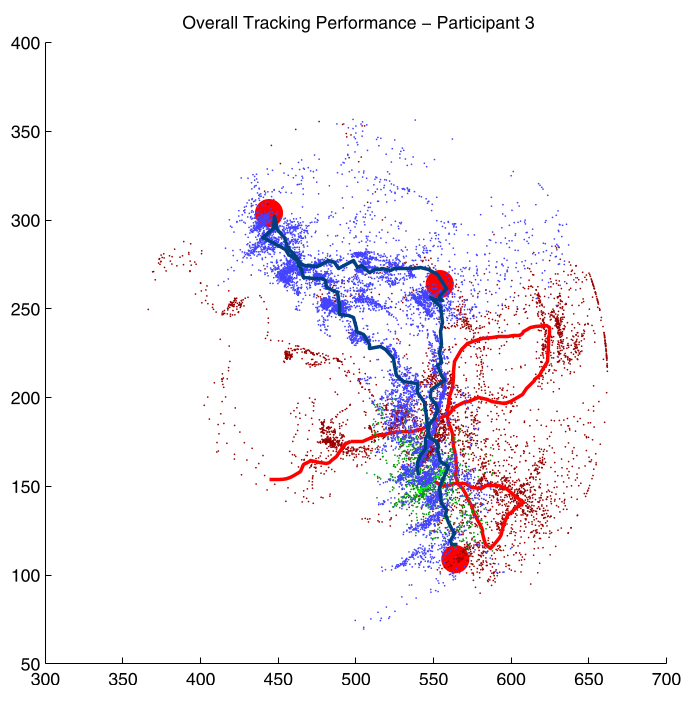 Figure 3: Comparing a high-performing user (Left) who tracks the agent's path closely vs. a low-performing user (Right) who covers a massive search area due to loss of contact.
Key Findings:
- Heading is intuitive: Panning audio makes it easy to "stay" on a target's bearing.
- Pitch is problematic: Linear mapping of tilt-to-distance is not as natural. Users often lost the agent when it moved towards or away from them because the audio feedback didn't change enough to signal depth.
- Social Cognition: The system allows for "joint attention," where one user can guide another's focus purely through haptic cues.
Critical Insight & Future Outlook
The paper proves that "eyes-free" geosocial interaction is feasible even with noisy sensors. However, the "distance tracking" issue suggests that human-computer interaction (HCI) needs more sophisticated metaphors for depth than simple tilting—perhaps using audio frequency or haptic pulse patterns to signify proximity.
Takeaway for Designers: When building for the "Real World," don't try to smooth out the noise. Display the uncertainty, and let human intuition handle the rest. The next step? Applying this to real-time, multi-user interactions where two humans can "feel" each other's gestures across a city.