
Beyond the Inner Circle: How Ad Hoc Interactions Drive Global Social Norms
Norm Convergence in Populations of Dynamically Interacting Agents
This paper explores norm convergence in Agent-Based Modeling (ABM) by introducing a Weighted Random Interaction (WRI) algorithm. It demonstrates how "ad hoc" interactions between non-acquaintances, biased by social distance on a small-world network, significantly accelerate the emergence of global social conventions.
TL;DR
Why do some social conventions spread globally while others stay trapped in local pockets? This paper suggests it's all about the "quality" of your random encounters. By using an Agent-Based Model (ABM) that blends stable social networks with distance-biased random interactions, the researchers show that "friends-of-friends" encounters are the catalyst for rapid, population-wide norm convergence.
Background: The Friction of Social Distance
In the study of multi-agent systems, Norms—the shared expectations that govern behavior—are the "social glue" that reduces friction. Historically, researchers looked at two extremes:
- Fully Connected Networks: Everyone talks to everyone (unrealistic).
- Static Topologies: You only ever talk to your immediate neighbors (leads to local "cliques" that never agree).
The authors of this paper argue that reality lies in between. You have your stable core (family, colleagues), but you also have random encounters. Crucially, you are more likely to meet your neighbor's best friend than a total stranger. This is the Inductive Bias the authors used to build their model.
Methodology: The Weighted Random Interaction (WRI)
The core innovation is the utility function used by agents to decide which norm to adopt. An agent chooses norm if:
- (Direct neighbors): Influence from your stable social circle ( weight).
- (Random interactions): Influence from ad hoc encounters ( weight).
To select random agents, they used a modified Zipf’s Law. Instead of pure randomness, the probability of interacting with someone decays as their "path distance" on the social graph increases.
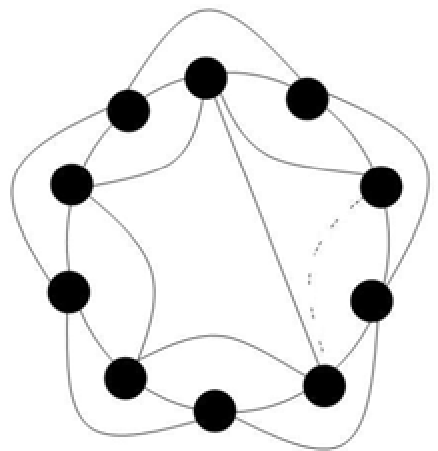 Fig 1: The model utilizes Small World properties where short path lengths exist despite high clustering.
Experiments and Insights: The Critical Thresholds
The researchers ran simulations with 1,000 agents to find the "tipping point" for global consensus.
1. The Power of "Weak Ties"
The paper confirms that increasing the rewiring probability () in a network increases convergence. However, high destroys the "clustering" seen in real human societies. The WRI model solves this by keeping the society clustered but adding random interaction "layers."
2. The β vs. r Trade-off
The most compelling result is shown in the heatmaps of Experiment 2.
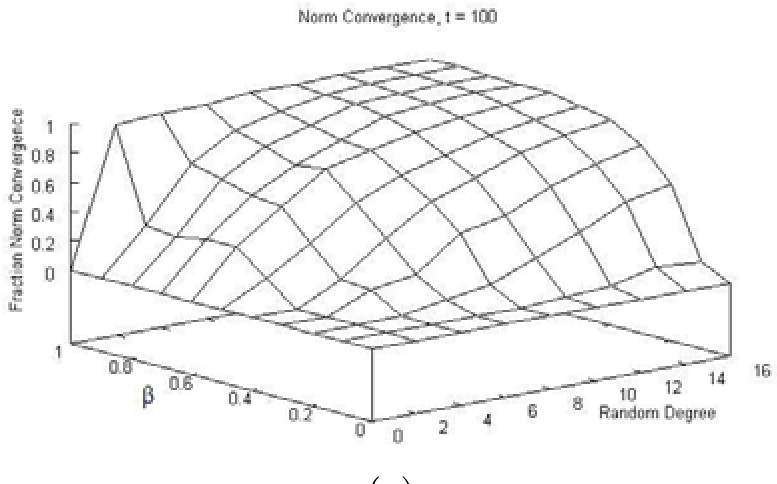 Fig 2: Convergence levels across varying β (influence weight) and r (number of random interactions).
- Observation: If the influence weight () is low, you need a high volume of random interactions () to reach a consensus.
- The "Guaranteed" Zone: When and , global norm convergence is virtually guaranteed.
Critical Analysis: Why This Matters
The paper provides a mathematical backbone to the architectural logic of social spaces. It explains why "large cities" (high random interaction frequency) often converge on new cultural norms faster than "rural areas" (focused on stable social circles).
Limitations: The model assumes all agents are "self-interested" but ultimately compliant. It does not account for "stubborn agents" who refuse to change regardless of the utility, or "anti-conformists" who purposely choose the minority norm.
Conclusion
This work shifts the focus from who we know to who we might meet. It demonstrates that global conventions are not just dictated by our inner circles but are heavily filtered through the quality and frequency of our "random" social periphery. For developers of Multi-Agent Systems or social platforms, the takeaway is clear: to foster consensus, design for quality "recommendations" that bridge social gaps without destroying local community clusters.