
nGPT: Why Normalized Architectures are Natively 4-Bit
Normalized Architectures are Natively 4-Bit
The paper introduces nGPT, a normalized Transformer architecture that constrains weights and activations to a unit hypersphere, making it natively robust to 4-bit (NVFP4) precision. It achieves stable end-to-end 4-bit training without requiring common "patches" like Randomized Hadamard Transforms (RHT) or per-tensor scaling, outperforming standard GPT baselines in accuracy and efficiency.
TL;DR
Quantizing Large Language Models (LLMs) to 4-bit precision usually requires a "survival kit" of complex tricks like Randomized Hadamard Transforms (RHT) and dynamic scaling. This paper proves that nGPT (Normalized Transformer) is inherently robust to 4-bit (NVFP4) arithmetic due to its hyperspherical geometry. By inducing a unique "signal-accumulation" effect, nGPT achieves stable 4-bit training with zero relative error and up to 3.6x speedup on Blackwell GPUs, all while stripping away the usual quantization overhead.
The "Patching" Problem in 4-Bit Training
Standard Transformer training at 4-bit precision is notoriously difficult. To prevent the model from "exploding," researchers have spent years developing patches:
- Randomized Hadamard Transforms (RHT) to smooth out outliers.
- Per-tensor scaling to manage dynamic ranges.
- Mixed-precision exceptions for sensitive layers.
These interventions treat quantization as a nuisance to be managed. The authors of this paper ask a more fundamental question: Can we design an architecture where quantization robustness is a feature, not a bug?
Methodology: The Geometry of Robustness
The secret lies in nGPT, an architecture where every hidden state and weight vector is normalized to lie on a unit hypersphere ().
1. From Noise Reduction to Signal Accumulation
In traditional quantization research, the goal is to minimize noise. However, the authors found that in nGPT, the quantization noise is roughly the same as in standard GPT. The breakthrough is in the Signal-to-Noise Ratio (SNR) of the dot product.
In a standard GPT, a few large, unbounded coordinates often dominate the dot product. When these are quantized, the signal is easily lost. In nGPT, because every element is bounded, the model is "forced" to align thousands of small dimensions to produce a strong output.
2. The Statistical Insight
As shown in the architecture analysis, nGPT induces a weak but systematic positive correlation among element-wise products. When you sum 4,096 of these correlated elements, the signal grows constructively (linearly), while the uncorrelated quantization noise grows much slower (like a random walk).
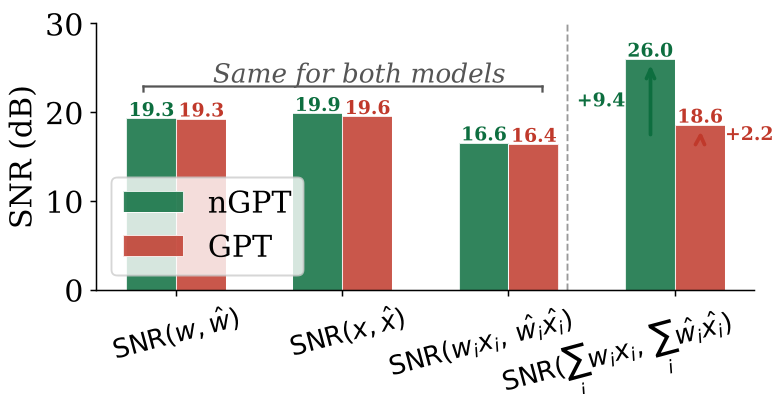 Figure: The normalized signal (zs) in nGPT is a robust predictor of SNR, whereas noise (zn) is indistinguishable from standard GPT.
Experimental Results: Scaling and Stability
The authors tested this theory across diverse scales, including 1.2B dense models and a 30B Mixture-of-Experts (MoE) hybrid (Mamba-Transformer).
Key Findings:
- Lower Relative Error: In 4-bit training, nGPT consistently maintains a lower loss gap relative to BF16 compared to standard Transformers.
- Loss Landscape: nGPT exhibits a 3.5x flatter loss landscape, making it remarkably resilient to weight perturbations and learning rate choices.
- Hardware Speedup: Using NVIDIA Blackwell (NVFP4) native support, nGPT hits a throughput speedup of 3.3x–3.6x over BF16 baselines.
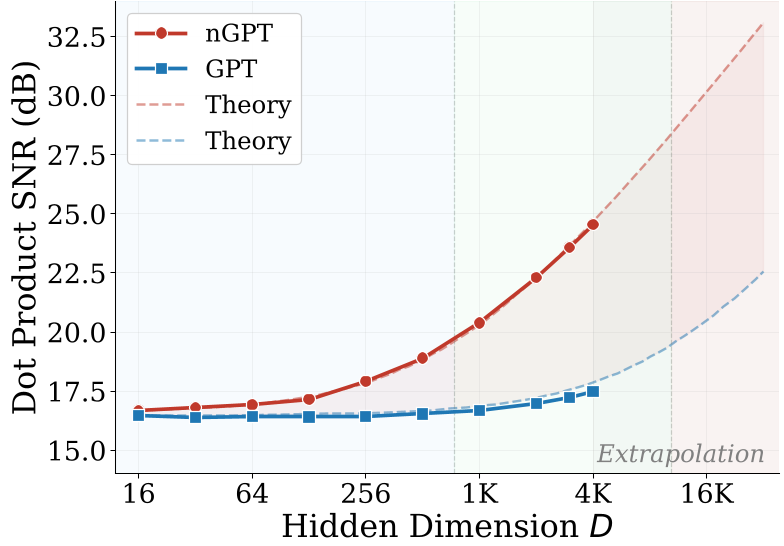 Figure: The SNR advantage of nGPT actually increases as the model gets wider (higher hidden dimension D), suggesting even greater benefits for trillion-parameter models.
Learning Rate Robustness
One of the most practical takeaways is Hyperparameter Transferability. Usually, if you move from BF16 to 4-bit, you have to re-tune your learning rate (LR) because the noise changes. nGPT is so robust that the optimal LR for BF16 is exactly the same for 4-bit, saving researchers thousands of GPU hours in tuning.
Critical Analysis & Conclusion
This work shifts the paradigm of low-precision AI. Instead of building increasingly complex "wrappers" around the Transformer to protect it from 4-bit arithmetic, we should perhaps change the Transformer itself.
Limitations:
- While the 3B/30B MoE results are promising, the authors acknowledge that 20T+ token "production-scale" runs are needed to confirm the long-term convergence properties.
- The source of the "positive correlation" in normalized architectures remains an empirical observation; a rigorous theoretical proof of why the optimizer chooses this alignment in nGPT is still an open question.
Final Takeaway: nGPT suggests that hyperspherical geometry is the "natural habitat" for low-bit neural networks. As we push toward 2-bit or even 1-bit training, architectural normalization may become a requirement rather than an option.