
To Tell the Truth: Finding the Optimal Threshold for Social Communication
Norms of assertion and communication in social networks
This paper addresses the epistemological debate over norms of assertion by applying Alvin Goldman's "veritistic value" framework to a Bayesian social network model. Using the "Laputa" simulation environment, the authors demonstrate that while the "Certainty Rule" (threshold = 1.0) is optimal in the limit of inquiry, lower probability thresholds are more effective for maximizing social knowledge in finite, real-world scenarios.
TL;DR
Is it better for society if we only speak when we are 100% certain, or should we share "likely" truths? Using Bayesian simulations, Erik J. Olsson and Aron Vallinder reveal that the "Certainty Rule" is only optimal if inquiry lasts forever. In the practical, finite world of human deliberation, a lower threshold (around 0.9) is actually better for maximizing the collective knowledge of a community.
The Great Epistemological Standoff
For decades, philosophers have been split into two camps regarding the Norms of Assertion:
- The Purists (Knowledge Rule): Led by Timothy Williamson, they argue that you should only assert what you know (effectively subjective probability 1.0).
- The Pragmatists (Reasonable Belief Rule): They argue that high subjective probability (e.g., "I'm 90% sure") is sufficient to warrant speaking up.
Until now, this debate was largely a battle of "intuitions." This paper changes the game by asking a social question: Which rule, if adopted by everyone, actually makes society smarter?
Methodology: Simulating the Social Mind
The authors utilize a Bayesian social network model executed via a tool called Laputa. In this model, agents attempt to determine if a proposition is true. They have two tools:
- Inquiry: Private "reality checks" (experiments/observations).
- Communication: Listening to what others in the network assert.
The "social epistemic good" is measured using Alvin Goldman’s Veritistic Value (V-value)—essentially the average credence the community holds in the true answer.
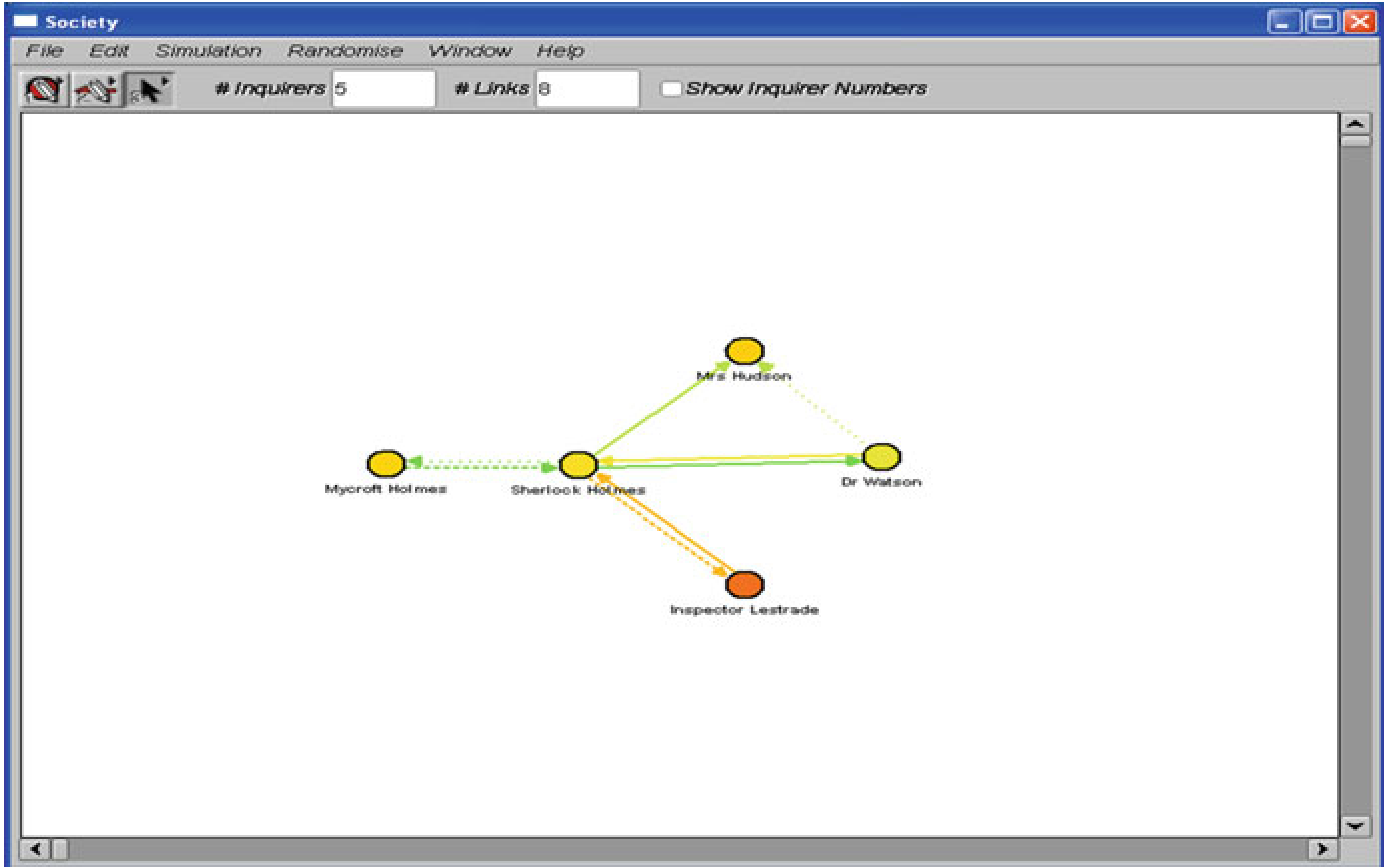 The simulation settings: Agents are assigned varied inquiry accuracy and "trust" levels in their peers.
The Core Discovery: Time Changes Everything
The most striking finding of the study is that the "optimal" threshold for assertion is not a fixed number—it depends on time.
- In the Short Term: When agents only have a few steps (e.g., 10) to communicate, a threshold of 0.92 is optimal. Why? Because information is scarce. If everyone waits for 100% certainty, the network stays silent, and no one benefits from the "wisdom of the crowd."
- In the Long Term: As the number of simulation steps increases to 100 or more, the optimal threshold climbs toward 1.0 (Certainty). Over long periods, the risk of "information pollution" from slightly-less-than-certain assertions begins to outweigh the benefit of quick sharing.
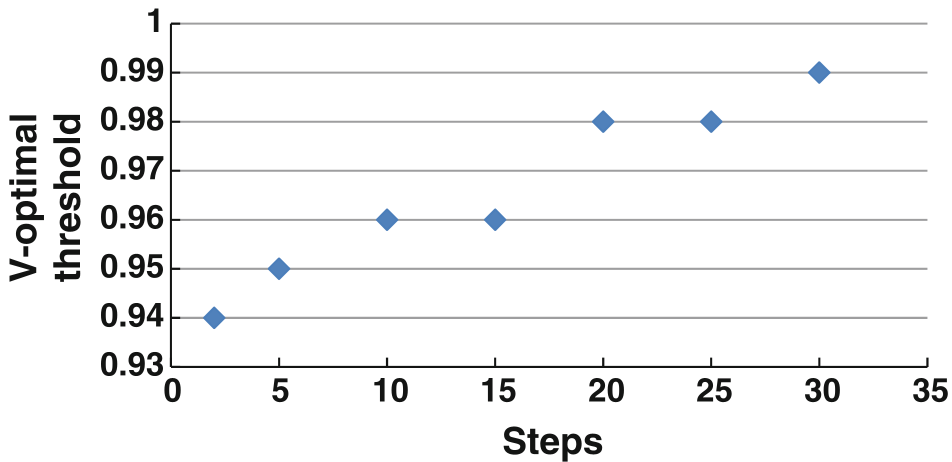 Crucial Result: As deliberation time increases, the community benefits from stricter rules of assertion.
Robustness and Exceptions
The authors tested whether this "0.99 limit" held up under different conditions. It was remarkably robust, with a few fascinating exceptions:
- Pre-existing Consensus: If everyone already strongly believes the truth, a lower threshold is better because it simply encourages the continued flow of true information.
- Distrust: If agents don't trust their communication sources (trust < 0.5), the only winning move is the Certainty Rule (), which acts as a filter against misleading noise.
Deep Insight: A Reconciliation
The beauty of this research is that it offers a "peace treaty" to the warring philosophical camps.
The Purists are right in an idealized, infinite timeline where we have all the time in the world to be perfect. However, the Pragmatists are right in the "real world" where decisions must be made under time pressure. In finite inquiry, being a "truth-teller" who is only 90% certain provides the necessary catalyst for the community to converge on the truth faster than a community of silent perfectionists.
Conclusion
This paper demonstrates that social norms shouldn't be judged in a vacuum. The "validity" of how we speak to one another is inextricably linked to our network structure and the time we have to deliberate. For future AI alignment and social media algorithm design, this suggests that "high-but-not-perfect" confidence thresholds may be the sweet spot for balance between information spread and accuracy.