
Beyond Volume: Building NoSQL Graph Data Warehouses for the "Very-Connected" Era
Towards NoSQL Graph Data Warehouse for Big Social Data Analysis
This paper explores the transition from traditional relational data warehouses to NoSQL-based architectures for Big Social Data analysis. It introduces the concept of "Very-Connected" data as a fourth V of Big Data and proposes a novel hybrid "Intra-NoSQL" architecture that combines document-oriented (MongoDB) and graph-oriented (Neo4j-style) databases to optimize social network mining.
TL;DR
As social media data explodes, traditional relational databases are hitting a "join wall." This paper argues that Big Social Data requires a shift from the 3 Vs (Volume, Velocity, Variety) to include a fourth: Very-Connectedness. The authors propose a novel Intra-NoSQL architecture that bridges Document Stores and Graph Databases to unlock complex social relationship mining that traditional warehouses simply cannot reach.
The "Very-Connected" Problem: Why RDBMS Fails Social Data
For decades, the Relational Data Warehouse (R-OLAP) has been the gold standard for decision support. However, social network data is fundamentally different from transactional data. It's not just about what an individual bought, but who they are connected to and how those connections influence behavior.
The authors identify several critical pain points in existing systems:
- The Join Penalty: In relational systems, traversing a social graph requires multiple expensive JOIN operations that degrade performance exponentially as the network grows.
- Rigid Schemas: Social data is messy and unstructured; forced normalization leads to "NULL-heavy" tables and lost context.
- The Missing V: While Big Data is usually defined by Volume, Velocity, and Variety, the authors insist on "Very-Connected" data—where the value lies in the edges, not just the nodes.
Methodology: The Intra-NoSQL Approach
The core contribution of this work is a strategic hybrid architecture. Instead of moving directly from Relational to Graph, the authors propose a two-step NoSQL pipeline.
1. The Multi-Model Pipeline
Social data is first ingested into a Document Store (like MongoDB). This handles the Variety of the raw data (posts, profiles, comments) in flexible JSON/BSON formats. Then, a recursive ETL process identifies entities and their relationships, moving them into a Graph Database.
2. Architecture Overview
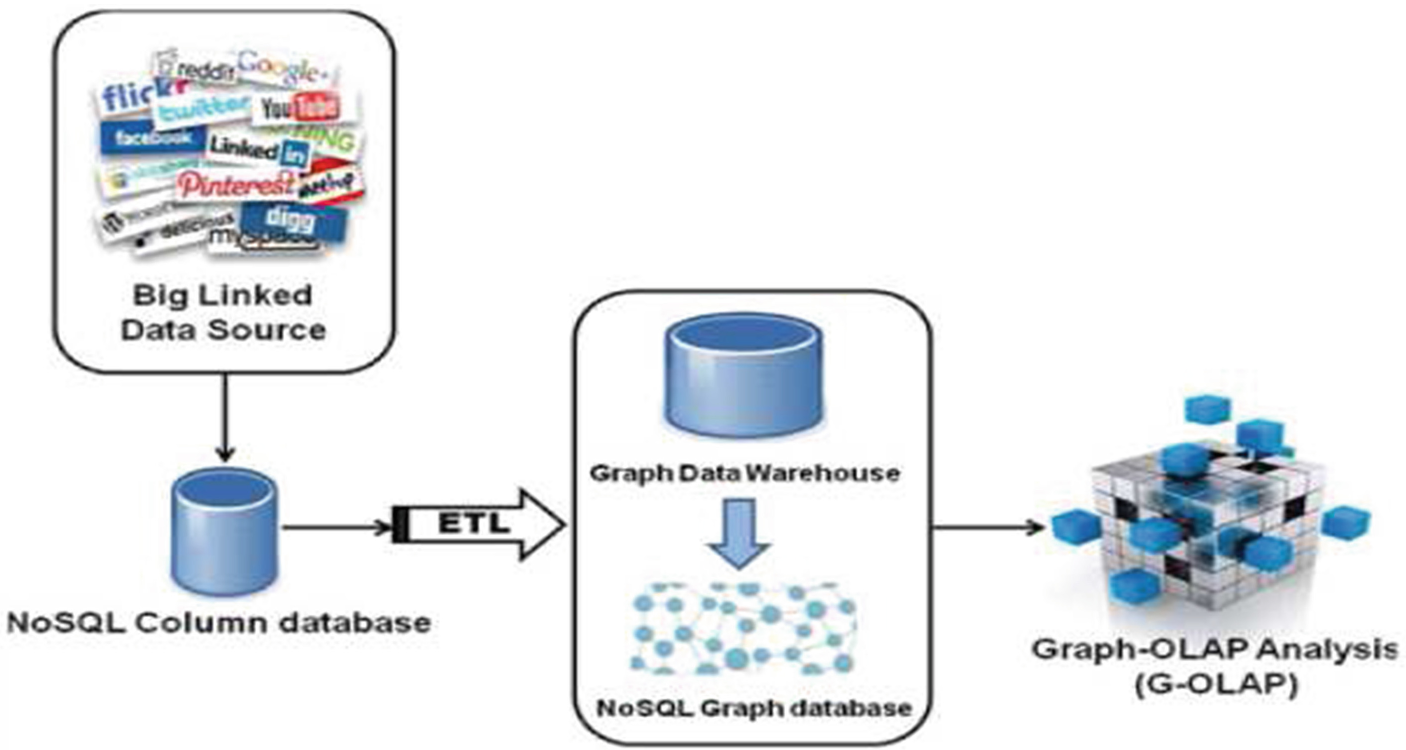
In this architecture, the Graph Store becomes the "Relational Engine" of the NoSQL world, where edges are first-class citizens.
Graph Theory as the Analytical Engine
By moving social data into a graph format, organizations can leverage 300 years of Graph Theory (dating back to Euler) to perform advanced analytics:
- Community Detection: Finding clusters of similar users for targeted marketing.
- Influence Analysis: Identifying "hubs" or "authorities" within a network using centrality measures.
- Recommendation Engines: Efficiently traversing "friend-of-friend" links to suggest products or connections.
Comparative Analysis: Picking the Right NoSQL Tool
The paper categorizes NoSQL models based on their warehouse utility:
- Key-Value: Best for simple lookups, poor for complex analysis.
- Column-Family (HBase/Cassandra): Excellent for massive volume, but suffers when queries require joining dimensions.
- Document (MongoDB): Great for variety, but lacks native structural relationship optimization.
- Graph (Neo4j): The optimal choice for "Very-Connected" social analysis.
Critical Insight: The "Recursive" Intra-NoSQL Migration
Unlike previous works that focus on "Relational-to-NoSQL" migration, this paper suggests that the future of data warehousing is "Intra-NoSQL". This means data should flow between different NoSQL types depending on the analytical stage. Use Document stores for storage and Graph stores for structural mining.
Conclusion & Future Outlook
The shift towards Graph-NoSQL Data Warehouses is not just a trend but a necessity for the "Social Age." While challenges like the lack of a standardized graph query language remain, the ability to treat relationships as first-class citizens offers a massive competitive advantage in customer loyalty and intelligent decision-making.
Future Work: The authors point toward the development of more robust ETL tools that can automatically preserve multidimensional hierarchies while migrating data across NoSQL layers.