
Smart Mobility in Virtuality: An AI-Assisted 3D Simulation for Pediatric Wheelchair Training
A Novel 3D Wheelchair Simulation System for Training Young Children with Severe Motor Impairments
The paper introduces a 3D wheelchair simulation system built on the Unity engine, specifically designed for children aged 2–5 with severe motor impairments. It leverages an Optimized A* algorithm and a variance-based intent recognition module to provide three navigation modes: manual, automatic, and hybrid.
TL;DR
For young children with severe motor impairments, movement is the gateway to cognitive development. This paper presents a Unity-based 3D wheelchair simulator that uses an Optimized A algorithm* and Intent Recognition to help toddlers (ages 2-5) learn to drive safely. By reducing redundant movements and filtering "noisy" joystick inputs, the system makes independent mobility accessible long before a child is ready for a real power wheelchair.
The "Zigzag" Problem: Why Traditional Navigation Fails Kids
Independent mobility is not just about getting from A to B; it's a catalyst for social and motor growth. However, placing a 3-year-old with motor impairments in a 400lb power wheelchair is a safety nightmare. While simulations are a logical solution, standard path-finding algorithms like A* often generate "zigzag" paths. For a child with limited motor control, these frequent, jerky turns are frustrating and physically taxing, leading to a "steep learning curve" that discourages use.
Methodology: Smoothing the Path to Independence
1. The Optimized A* Algorithm
The core technical contribution is the refinement of the A* algorithm. Standard A* moves cell-by-cell on a grid, often resulting in unnecessary turns. The authors introduced a checkpoint-marker system:
- It examines the "Next" and "Checkpoint" nodes.
- If no obstacle exists between the current position and a distant future node (Line of Sight), intermediate nodes are discarded.
- Result: A smooth, direct trajectory that feels natural.
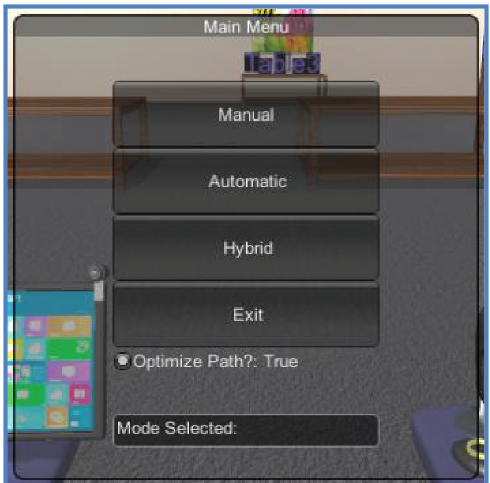 Figure 1: The simulation interface showing Control Modes and the training environment.
2. Hybrid Control & Intent Recognition
This is where the AI acts as a "co-pilot." Children with motor impairments often suffer from hand tremors. The system uses Variance Analysis:
- It gathers input data from the joystick and calculates the standard deviation.
- If the user's input falls within the "noise" (tremor) threshold, the AI ignores it.
- If the input is sustained and significant, the Intent Recognition module calculates the angle of the joystick relative to potential goals (like a table or sofa) and automatically reroutes the wheelchair to the new intended destination.
Experiments: Performance Leap
The team tested the optimized AI against a standard baseline. The results were stark:
- Speed: The optimized A* consistently took half the time to reach goals compared to traditional A* because it removed the "overhead" of zigzag turns.
- Usability: In hybrid mode, even healthy adults (serving as initial test subjects) struggled with the traditional algorithm's jerky response, whereas the optimized version allowed for fluid, intuitive navigation.
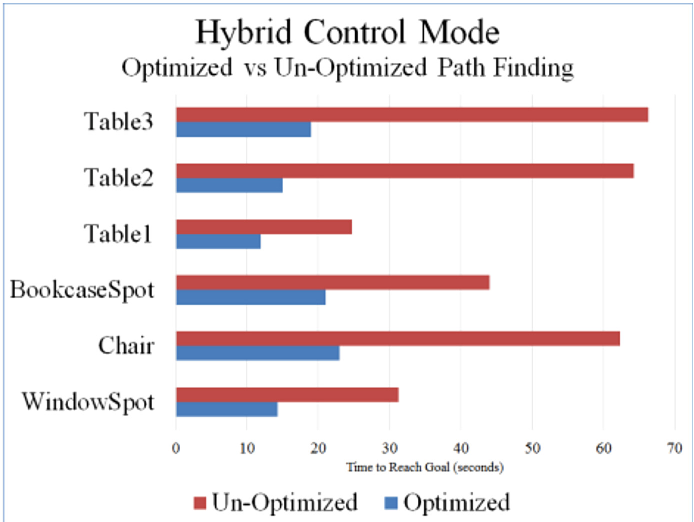 Figure 2: Performance comparison showing the dramatic reduction in navigation time with the optimized algorithm.
Critical Insight: Beyond the Code
The brilliance of this work isn't just in the math—it's in the Inductive Bias designed for the user. By assuming that a user's intent is to move toward specific objects in the room, the AI can "fill in the gaps" of the child's motor output.
Limitations & Future Work
- Human Factors: Currently, data collection on children with impairments is ongoing. The "noise" profile of a child’s tremor may be more complex than the adult-simulated tremors used in early trials.
- Real-world Transfer: While simulated progress is great, the true test will be the "Sim-to-Real" transfer—how well these skills translate to a physical wheelchair with real-world physics and floor friction.
Conclusion
This simulation system effectively democratizes mobility training. By combining the safety of a virtual environment with the "assistance" of an intelligent co-pilot, it ensures that children with severe impairments don't miss out on the critical developmental milestones that independent movement provides.