
Music as Complexity: Decoding Emotion via Compressibility and Sparse Spectra
Novel affective features for multiscale prediction of emotion in music
The paper introduces two novel global audio features, Compressibility and Sparse Spectral Components (SSC), designed specifically for Music Emotion Recognition (MER). By leveraging complexity theory and Non-negative Matrix Factorization (NMF), the authors achieve State-of-the-Art performance in predicting Arousal and Valence dimensions on the MediaEval2014 dataset.
TL;DR
Researchers from USC and IIT Kanpur have challenged the status quo of Music Emotion Recognition (MER) by shifting focus from complex machine learning architectures back to feature engineering. They introduce two global features: Compressibility, which treats the randomness of a song as a proxy for arousal, and Sparse Spectral Components (SSC), which identifies latent "spectral fingerprints" tied to valence. Their findings prove that "global" summaries of a song can predict time-varying "dynamic" emotions better than previously thought.
Problem & Motivation: The Gap in Generic Features
Most MER research treats music like speech, borrowing features like MFCCs (Mel-Frequency Cepstral Coefficients). While useful for technical audio processing, MFCCs don't necessarily capture the feeling of music. High arousal is often linked to musical complexity—an interplay of rhythm, harmony, and timbre—while valence (positivity/negativity) is tied to specific spectral patterns.
The authors' insight was simple: complexity is emotion. A highly energetic, high-arousal track is harder to compress (more "random") than a simple, repetitive one. Similarly, specific spectral "atoms" might inherently evoke happiness or sadness.
Methodology: The Core Innovations
1. Compressibility (Kolmogorov Complexity)
The authors used the concept of Kolmogorov Complexity—the length of the shortest program required to represent a signal. Since this is mathematically non-computable, they approximated it using the ratio of a song’s lossless compressed size (FLAC) to its raw size.
- Intuition: High arousal = Higher complexity = Lower compression ratio.
2. Sparse Spectral Components (SSC)
Using Non-Negative Matrix Factorization (NMF), the system learns a dictionary () of spectral "atoms" from a training set. Each song is then represented by how much it activates these specific atoms ().
- Visual Evidence: As shown in the figure below, high-valence songs activate specific high-frequency components more frequently than low-valence ones.
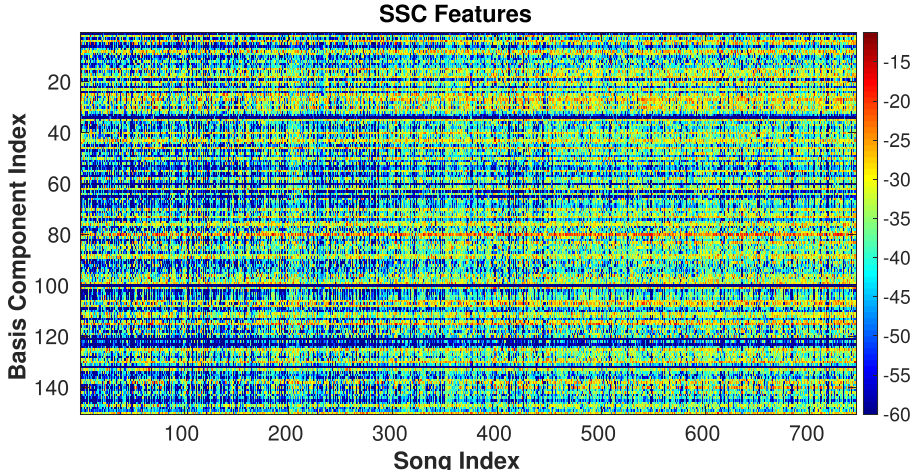 Fig 1: NMF atomic activations. Notice the shift in intensity (65-75 and 102-150) as valence increases from left to right.
3. The Haar Transform for Dynamic Prediction
To bridge the gap between a single "global" value per song and "dynamic" ratings (changing every 0.5 sec), the authors used the Haar Transform. By predicting the coefficients of the Haar space, they essentially reconstructed a time-varying signal from a static feature.
Experiments & Results: Outperforming the Classics
The features were tested on the MediaEval2014 dataset (1744 clips). The global Compressibility feature essentially "crushed" the baseline, especially in Arousal prediction.
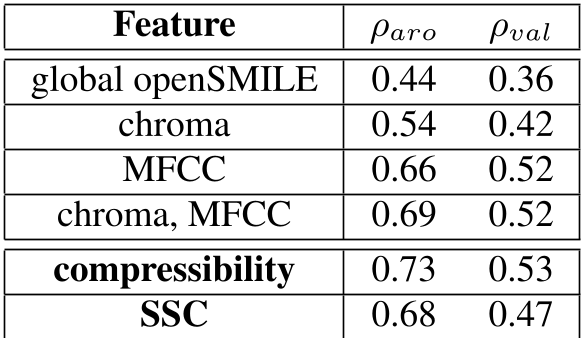 Table 1: Comparison of features. Compressibility ( for Arousal) significantly outperforms the standard OpenSMILE and Chroma sets.
Key Findings:
- Arousal (): Compressibility is a near-perfect proxy for emotional energy.
- Valence (): Still harder to predict than arousal, but SSC and Compressibility provided a notable boost over traditional MFCCs/Chroma.
- Dynamic Prediction: Using global features to predict dynamic changes yielded a correlation of 0.22, proving that a song's overall "character" sets the stage for its moment-to-moment emotional shifts.
Critical Analysis & Conclusion
Takeaway
This paper serves as a reminder that feature design often outweighs model complexity. While many modern researchers jump straight to Transformers or RNNs, this work shows that a single scalar (Compressibility) can outperform high-dimensional feature sets if it aligns with the underlying physics/psychology of the task.
Limitations
- Lossless Dependency: The compressibility feature relies on lossless codecs. Using lossy formats (like MP3) as raw input might introduce artifacts that skew the complexity measure.
- Valence Ceiling: Valence prediction remains significantly lower than Arousal, suggesting that spectral features alone aren't enough—cultural context and lyrical content likely play a role that "raw audio complexity" cannot reach.
Future Work
The success of the Haar Transform approach suggests a future where multiscale fusion (combining the "vibe" of the whole song with the "beat" of the second) becomes the standard for music AI. Transitioning these global features into a deep learning front-end could potentially lead to even more robust Music Information Retrieval (MIR) systems.
Keywords: Music Emotion Recognition, Kolmogorov Complexity, NMF, Affective Computing, Haar Transform.