
Deciphering the Digital Noise: A New Framework for Ranking Trendy and Novel Cyber Threats on Twitter
A novel approach for detection and ranking of trendy and emerging cyber threat events in Twitter streams
This paper introduces an unsupervised machine learning framework for detecting and ranking cyber threat events in Twitter streams. It utilizes DBSCAN clustering on TF-IDF vectors combined with TextRank and Named Entity Recognition (NER) to differentiate between "novel" and "trendy" threats while incorporating user influence scores for importance ranking.
TL;DR
The research proposes an unsupervised pipeline to identify and rank cyber threat events in Twitter streams. By separating "Novel" events (newly appeared) from "Trendy" events (developing stories), and weighting them by user influence, the system provides a ranked list of actionable security intelligence with a precision of 93.75%.
Background & Motivation: Why Twitter for Cyber Defense?
Twitter serves as a high-bandwidth battleground where both hackers and security researchers exchange information. However, the platform's nature—short, noisy, and ungrammatical text—makes traditional NLP tools fail. Previous works have either focused purely on "burstiness" (ignoring novelty) or required massive labeled datasets for deep learning models that are too slow for real-time streaming.
The authors' core Insight is that an event's significance is not just about what is being said (keywords), but who is saying it (user influence) and whether it represents a new threat or a development of an existing one.
Methodology: Orthogonal Novelty and Trend Detection
The system follows a multi-stage pipeline designed to handle the "unstructuredness" of microblogs:
- Preprocessing & Correction: Using SymSpell for spelling correction and alphanumeric filtering to clean the noisy input.
- Influential Impact Mapping: The system extracts noun phrases and assigns weight based on the user's normalized follower count. A tweet from a security expert is mathematically weighted higher than a bot.
- Density-Based Clustering: Unlike K-Means, which requires a predefined cluster count, the authors use DBSCAN on TF-IDF matrices to find natural groupings of similar tweets, effectively identifying "events."
- Heuristic Scoring: The system identifies Keywords (via TextRank) and Named Entities (via TextRazor).
The Architecture of Event Classification
The authors define four sets of tokens (Common, Keyword, Named Entity, and Union) to categorize events into:
- Novel & Trendy: New topics that are currently viral.
- Just Novel (First Story): New topics with low volume (critical for early warning).
- Just Trendy: Existing stories that are seeing a surge in volume.
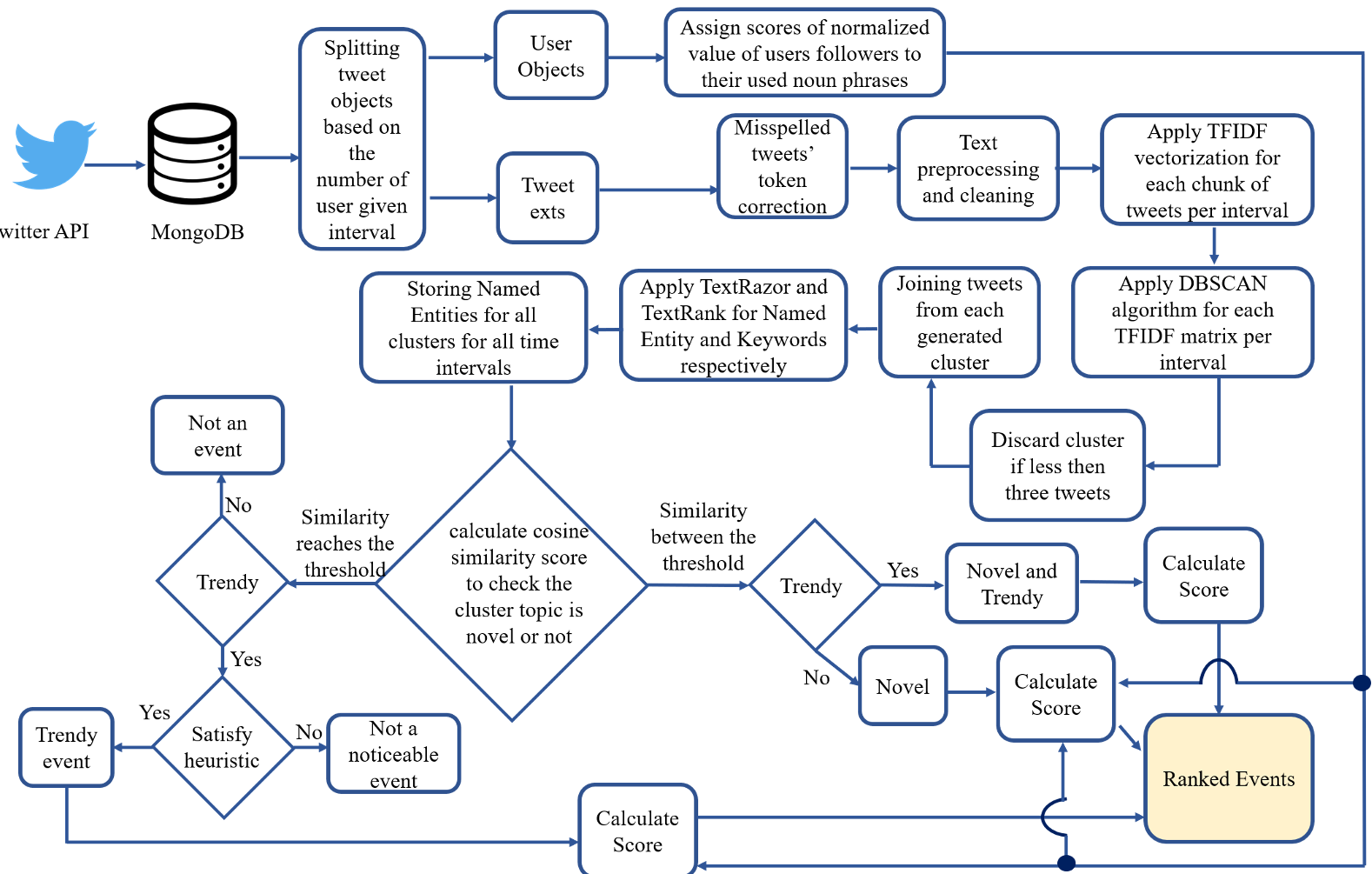 Fig 1: The proposed approach flowchart, from tweet collection to final event ranking.
Experiments and Results
The researchers validated their model against 4 days of cybersecurity-related tweets from late 2018. They compared their TF-IDF/DBSCAN approach against semantic models like Doc2Vec and LDA, finding that the latter performed poorly on short texts due to "thin contextual relations."
Performance Metrics
Compared to human annotators:
- Precision: 93.75%
- True Negative Rate: 83.33%
- True Positive Rate: 75%
The ranking mechanism, which combines entity confidence and user influence, matched closely with human-perceived importance, as shown in the score-to-tweet count comparison.
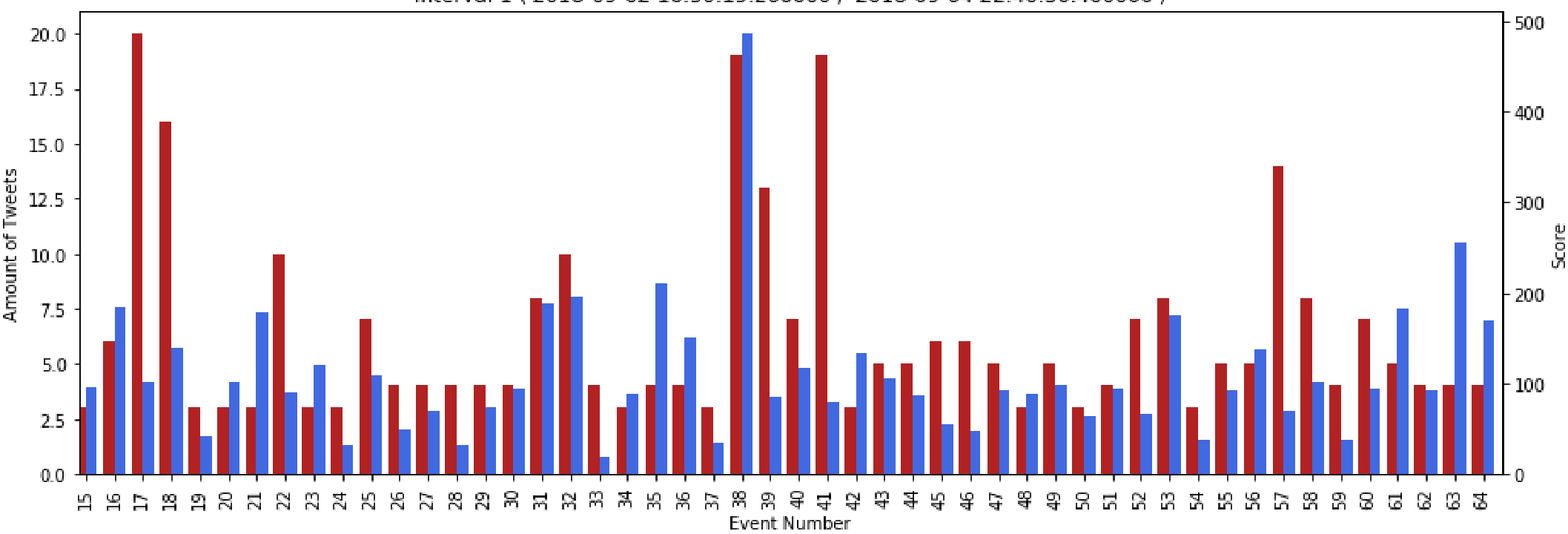 Fig 2: Event plot for the 2nd time interval, showing the relationship between tweet count (red) and calculated event score (blue).
Critical Analysis & Conclusion
Takeaway
The paper proves that you don't always need a heavy Transformer model to extract high-quality threat intelligence. By intelligently combining social signals (followers) with traditional text ranking (TextRank) and density clustering (DBSCAN), we can build an efficient, unsupervised early warning system.
Limitations & Future Work
The current approach relies on a manual cosine threshold (0.5) and is limited by the Twitter Streaming API's 1% sample rate. Future iterations could benefit from:
- Meta-Network Modeling: Mapping the relationship between users to better define "influence" beyond simple follower counts.
- Sub-event Tracking: Breaking down a major attack (e.g., a massive data breach) into its constituent sub-events (leak, ransom demand, investigation).
This work provides a solid foundation for automated SOC (Security Operations Center) tools that need to sift through millions of signals to find the "First Story" of a zero-day exploit.