
Maximizing Impact at Scale: A Predictive Approach to Location Promotion in LBSNs
A novel approach for location promotion on location-based social networks
This paper introduces the Predicting Mobility in the Near Future (PMNF) model and two Influence Maximization (IM) algorithms, IM num and IM score, specifically designed for Location-Based Social Networks (LBSNs). The framework identifies the top-k influential users to maximize advertisement reach at specific physical locations by integrating user movement history, social ties, and "hot region" attractiveness.
TL;DR
In the era of Location-Based Social Networks (LBSNs), the challenge isn't just knowing who has a lot of friends, but who can actually drive those friends to a specific physical location. This paper introduces the Predicting Mobility in the Near Future (PMNF) model and a set of Influence Maximization (IM) algorithms. By combining human mobility patterns, social influence, and "hotspot" attractiveness, the authors provide a framework that identifies the most influential "seed" users, achieving an order of magnitude better performance in location promotion than traditional methods.
The Core Problem: Why Direct Influence Isn't Enough
Traditional marketing on social networks often assumes that if User A is popular, their influence spreads like a virus. However, in Location Promotion, physical presence is the ultimate KPI. Just because someone has 1,000 friends doesn't mean they can convince those friends to visit a specific restaurant at a specific time.
Existing approaches (Prior Work) suffered from two main flaws:
- Static Metrics: Relying on "total friend count" or "total check-ins" which ignore when and where people actually go.
- Redundancy: Failing to account for overlapping friend circles, leading to wasted marketing spent on the same audience.
Methodology: The PMNF Model
The authors break down human mobility into three distinct, weighted features:
- Regular Movement (0.7 weight): Based on the "Home" and "Work" latent states. Humans are creatures of habit; we are 50-70% likely to return to places we’ve been before.
- Social Influence (0.1 weight): The probability that a user visits a spot because a friend has been there or recommended it.
- Hot Regions (0.2 weight): Generally attractive areas (malls, landmarks) that draw users regardless of their personal history.
Architecture Overview
The system clusters hundreds of thousands of check-in points into manageable "locations" using density-based algorithms like OPTICS. From there, it calculates the "Influence Spread" of a user based on the predicted probability of their friends visiting that specific coordinate in the future.
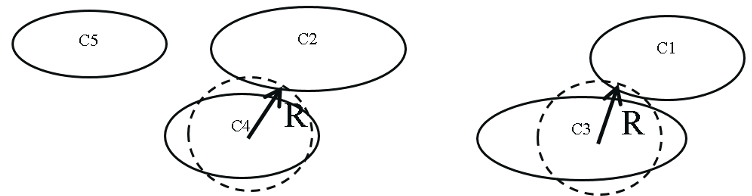 Fig 1: Visualization of user bounded regions and latent state clusters (Home/Work).
The IM Algorithms: Smarter Greedy Selection
The paper proposes two variations of influence maximization:
- IM num: Maximizes the raw number of unique friends predicted to visit.
- IM score: Maximizes the sum of the probabilities of those friends visiting.
The genius of these algorithms lies in the Marginal Gain principle. Instead of just picking the "top 10" most influential people, the algorithm iteratively picks the person who adds the most new potential visitors not covered by the users already selected. This significantly reduces advertising costs by eliminating overlap.
Experimental Results
Using the Brightkite and Gowalla datasets (over 150k users and 10 million check-ins), the results were stark:
- Massive Gains: The IM algorithms provided an order of magnitude improvement over "Baseline 1" (most check-ins) and "Baseline 2" (most friends).
- Data Sensitivity: The model’s performance improved by up to 8x as the training data increased from 32% to 85%, proving that "more history equals better prediction."
- Efficiency: Even with a small k (number of influencers), the "IM score" achieved a 16% higher improvement than the strongest baseline.
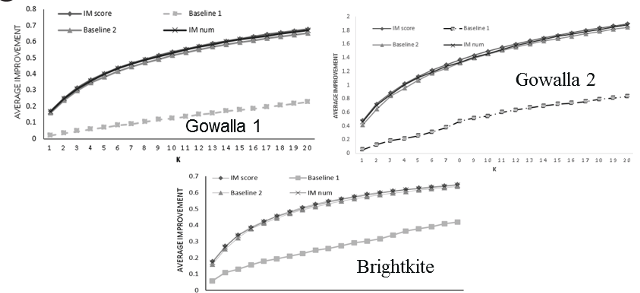 Fig 2: Average improvement of IM models across different LBSN datasets.
Critical Insight & Tactical Conclusion
The primary takeaway for the industry is that social influence in the physical world is highly localized.
While this paper effectively solves the "who to target" problem, it does acknowledge limitations: it doesn't yet account for "group recommendations" (where a whole clique moves together) or the real-time decay of influence. For future LBSN applications, the jump from "predicting one user" to "predicting group dynamics" will be the next frontier.
Final Verdict: This is a robust, mathematically grounded framework for any business—from tourism boards to local coffee shops—looking to turn social media data into physical foot traffic with surgical precision.