
Beyond Social Closeness: Leveraging Geometric Physics for Robust D2D Networks
A Novel Behavioral Social-Aware D2D User Association Scheme based on Self-Propelled Voronoi
This paper introduces a device-centric D2D user association scheme using the Self-Propelled Voronoi (SPV) model and the fφ measure to address selfish node behavior. By leveraging geometric shape indices (p0), the method identifies Important User Equipments (IUEs) and achieves performance gains of up to 3.3x over conventional algorithms while maintaining low computational complexity.
TL;DR
In the evolving landscape of 5G and heterogeneous networks, Device-to-Device (D2D) communication is often modeled as a social network. However, "important" nodes—those with heavy traffic—frequently turn "selfish" to conserve battery, crippling network performance. This paper introduces a breakthrough approach using the Self-Propelled Voronoi (SPV) model and a new fφ measure, replacing complex central processing with simple geometric intuition to handle selfish nodes, boosting efficiency by up to 330%.
The "Selfishness" Crisis in Social D2D
Current D2D frameworks treat high-degree nodes as reliable gateways. But humans are inherently survivalist. In high-stress environments (stadiums, disaster zones, crowded airports), a node designated as "Important" (IUE) faces a battery-drain nightmare. Consequently, these nodes may shut off communication or throttle bandwidth.
Prior works attempt to solve this with repeated central intervention or complex graph-theoretic calculations (closeness, betweenness). The catch? These are computationally heavy and fail to react quickly when a node suddenly stops cooperating.
Methodology: From Biological Tissues to Wireless Nodes
The authors pivot from pure social metrics to Biologically-inspired Physics. They utilize the Self-Propelled Voronoi (SPV) model, typically used to describe cell jamming in biological tissues.
1. The p0 Shape Index (Geometric Centrality)
Instead of counting friends (social distance), the system looks at the shape of the node's Voronoi cell.
- Physical Intuition: Central nodes in a cluster have more compact, regular shapes. Edge nodes or outliers have "stretched" shapes.
- Measure: (Perimeter divided by the square root of Area).
- Insight: A lower signifies a node is centrally located within its cluster, making it a "natural" candidate for an IUE without requiring global network knowledge.
2. The fφ Measure (Reactive Association)
When an IUE turns selfish (), the network must re-associate orphaned UEs immediately. The paper proposes the fφ measure, a 3D vector fusion of:
- Achievable Throughput ()
- Shape Index ()
- Node Degree ()
By applying an adaptive k-Nearest Neighbor (kNN) search in this feature space, the network achieves "Social-Aware" performance with linear complexity .
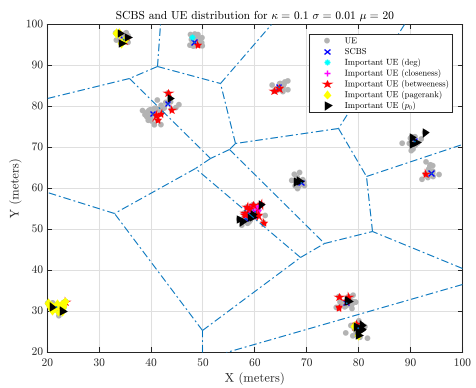 Figure 1: Distribution of Small Cell Base Stations (SCBS) and UEs using the Thomas Point Process, highlighting the Voronoi boundaries used for calculation.
Experiments and Results
The researchers tested the scheme across four distinct scenarios involving different node densities and mobility patterns (modeled after airport gate behaviors).
- Superiority over Random Association (RA): The fφ measure achieves a 2.7x to 3.3x improvement in achievable data rates.
- Comparison to Social-Aware (SA) SOTA: While the p0 measure matches the performance of complex SA algorithms, the fφ measure outperforms SA by 20% to 60% because it reacts more effectively to the disassociation of selfish nodes.
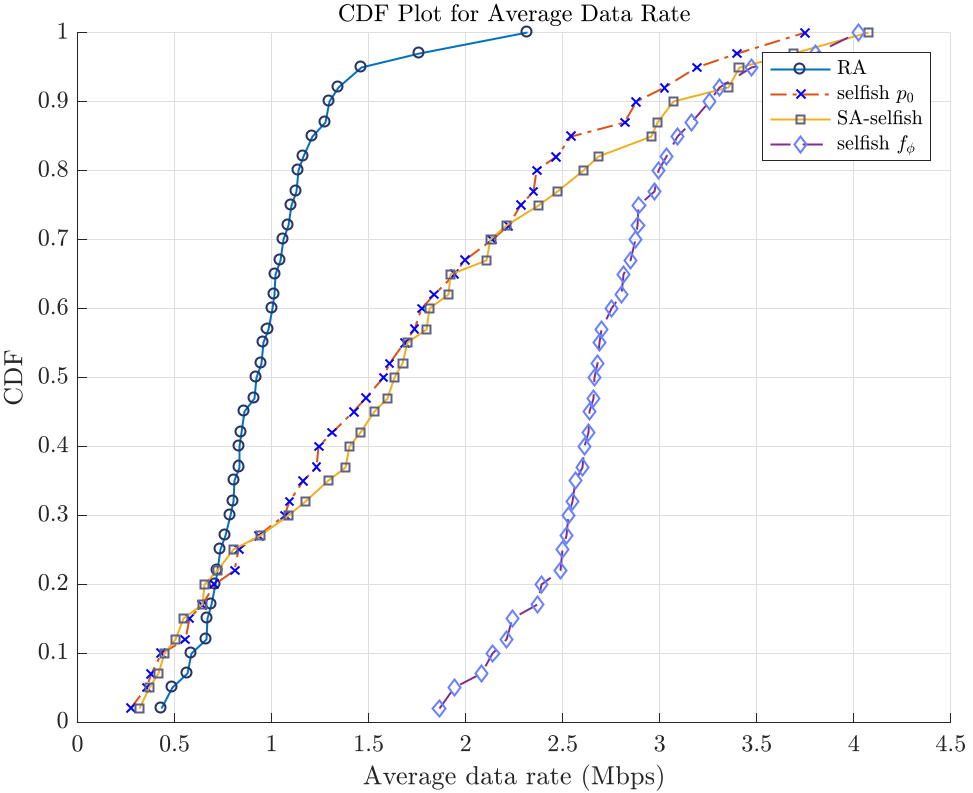 Figure 3: Throughput performance comparison showing fφ-RA (fφ vs Random) drastically outperforming standard association strategies.
Critical Insight: Why This Matters
The brilliance of this work lies in Complexity Reduction. By proving that a node's geometric footprint (Voronoi shape) correlates with its social importance, the authors eliminate the need for global graph updates.
Limitations: The model assumes the central authority can still perform initial Voronoi tessellation. In a truly decentralized ad-hoc network, calculating the exact Voronoi perimeter might still require local coordinate exchanges.
Future Outlook: Integrating this "Survivalist" modeling into 6G standards could lead to self-healing networks where device behavior is as much a part of the PHY/MAC layer as signal strength.