
COTS: Transforming Crowdsourced Chaos into Precision Software Testing
A novel approach to collaborative testing in a crowdsourcing environment
This paper introduces a crowdsourcing-based collaborative testing approach that treats test case assignment as an Integer Linear Programming (ILP) problem. By implementing a greedy algorithm with four heuristic strategies, it optimizes the allocation of software testing tasks to distributed crowd workers while considering their reliability and expertise.
TL;DR
Software testing has long been a bottleneck in the development lifecycle. While crowdsourcing platforms like Amazon Mechanical Turk offer a solution, they often result in redundant work and low-quality reports. This paper presents COTS (Collaborative Testing System), which uses Integer Linear Programming (ILP) and greedy heuristics to intelligently assign test cases. The result? A 53% reduction in testing effort and quality near 90% of the theoretical optimum.
The Problem: The Inefficiency of the Crowd
Crowdsourcing is a double-edged sword. On one hand, you have thousands of potential testers; on the other, you have a "random walk" problem. Without guidance, crowd testers gravitate toward the most visible or popular functions of a Web application (e.g., the Login page), leaving complex, deep-link functionalities ignored.
Furthermore, unlike professional QA teams, crowd testers vary wildly in trustworthiness and availability. Simply put: how do you ensure that every line of code is tested by the right person without wasting time?
The Breakthrough: Testing as an Optimization Problem
The authors' core insight is to treat testing not as a management task, but as a mathematical optimization problem. They define the mission as finding the minimal-time test case combination that meets a "Trustworthiness Threshold" for every page in the application.
The Methodology
The system operates in two distinct phases:
-
Training Phase (Modeling): The application is mapped as a dependence graph. Five matrices are created to capture the physical reality of the task:
- A (Coverage): Which test case hits which page?
- T (Time): How long does each tester take for each task?
- TH (Threshold): How "complex" is a page (measured by Lines of Code)?
- W (Trust): How reliable is this specific tester based on history?
- H (Availability): How much time does the tester actually have?
-
Testing Phase (Execution): Since solving ILP for thousands of variables is NP-Complete (too slow for real-time), the authors developed a Greedy Test Case Assignment Algorithm.
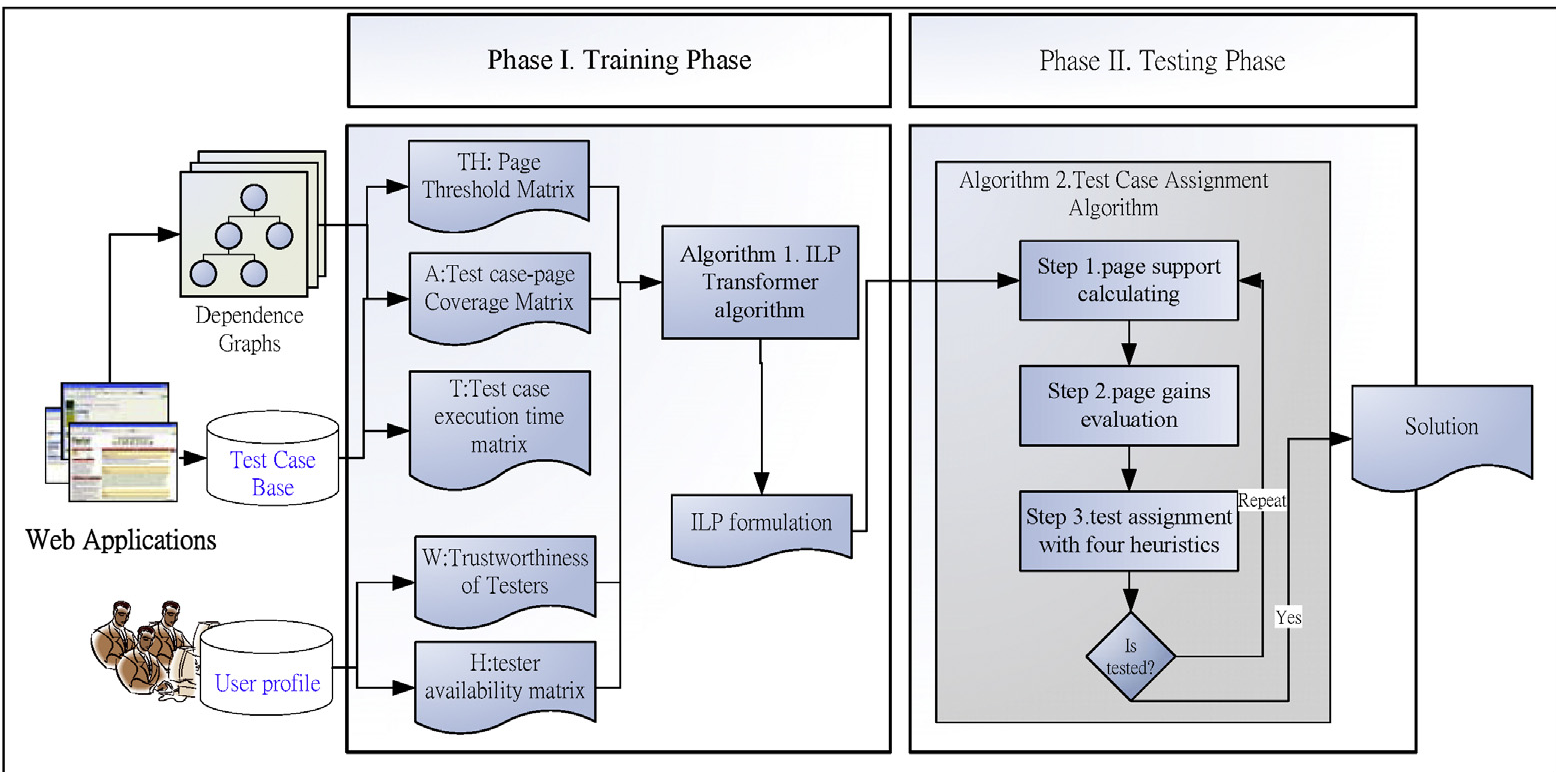
The Heuristic Strategies
The paper evaluates four heuristics (H1-H4) to decide who gets which test case:
- H1: Maximal Coverage (priority on "hitting" more pages).
- H2: Minimal Time (priority on speed).
- H3: Maximal Trust (priority on the best testers).
- H4 (Compound): A balance of time and coverage.
Experimental Results: Speed vs. Quality
The researchers tested COTS against IBM ILOG CPLEX ( a standard for finding "perfect" mathematical solutions).
- Scalability: CPLEX failed to find solutions once variables (testers × test cases) exceeded 2,800. The COTS heuristic, however, produced results in near-constant time.
- Accuracy: The greedy algorithm maintained an approximate solution quality of 90% compared to the mathematical optimum.
- Efficiency: In a real-world test with 144 testers, the "Guided" group (using COTS) discovered all 10 hidden bugs 3 days faster than a "Random" group, reducing total effort by 53%.

Professional Insight & Future Outlook
The true value of this work lies in the quantification of "Trustworthiness." By turning a subjective human trait into a weighting variable (), the model can effectively filter out "noise" from inexperienced testers.
However, a notable limitation is the static nature of the "trust" variable. Future systems would benefit from reinforcement learning, where the model updates a tester's trust score in real-time based on the validity of the bug reports they submit during the session.
In an era where "Test-as-a-Service" (TaaS) is becoming the norm, COTS provides a blueprint for how companies can stop treating crowdsourcing as a "black box" and start treating it as a precision engineering tool.
Summary Takeaway: By framing collaborative testing as an ILP problem, the authors prove that algorithmic guidance can halve the cost of QA while maintaining professional-grade defect detection.