
CISIR: The Mathematical Battleground of Competing Social Media Information
Novel competitive information propagation macro mathematical model in online social network
This paper proposes CISIR (Competitive Information Susceptible Infected Recovered), a novel macro-mathematical model for competing information propagation in Online Social Networks (OSNs). By integrating Markov chain theory and mean-field dynamics, the authors quantify how different information types compete for node attention and achieve SOTA accuracy in simulating real-world social media "battle for public opinion."
Executive Summary
TL;DR: This paper introduces the CISIR (Competitive Information Susceptible Infected Recovered) model, a mathematical framework that explains how two different pieces of information "fight" for survival in Online Social Networks (OSNs). Unlike traditional spreading models, CISIR accounts for the replacement mechanism, where a more "attractive" or authoritative piece of news can effectively overwrite an existing one in a user's mind.
Academic Positioning: This work bridges the gap between traditional epidemiology-inspired models and complex social psychology, providing a rigorous Markovian foundation for understanding public opinion shifts and rumor control.
Problem & Motivation: The Zero-Sum Game of Attention
In the modern OSN landscape, users are bombarded with conflicting narratives. Previous models often treated information spreading as an independent process (like two viruses that don't interact). However, the authors argue that information is competitively interactive.
If "Information A" is a rumor and "Information B" is an official debunking, they are in direct competition. The core challenge is: How do we mathematically model the moment one piece of information "kicks out" another from a node?
Methodology: Markov Chains and Mean-Field Evolution
The authors define a state space . The transformation logic is governed by a Transition Probability Matrix, where the probability of moving from to depends on the Replacement Rate ().
The Core Framework
The system's behavior is captured by a set of differential equations that describe the rate of change for each population:
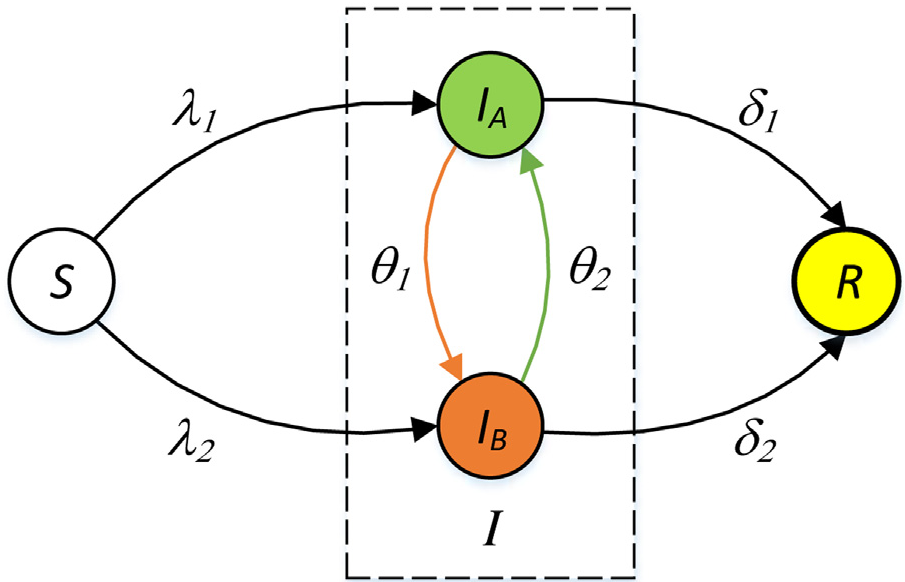
In this diagram, we see the crucial paths: S-nodes can be "infected" by either A or B, but IA and IB nodes can also transform into each other based on mutual attractiveness ().
The authors then use Stability Analysis (Routh-Hurwitz criterion) to prove that the system eventually reaches an equilibrium. Crucially, they found that in a strictly competitive environment, the network usually "tips" toward one dominant narrative, effectively suppressing the other.
Experimental Results: Timing is Everything
The authors conducted experiments on a Small-World Network (N=5000, ) to test various scenarios:
- Synchronous Competition: When A and B are released together, the one with the higher replacement rate () wins almost instantly.
- Asynchronous Competition: If Information A starts early, it can cover 90%+ of the network. However, if Information B is released with a high enough replacement rate, it can reverse the trend.
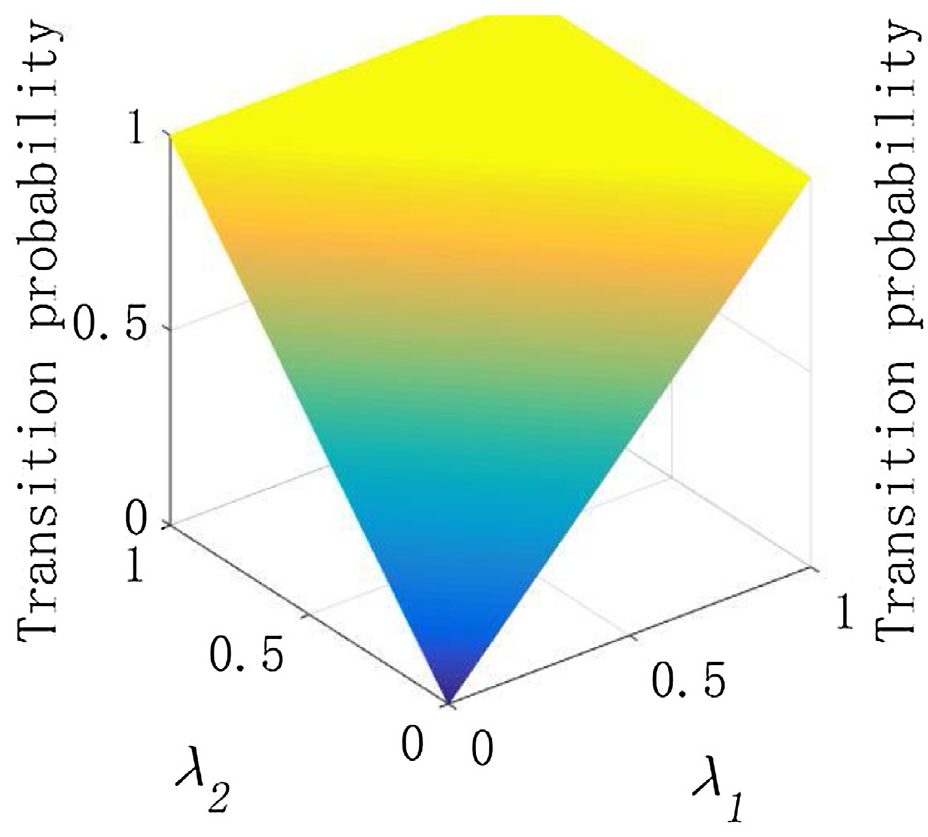 Figure: The "overtaking" maneuver where Information B (solid line) displaces Information A (dotted line) over time.
Real-World Case Study
The model was applied to the "Fan Bingbing Evasion Tax" incident.
- Info A: Rumors and unofficial reports during her 100-day disappearance.
- Info B: Official punishment announcement by authorities. The model's output showed a remarkable fit with real-world Weaver/Baidu Index data, proving that official, high-credibility information acts as a "high-" infector that sanitizes the network.
Critical Analysis & Takeaways
The "Opinion Leader" Effect
The research highlights that the network structure (specifically node degree) acts as a force multiplier. If an "Opinion Leader" (high-degree node) adopts Information B, the replacement process accelerates exponentially across the network.
Limitations
The model assumes a "closed system" with constant node counts and simplifies social psychology into a single parameter (). In reality, factors like "confirmation bias" might make certain nodes immune to replacement, a factor not fully explored here.
Conclusion
The CISIR model provides a powerful tool for both brands and governments. It suggests that to stop a rumor, one should not just "filter" it, but replace it with a more "infectious" and credible counter-narrative as early as possible.