
A New Defense for Cognitive Radio: Crowdsourcing Spectrum Sensing via Agreement Ratio
The Novel Crowdsourcing Algorithm for Cooperative Spectrum Sensing
The paper introduces a "Novel Crowdsourcing Algorithm" for Cooperative Spectrum Sensing (CSS) in cognitive radio networks. It utilizes an Agreement Ratio (AR) estimation and joint verification of location/reputation to distinguish between honest secondary users and malicious ones, significantly enhancing spectrum state information (SSI) accuracy.
Executive Summary
TL;DR: This paper tackles the "trust" issue in crowdsourced spectrum sensing by introducing an Agreement Ratio (AR). By combining spatial verification (where the user is vs. what they should hear) with a dynamic reputation system, the algorithm successfully filters out malicious actors, maintaining over 90% sensing accuracy even in hostile environments.
Academic Positioning: This work enhances the robustness of Cognitive Radio Networks (CRNs). It bridges the gap between simple reputation voting and complex multidimensional data fusion, providing a practical framework for 5G and future 6G spectrum sharing.
Problem & Motivation
The scarcity of wireless spectrum is a major bottleneck for 5G. Cognitive Radio allows "Secondary Users" (MUs) to use licensed spectrum when the "Primary User" is idle. However, building a dedicated sensing infrastructure is expensive.
The Crowdsourcing Opportunity: Using billions of mobile devices as sensors. The Fatal Flaw: Malicious users. Some MUs might lie about spectrum occupancy to hog resources or cause interference.
- Prior Work Limits: Existing methods like reputation-based filtering [6] or simple clustering [9] struggle when the network is split (low agreement) or when channel conditions are volatile, often misidentifying honest users as malicious.
Methodology: The Core Architecture
The proposed algorithm operates in three critical stages: Estimation, Verification, and Update.
1. The Agreement Ratio (AR)
Instead of just voting, the Fusion Center (FC) calculates an Agreement Ratio (AR_i). It measures the consensus among users who meet a minimum reputation threshold. If AR > ψ (high consensus), a majority verdict is used. If AR ≤ ψ (low consensus), the system enters "Joint Verification."
2. Joint Verification (Location + SNR + Reputation)
This is the "Secret Sauce" of the paper.
- Spatial Consistency: For MUs claiming the spectrum is occupied, the FC checks if their reported SNR matches their distance from the primary transmitter using a multi-ring region model.
- Stricter Thresholds: For MUs claiming the spectrum is idle, the FC applies a meatier reputation check (), as SNR data is less informative in idle states.
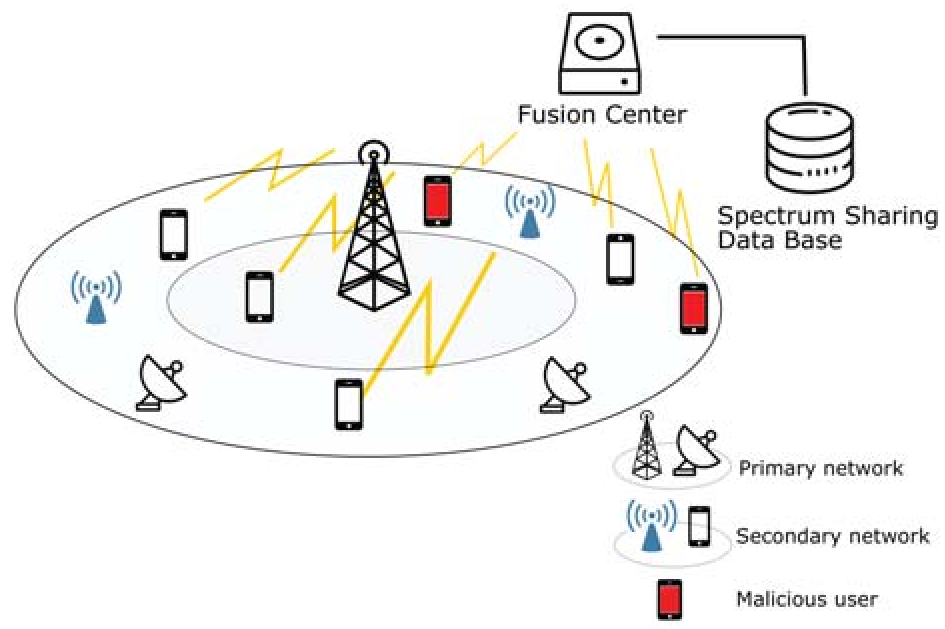 Fig. 1: The interaction between Primary Networks, Secondary Users (MUs), and the Fusion Center.
3. Dynamic Reputation Update
Reputation isn't static. In low-agreement scenarios, a Reputation-loss factor (β) is applied to penalize users whose spatial data contradicts their reported SSI significantly.
Experiments & Results
The authors tested the system against SOTA benchmarks with up to 100 MUs and varying numbers of malicious actors ().
- Sensing Accuracy: While competitors saw accuracy drop sharply as malicious users increased, the proposed scheme remained robust, staying above 90% accuracy in most scenarios.
- Misclassification: A standout result is the significant reduction in "False Positives"—honest users are far less likely to be blacklisted compared to the methods in [9] and [12].
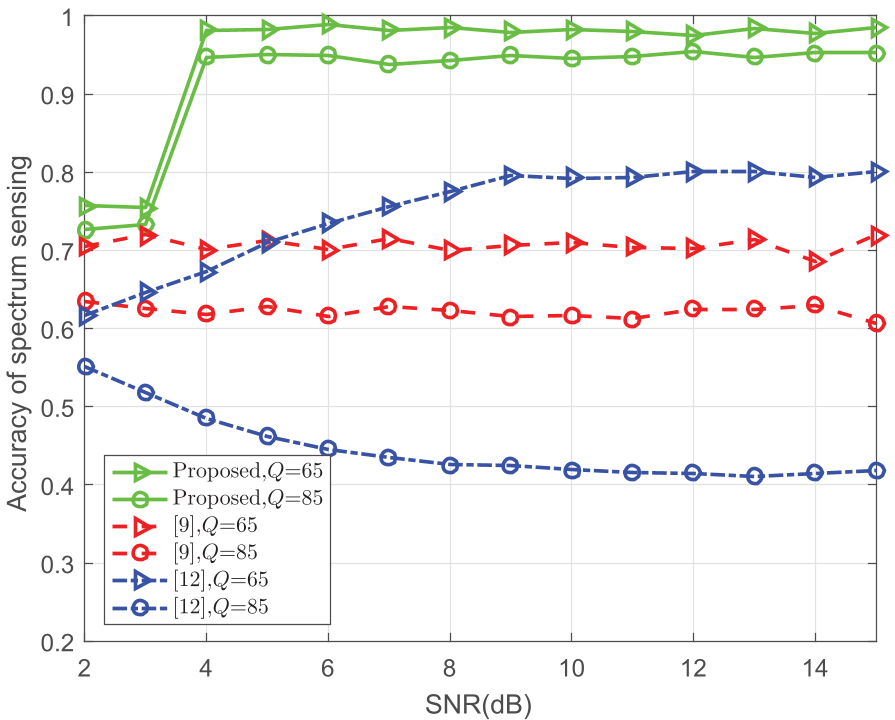 Fig. 4: Accuracy of spectrum sensing vs SNR. The proposed algorithm (top curves) shows clear superiority as malicious users increase from 20 to 30.
Critical Analysis & Conclusion
Takeaway
The genius of this work lies in the Agreement Ratio as a trigger. By only performing expensive joint verification when users disagree, the system stays computationally efficient while remaining secure.
Limitations
- Static Primary User: The model assumes a fixed location for the primary transmitter. In dynamic environments (e.g., mobile base stations), the spatial verification math would become significantly more complex.
- Collusion: The paper focuses on individual malicious behavior. If malicious users collude to report a singular, spatially consistent lie, the Agreement Ratio might be bypassed.
Future Work
The next frontier is extending this to dynamic path-loss environments and integrating Machine Learning to predict malicious patterns before they compromise a sensing task.