
Beyond RMS: A DTW-Driven Paradigm for Reservoir History Matching
A Novel Data Analytics Framework for the History Matching Problem for Reservoir Simulation in Up-Stream Petrochemical Industry
This paper introduces a novel data analytics framework for the "History Matching" problem in reservoir simulation, replacing traditional RMS-based metrics with Dynamic Time Warping (DTW). By leveraging DTW distance scores as features for Machine Learning, the framework achieves automated classification and ranking of geological simulation models.
TL;DR
In the upstream oil and gas industry, "History Matching" is the critical yet exhausting task of aligning reservoir simulations with historical production data. Traditional Root Mean Square (RMS) metrics fail to handle temporal shifts, leading to poor model selection. This paper presents an IBM-led framework that replaces RMS with Dynamic Time Warping (DTW) and Machine Learning, enabling the automated identification of breakthrough phenomena and ranking of simulation models.
The "Breakthrough" Problem: Why RMS Fails
In reservoir modeling, engineers tweak millions of geophysical properties to match simulation outputs with reality. The industry standard for "matching" has historically been Root Mean Square (RMS) error.
However, RMS is inherently flawed for time-series analysis in this context. If a simulation predicts a water breakthrough two weeks early (an "Early Breakthrough"), RMS will penalize the model heavily because it only compares data points at the exact same time stamp. This rigidness ignores the fact that the shape and trend of the curve might be highly accurate, just shifted in time. Consequently, the industry has struggled to automate this process, relying instead on the "trial and error" expertise of human modelers.
Methodology: The Elasticity of Dynamic Time Warping
The core innovation is the transition from point-to-point comparison to Dynamic Time Warping (DTW). DTW is a dynamic programming algorithm that finds an optimal alignment between two sequences by "warping" the time axis.
1. The Geometry of Matching
The authors define three states of matching based on the DTW path relative to the diagonal of a 2D sequence matrix:
- Perfect Match: The path is a straight diagonal, and the DTW score is zero.
- Amplitude Shift: The path is diagonal, but a positive score indicates magnitude differences (where DTW behaves like a robust RMS).
- Temporal Shift: The path deviates from the diagonal, capturing phase lags like early or late breakthroughs.
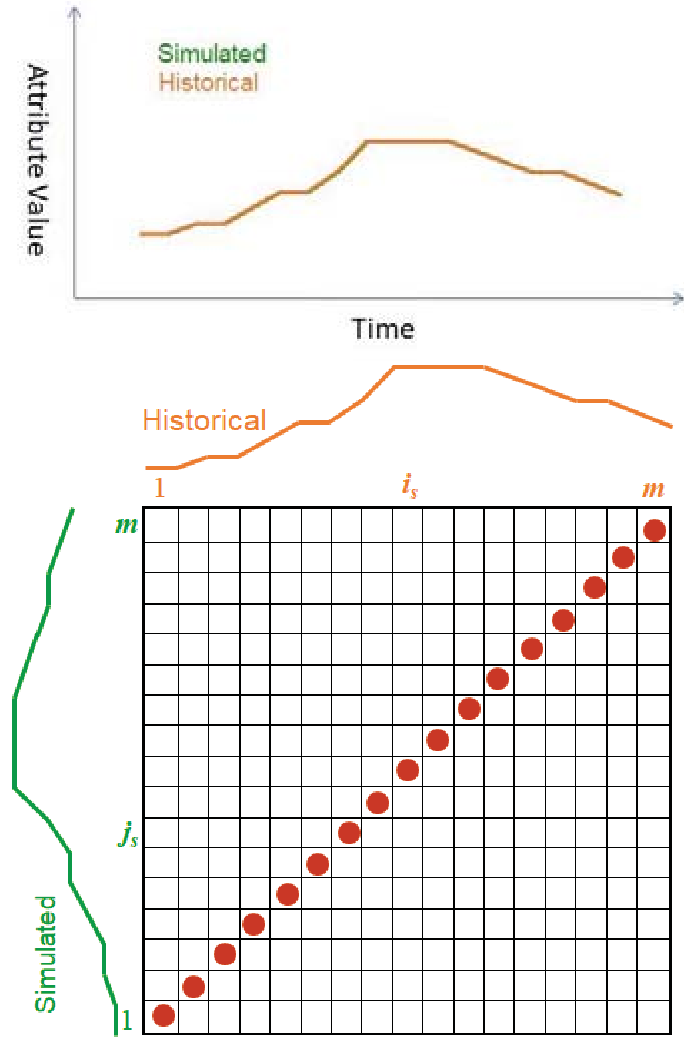 Fig 1: The logical solution blocks, showing the transition from DTW extraction to ML classification.
2. Feature Engineering & Rules Engine
By processing functional attributes like FOPR (Field Oil Production Rate) and FGPR (Field Gas Production Rate) through DTW, the system generates "DTW extracts." These extracts are fed into a rules engine. For instance, if a physical phenomenon occurs in the reservoir, the temporal shift should be consistent across both oil and gas rates. If the DTW paths for both attributes show a deviation at the same time interval, the model is flagged as "consistent" or "high pedigree."
Experimental Insights
The framework was deployed on IBM CloudPak for Data, utilizing open-source Python libraries. Testing on a decade of production data revealed that DTW could pinpoint specific time-warping instances (e.g., between weeks 18-22) that RMS would have either over-penalized or mischaracterized.
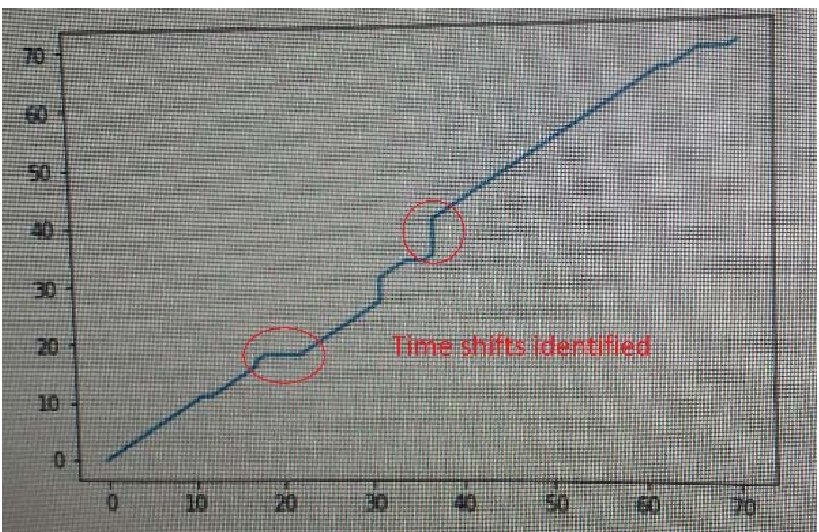 Fig 2: Visualization of the FGPR attribute (top) and the corresponding DTW output (bottom) identifying precise regions of time-shifts.
By quantifying these shifts into feature vectors, the authors moved from qualitative "expert hunches" to quantitative ML-based ranking. They successfully categorized models on a scale from 1 (Excellent) to 5 (Reasonable), allowing engineers to focus only on the most promising geological scenarios.
Critical Analysis & Conclusion
This work represents a significant step toward the "Digital Twin" in the oil and gas sector. The primary contribution is the shift in Inductive Bias: recognizing that in physical reservoirs, temporal sequences are rarely perfectly synchronized.
Limitations & Future Work
While the results are encouraging, the current paper focuses heavily on the filtering mechanism. The second half of the pipeline—using Self-Organizing Maps (SOM) to map simulation parameters (like permeability or porosity) to the resulting match quality—is only briefly mentioned. Furthermore, while DTW solves time-shifting, it can be computationally expensive () compared to RMS (), which may pose challenges for real-time processing of millions of models without further optimization (like FastDTW).
In conclusion, by encoding temporal elasticity into the matching process, this framework provides a more "physically intuitive" metric that brings the industry closer to fully autonomous reservoir management.