
SMAR: Secure Data Integrity for Highly Dynamic Vehicular Social Networks
A Novel Data Sharing Mechanism via Cloud-Based Dynamic Audit for Social Internet of Vehicles
The paper introduces SMAR (Secure Mechanism for Auditing shared data in IOV with signature Refreshment), a novel cloud-based data sharing and auditing scheme for Social Internet of Vehicles (SIoV). It utilizes a specialized Proxy Re-signing mechanism with Homomorphic properties (PRSH) to ensure shared data integrity and efficient signature updates when vehicle group members change.
TL;DR
In the Social Internet of Vehicles (SIoV), vehicles frequently join and leave "interest groups" (e.g., traffic update groups, chat rooms), creating a security nightmare. When a member leaves, their signatures on shared data must be updated to prevent unauthorized modifications. The SMAR (Secure Mechanism for Auditing with signature Refreshment) framework offloads this heavy cryptographic burden to the cloud using a Proxy Re-signing approach. It allows the cloud to refresh signatures without seeing the private keys, improving efficiency by over 60% compared to traditional vehicle-centric methods.
Problem & Motivation: The "Churn" Challenge in SIoV
Modern intelligent transportation relies on vehicles sharing sensor data and road conditions in real-time. However, vehicles are highly dynamic; a car might belong to a local "traffic jam" group for only five minutes.
Current security paradigms often use User-Centered Design (UCD). In UCD, if a user leaves, the remaining users must:
- Download the old data segments.
- Verify the signatures of the departed user.
- Re-sign the data with their own keys.
- Re-upload the data.
For a vehicle with limited battery and processing power, this cycle is a performance killer. The authors identify this bottleneck and ask: Can we let the cloud handle signature updates without the cloud ever actually knowing our private keys or the raw data?
Methodology: Proxy Re-signing meets Homomorphism
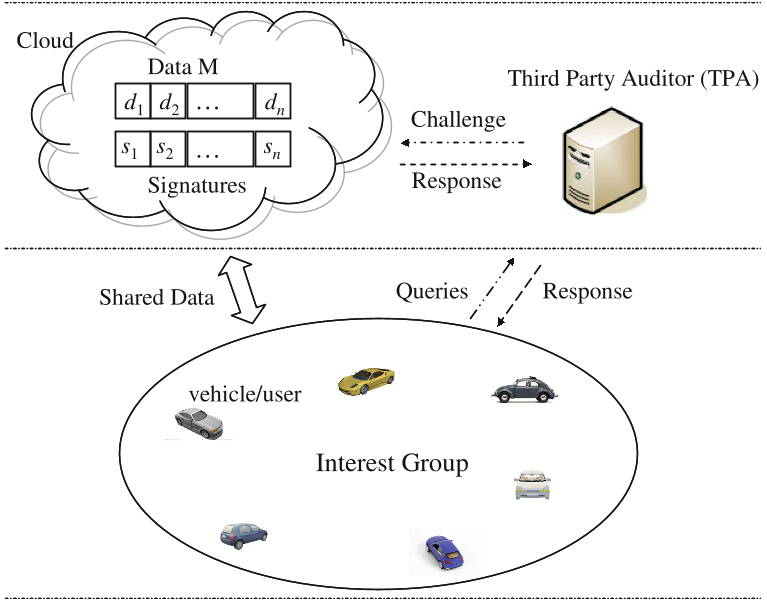
The heart of the paper is PRSH (Proxy RE-signing with Homomorphic properties). The system model involves four players: Vehicles, Gateway/AP, the Cloud, and a Third Party Auditor (TPA).
The Core Logic (Re-signing)
When User A leaves the group and User B is the new designated signer:
- The cloud collaborates with A and B to generate a Re-signing Key ().
- Crucially, this key is a "blind" transformation factor. The cloud uses it to turn into without ever knowing User B's private key or the contents of the data.
Dynamic Auditing
By utilizing Homomorphic signatures, the Third Party Auditor (TPA) can verify the aggregate integrity of the data. Instead of checking every segment, the TPA sends a "challenge" for a subset of data. The cloud generates a single "proof" that combines multiple signatures into one, saving massive amounts of bandwidth.
Experiments & SOTA Performance
The authors benchmarked SMAR against the UCD baseline across several metrics:
1. Re-signing Efficiency
As the number of segments to be re-signed grows, SMAR maintains a much flatter growth curve. When re-signing 1,000 segments, SMAR is nearly 3 times faster than UCD. This is because vehicles only need to participate in a tiny key-generation step rather than a massive data download/upload cycle.
2. Scalability to Large Groups
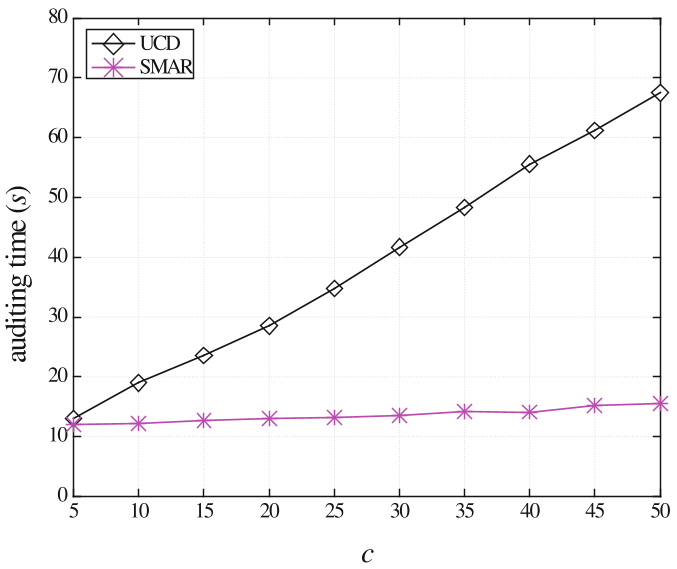
As the number of vehicles (c) in a group increases, the auditing time for SMAR remains relatively stable. In a group of 50 vehicles, SMAR's auditing time is only 1/3 of the UCD baseline.
3. Communication Overhead
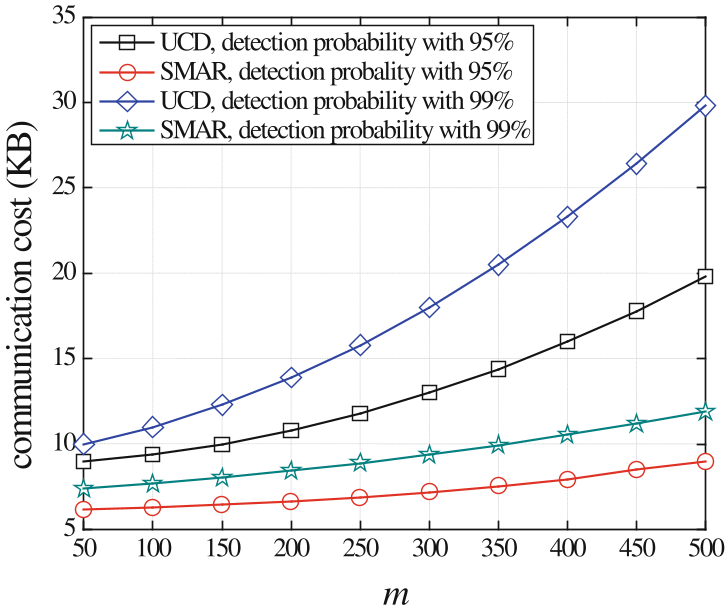
The TPA doesn't need to be 100% certain locally. By auditing roughly 300 random segments, the system reaches a 95% to 99% probability of detecting malicious data tampering, significantly lowering the "security tax" on the network.
Critical Analysis & Conclusion
Takeaway: SMAR proves that for IoT environments with high "churn," the cloud must be an active participant in security maintenance, not just a passive storage bucket. By using Proxy Re-signing, we achieve a "Zero-Knowledge" like effect where the cloud performs work on signatures it doesn't truly "own."
Limitations: The paper assumes no collusion between the cloud and the users. In a real-world scenario, if a malicious cloud provider colluded with a revoked user, they might still find ways to spoof data.
Future Outlook: The next step for this research is likely integrating State Space Models (SSMs) or Blockchain to remove the need for a semi-trusted Third Party Auditor entirely, creating a fully decentralized and trustless Social IoV environment.