
IEDP: Scaling Information Diffusion Prediction with Information-Dependent Latent Space
9139_A Novel Embedding Method for Information Diffusion Prediction in Social Network Big Data.
The paper introduces IEDP (Information-dependent Embedding-based Diffusion Prediction), a novel framework that maps social network users into a latent embedding space to predict information diffusion cascades. By utilizing information-specific matrices and translation-based scoring, it achieves state-of-the-art accuracy and multiple orders of magnitude speedup in inference compared to traditional probabilistic models.
Executive Summary
TL;DR: The IEDP (Information-dependent Embedding-based Diffusion Prediction) model transforms the complex problem of temporal information propagation into a spatial distance problem in a latent embedding space. By embedding both users and the specific content being spread, it achieves higher precision and significantly faster inference than traditional simulation-based methods.
Positioning: This work moves away from graph-heavy simulations (like Independent Cascade Models) toward representation learning. It effectively bridges the gap between Natural Language Processing (NLP) embedding techniques and Social Network Analysis (SNA).
The "Big Data" Pain Point in Diffusion
Traditional models for predicting "who will share this next" suffer from two fatal flaws in the era of social big data:
- Structural Dependency: Models like ICM and LTM assume we have a perfect map of the social graph. In reality, "follower" lists are often private or incomplete.
- Content Blindness: Most models treat "Sports News" and "Political Rumors" as the same biological-style infection, ignoring that user influence is highly topic-dependent.
- Computational Complexity: Relying on Monte-Carlo simulations to predict cascades is computationally prohibitive for real-time applications.
Methodology: From Time to Space
The core insight of IEDP is that the temporal order of user infections in a cascade can be represented as spatial distance in a latent manifold.
1. Translation-style Embedding
Inspired by the TransE model in Knowledge Graphs, IEDP posits that if user (source) shares information to user (infected), then: Here, acts as a "translation vector" that moves the source user toward the infected user in the latent space.
2. Information-Dependent Projections
Unlike previous embedding models (like CSDK), IEDP introduces information-specific matrices and . This allows the model to project users into different subspaces depending on whether the content is about sports, politics, or entertainment, capturing the asymmetric influence between users more accurately.

3. Ranking-Loss Optimization
The model is trained using a margin-based ranking loss. It ensures that "true" infections have a smaller distance score in the embedding space than "false" or "later" infections:
Experimental Validation
The authors tested IEDP on three major datasets: Digg, Memetracker, and Google+.
1. Superior Accuracy
In all cases, IEDP outperformed baselines. The inclusion of content-dependent embeddings (the "I" in IEDP) provided a noticeable boost over its simplified version (TransE), proving that the topic matters as much as the social link.
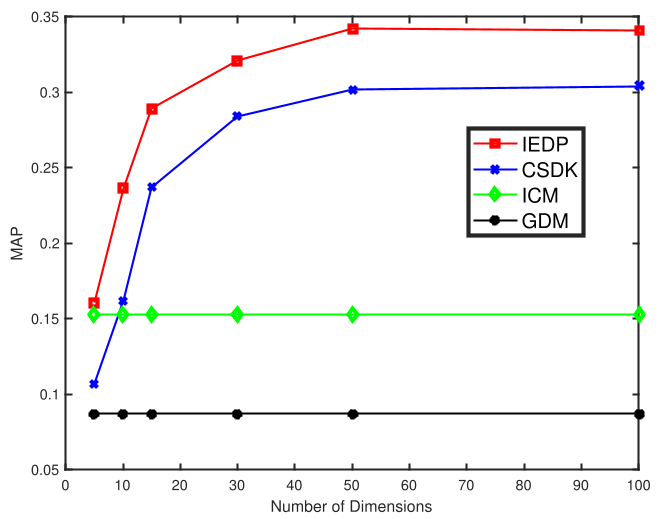
2. Inference Speedup
This is where IEDP shines. By replacing graph traversals with vector distance calculations:
- ICM: > 24 hours
- CSDK: 1 hour
- IEDP: 25 minutes (on the same hardware)
Critical Insight & Conclusion
Takeaway
IEDP demonstrates that we don't need the "full graph" to predict social behavior. The observed cascades themselves contain enough geometric structure to build a latent map of influence. By treating content as a translation vector, the authors effectively modeled the "momentum" of information.
Limitations & Future Work
While IEDP is efficient, it still requires retraining to handle entirely new users not seen in the training cascades. The authors suggest that future work could integrate explicit social structures (where known) into the embedding process to create a hybrid model that captures both global relationships and local content dynamics.