
The Ghost in the Machine: A Bio-Inspired Emotion Engine for Robots
Novel emotion engine for robot and its parameter tuning by bacterial foraging
This paper proposes a novel "Emotion Engine" for robots, integrating a Multi-Agent System (MAS) to simulate human-like emotional dynamics and employing Bacterial Foraging Optimization (BFO) for efficient parameter tuning. The system aims to move beyond simple classification toward a functional, reactive emotional architecture for autonomous agents.
TL;DR
Researchers have developed a hybrid "Emotion Engine" that treats robot feelings as a competing Multi-Agent System. By applying Bacterial Foraging Optimization (BFO)—an algorithm mimicking E. coli's search for food—they've created a method to tune emotional parameters that is faster and more biologically grounded than traditional high-dimensional Neural Networks.
Background: Why Do Robots Need Feelings?
In the quest for true Artificial Intelligence, "Emotion" is often the final frontier. It isn't just about making a robot smile; it’s about Action Selection. Feelings like fear or anger serve as heuristic shortcuts for biological entities to prioritize survival. Conventional methods try to "recognize" emotions using heavy deep-learning models, but these models are often black boxes and computationally expensive. This paper shifts the focus from simple classification to an integrated emotional dynamics system.
The Problem: The High-Dimensional Trap
Previous work using Neural Networks (NNs) for facial and speech recognition suffers from:
- Low Speed: High-dimensional data requires massive training time.
- Lack of Dynamics: NNs often output a static label (e.g., "Sad"), whereas human emotions are fluid and interactive.
Methodology: Bacteria and Brains
The authors propose a two-pronged "Hybrid" approach.
1. The Multi-Agent Emotion Architecture
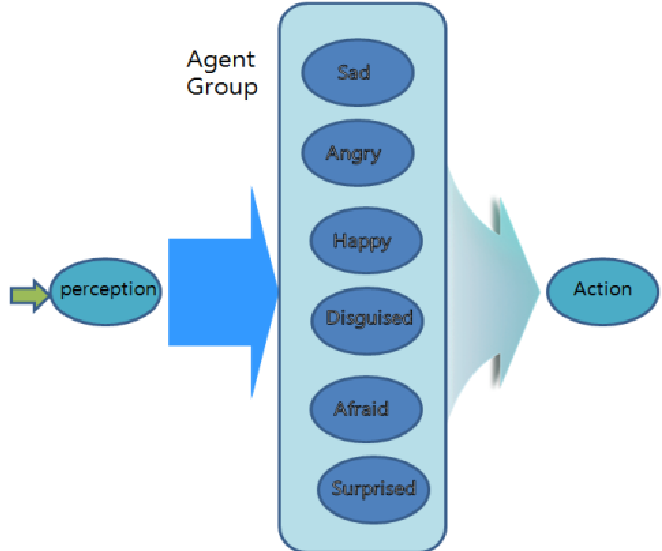
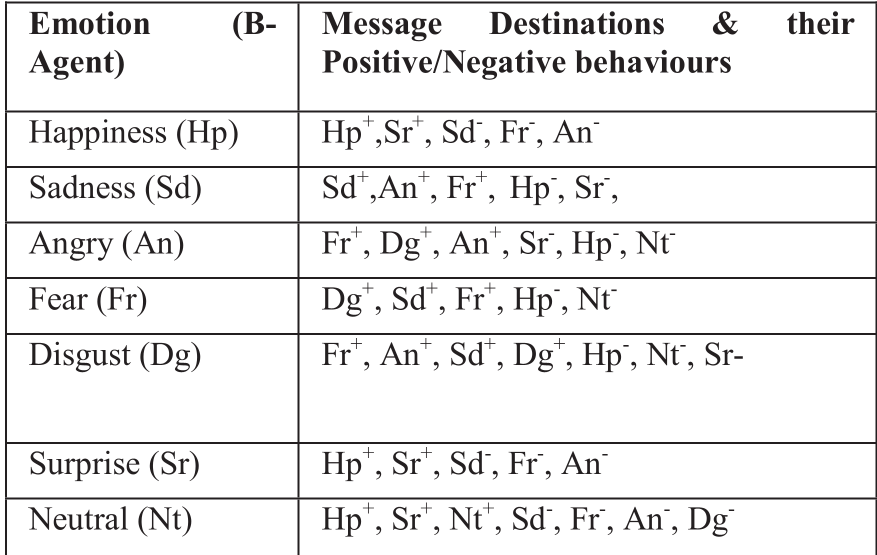
Instead of one "Emotion Module," the robot possesses several B-Agents (Happiness, Sadness, Angry, Fear, Disgust, Surprise, Neutral). These agents interact via messages that act like biological neurotransmitters.
- Stimulation: A "Happy" agent sends positive signals to "Surprise" agents.
- Inhibition: A "Happy" agent sends suppressive signals to the "Sadness" or "Angry" agents.
2. Bacterial Foraging Optimization (BFO)
To find the perfect balance (tuning) for these emotional responses, the authors looked at E. coli. The BFO algorithm simulates:
- Chemotaxis: "Tumbling" and "Running" towards higher nutrient gradients (lower error).
- Reproduction: The healthiest bacteria (best parameters) split, while the weakest die.
- Elimination-Dispersal: Occasional random triggers move bacteria to new areas to avoid getting stuck in "local optima."
Experiments & Results
The system was tested using a robot designed to navigate terrain while managing these internal emotional states. The parameters for the robot’s PID controller were tuned using the BFO process, focusing on the Integral of Time multiplied by Squared Error (ITSE) as the cost function.

Key Findings:
- Efficiency: The BFO-MAS hybrid outperformed traditional NN-based recognition in speed.
- Inter-agent Dynamics: The table below illustrates the complex inhibitory/excitatory relationships the system manages, ensuring that the robot doesn't exhibit "confused" emotional states.
Deep Insight: Beyond Recognition
The brilliance of this work lies in the Inductive Bias that emotions are not just outputs, but control variables. By using Bacterial Foraging, the authors acknowledge that the "Search Space" of human-like emotion is irregular and noisy. BFO’s ability to "swarm" and "disperse" makes it uniquely suited for tuning non-linear systems like an Emotion Engine.
Conclusion & Future Look
The proposed method proves that bio-inspired algorithms can handle the "fuzziness" of artificial emotions better than rigid architectures. However, the current model relies on predefined "Positive/Negative" behavior tables. The next step for this research will likely involve Unsupervised Learning, where the robot discovers which emotional cross-talk (e.g., should Disgust inhibit Sadness?) is most beneficial for its specific environment.
Takeaway for Tech Leads: If you are dealing with high-dimensional parameter tuning in non-linear control systems, look past standard SGD or Adam optimizers—natural foraging models like BFO offer a robust, global-search alternative.