
Beyond Fuzzy Guesses: A New Era for Intelligent Healthcare Evaluation using CoCoSo and CRITIC
A novel interval-valued fuzzy soft decision-making method based on CoCoSo and CRITIC for intelligent healthcare management evaluation
The paper introduces a novel decision-making model for Intelligent Healthcare Management (IHM) by integrating Interval-Valued Fuzzy Soft Sets (IVFSS) with the Combined Compromise Solution (CoCoSo) and CRITIC weighting methods. The method establishes a new score function to better handle uncertainty and achieves SOTA performance in alternative differentiation for healthcare assessment.
TL;DR
As AI becomes the backbone of modern healthcare, the ability to evaluate health risks under uncertainty is paramount. This paper presents a robust decision-making framework using Interval-Valued Fuzzy Soft Sets (IVFSS) combined with CoCoSo and CRITIC. It solves long-standing mathematical bugs like "division by zero" and "counterintuitive results," providing a reliable tool for ranking patient health profiles or selecting the best AI healthcare partners.
Background: The Fog of Medical Uncertainty
Intelligent Healthcare Management (IHM) isn't just about reading a blood pressure cuff; it’s about synthesizing a dozen variables—from BMI to Homocysteine—into a coherent action plan. However, medical data is inherently "fuzzy." Standard fuzzy sets often fail because they provide a single point of membership. Interval-Valued Fuzzy Soft Sets (IVFSS) allow for a range (e.g., membership degree [0.6, 0.8]), which better captures the hesitation and imprecision of clinical judgment.
The "Pain Points" in Traditional MCDM
The authors identify four gaps in current SOTA methods:
- Counterintuitive Phenomena: Some models rank a clearly inferior candidate higher due to mathematical artifacts.
- The Zero-Division Trap: Classical TOPSIS variants fail if the denominator in normalization hits zero.
- Low Resolution: When patients have similar profiles, existing score functions often yield identical scores, making them useless for tied-break scenarios.
- One-Sided Weighting: Relying only on an expert's opinion (subjective) or only on data variance (objective) leads to biased evaluations.
The Core Innovation: CoCoSo + CRITIC
The paper introduces a hybrid pipeline to solve these issues:
1. A Novel Score Function
The authors propose a logarithmic-based score function (): Unlike previous linear functions, this version is strictly monotonic and has a significantly higher "differentiation power," ensuring that even subtle differences in medical intervals result in distinct rankings.
2. Hybrid Weighting (The CRITIC Edge)
To determine how much weight to give to "Blood Glucose" vs. "Waist Circumference," the authors use:
- CRITIC: An objective method that looks at the standard deviation of data and the correlation between criteria (if two metrics are twins, they shouldn't both get full weight).
- Subjective Input: Expert clinical experience. The result is a Combined Weight that is neither purely data-driven nor purely anecdotal.
3. The CoCoSo Framework
The Combined Compromise Solution aggregates scores using three different strategies (Arithmetic mean, relative scores, and balanced compromise) to reach a final ranking that is resilient to outliers.
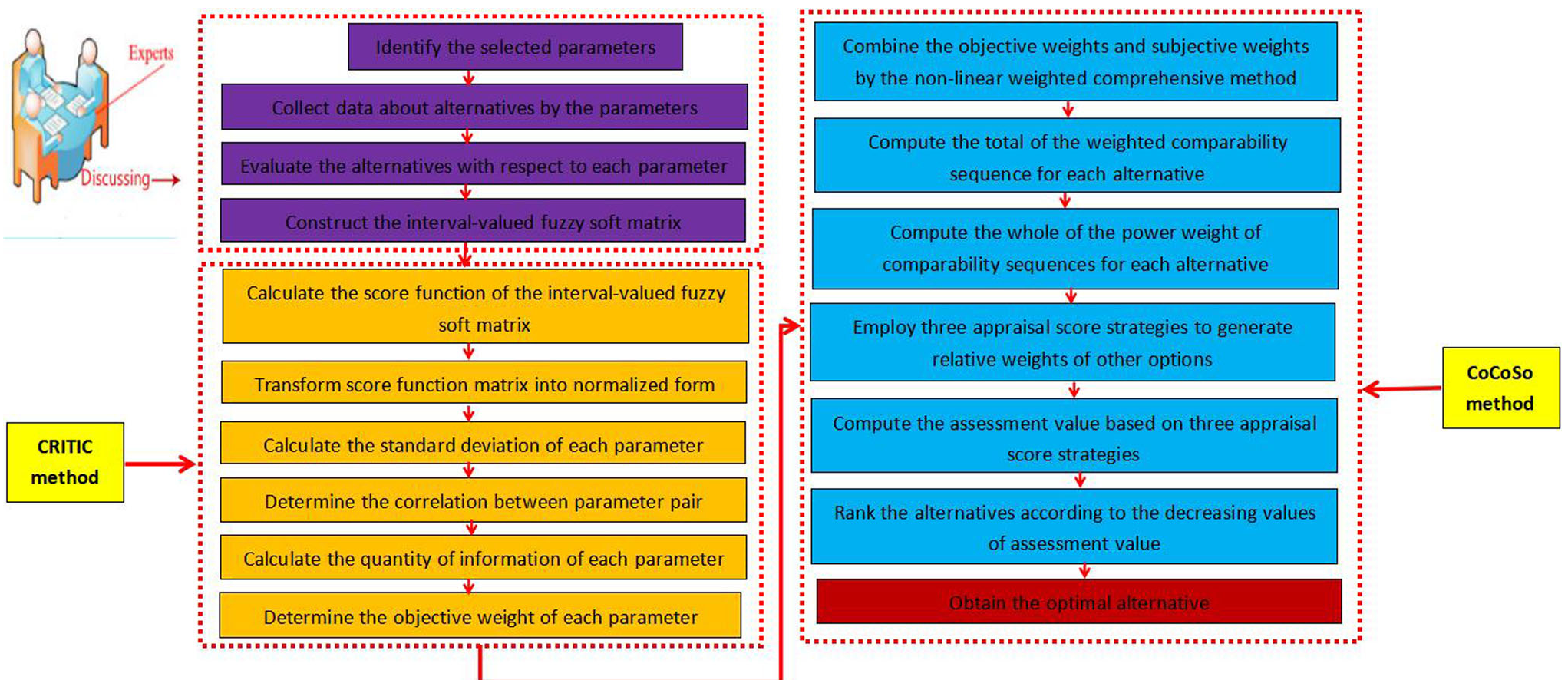 The Integrated Framework: From Fuzzy Input to Final Ranking.
Real-World Application: Healthcare Check-ups
The model was tested on an evaluation of check-up individuals utilizing 16 key physiological parameters.
Experimental Results
The study compared the proposed model against 10 existing methods (WDBA, CODAS, TOPSIS, etc.). While older methods like TOPSIS (Yang & Peng 2017) crashed due to "division by zero" errors in specific medical scenarios, the CoCoSo model remained stable.
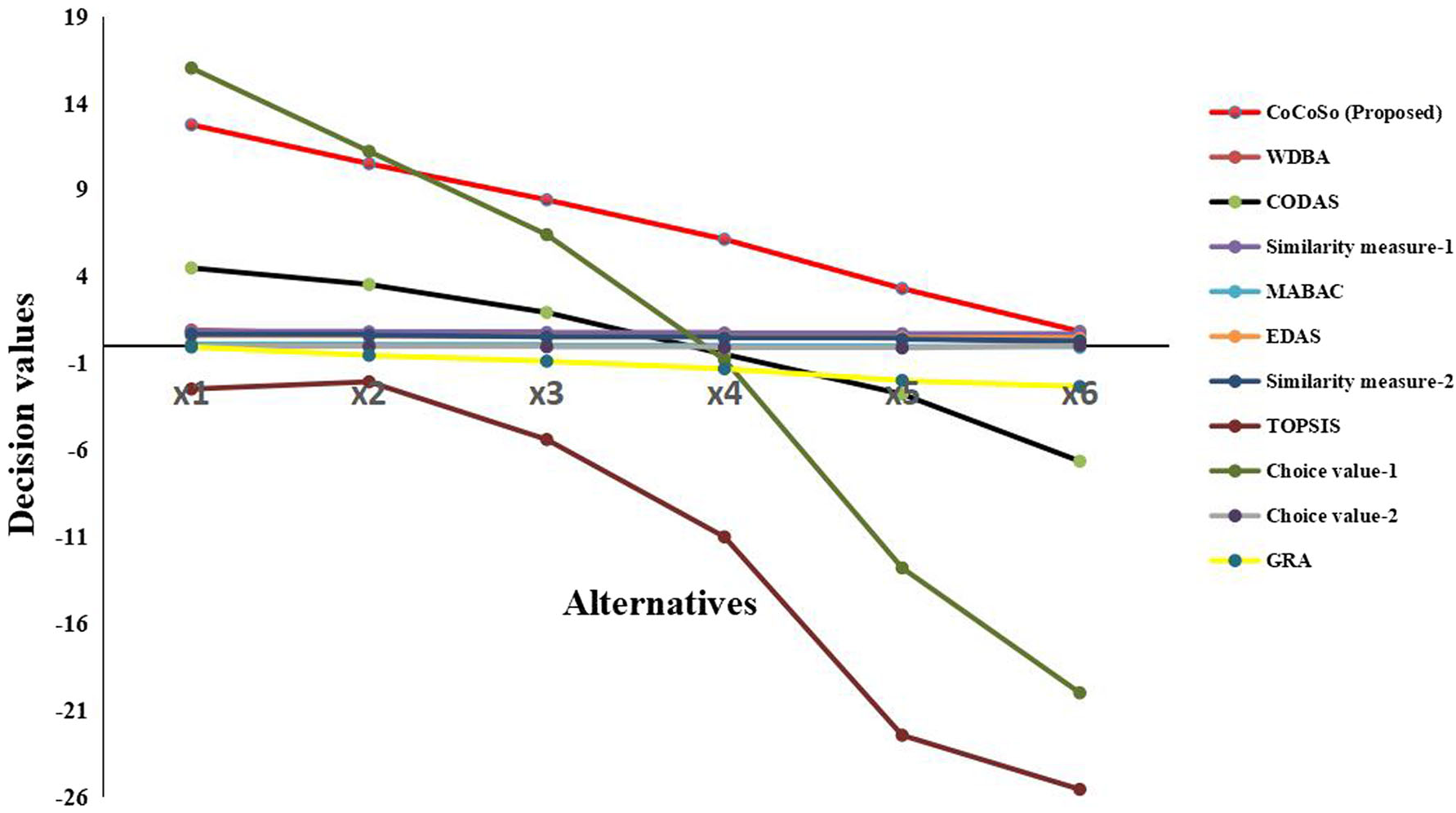 Figure: The proposed method demonstrates superior discrimination degrees (higher clarity in gaps between alternatives) compared to GRA and Choice Value methods.
Critical Insight
The most impressive part of this work is the treatment of Interval-Valued Fuzzy Soft Matrices. By defining new operational laws (like the and operators for interval matrices) and proving their properties, the authors provide a rigorous mathematical foundation that goes beyond just "applying an algorithm." It's a theoretical upgrade to how we handle fuzzy data structures.
Conclusion & Future Outlook
This paper is a significant win for Evidence-Based Medicine. It provides a way to turn messy, interval-based clinical data into a prioritized list of health interventions.
Limitations: The computational complexity is higher than simple additive models. Next Steps: Integrating Self-Paced Learning into the weighting mechanism to allow the model to "learn" which parameters are most important over time as more patient data is collected.
Takeaway: In the future of IHM, success won't just come from better sensors, but from the superior fuzzy logic that interprets the data.